
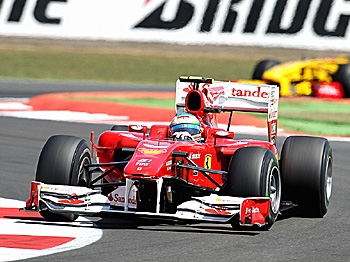
Although the stewards did not issue a drive-through penalty until ten laps after the incident in Sunday’s Formula One British Grand Prix at Silverstone, Whiting says Ferrari was told immediately after the offending maneuver.
“"We told Ferrari three times that in my opinion they should give the position back to Kubica," Whiting told Autosprint magazine. "We told them that immediately, right after the overtaking maneuver. On the radio, I suggested to them that if they exchange position again, there would be no need for the stewards to intervene.”
Whiting claims that after the third warning, Ferrari told him Kubica was too far back to let him pass.
Ferrari team principal Stefano Domenicali said that Ferrari was not informed until too late.


It would seem Alonso could have given the position back immediately after the maneuver, on lap, 17, or in either of the next two laps.
"As soon as we received the information that in the opinion of the stewards, that Fernando should have given back the position to Robert, Robert was already very far behind and Robert was really slowing down because he had a problem," Domencali is reported as saying.
"You can have a situation where immediately there is a possibility to give back the position to a driver if you feel that there is really an advantage that you gain. On our side we felt that was not the case otherwise we would have done it."
Neither Charlie Whiting nor Stefan Domenicali has publicly offered any documentation supporting when the first radio warning was issued.
The rules specify that after a specific list of offenses (which does not include overtaking by going off-course) a team should be notified of its penalty—a drive-through or stop-and-go—and will be given three laps to comply.
It is not immediately clear how many laps a driver would have to give back a place gained by questionable means.
It could be argued that even if Ferrari had been notified on lap eighteen, Kubica would have left the course before Alonso would have exhausted his three laps, if the rule were interpreted that way.
The statements form Whiting and Domenicali leave open the glaring question of, why was Alonso was ordered, rather than urged, to give back the position immediately? Why would a directive from the Race Director of the governing body, be optional?
Between unclear rules, lax enforcement, and arbitrary penalties and noncompliant teams, it is unclear who governs Formula One.







