
The effect of climate change on our daily lives is becoming more apparent every day. Most of us are as acutely aware of the environmental challenges facing the world today, as we are of the increasingly high cost of living and of our own health and well-being. Organic gardener, co-founder of “Bellis”( Brisbane’s award-winning sustainable house and garden) and a presenter on ABC TV’s Gardening Australia show Jerry Coleby-Williams will be in town for the Organic Expo & Green Show at Darling Harbour this week. He spoke with The Epoch Times about how the average household can play a powerful role in the challenges our society faces.
Grow Your Own Food
“The single easiest thing that anybody can do that can have the most profound influence on their life, their health, their wealth is to grow food at home,” said Jerry.
“Every plate of food you’ve bought from the supermarket will have travelled 22,000km to get from the farm to your plate. So immediately if you start to grow food at home, even if its potatoes, you are starting to cut food miles, fossil fuel emissions.”
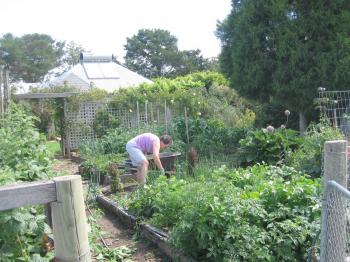
Jerry spends about 14 hours a week in his garden; however, not all of this time is spent on food production. His garden beds, which are 300m2, provide 70 per cent of the food for three grown adults. “As a general rule, 100m2 of soil provides 70 per cent of the food for one adult for one year.”
Carbon Sequestration
Following very basic organic gardening techniques, things like routinely adding compost to your garden and mulching, provides a stable long-term removal of carbon (dioxide) from the atmosphere, he says. Removing carbon from the atmosphere is called sequestration. Sequestering atmospheric carbon can be done at a rate of 0.7 of a tonne of CO2 per hectare per year.
Traditional Seeds
Using traditional seed varieties when growing at home is also important. “The genetic diversity that modern crops depend upon is in the old fashion varieties.” Jerry explains that a good example of this occurred in 1970 when the United States, which is the world’s major corn grower, nearly lost all their corn to a disease known as “corn blight”. The genetic resistance to this disease was found in an old variety of corn only found in China. By selective breeding, they were able to reintroduce resistance back into their corn. By growing these valuable traditional varieties in our backyards, we are preserving the very genetic diversity that the world’s food supplies will come to rely upon.
Sprouting Seeds
For those people who want to grow food at home, but don’t have the room or have very little gardening experience, Jerry recommends sprouting seeds as the simplest way to grow food at home.
“Before a seed produces its first pair of true leaves, its more nutritionally dense than at any other stage in its life. You can throw the multivitamins away if you sprout seeds.” Sprouting also reduces the need to freight in food by air and buffers against food shortages. Jerry gave one recent example as Britain’s salad crisis of 2010, which was a result of the volcanic eruption in Iceland.
Buy Organic
“If you start buying organic, then you will be encouraging farmers to start sequestering carbon in the soil. We have 50million hectares of farmland and 50million hectares of rangeland. If that went organic, we could be sequestering 70 per cent of our national carbon emissions per year and that starts within a year. So if you grow a little bit for yourself at home–great for you! You’re making a very big impact, a bigger impact than you’d expect. If you buy organic, then you are encouraging people to do likewise and the more you do it, the better things will be.”
Jerry advises that if you can’t buy organic, then you should at least buy local. This is the best example of how people can exercise their economic power. Buying local produce supports local business and all national economies are built on small business.
Use Green Energy
The first thing we can do to both reduce our greenhouse gas emissions and reduce our household bills is buy green electricity. Jerry has installed six solar panels on his house and by doing so, is producing about 40 per cent of his households’ energy. With the Government rebate, the panels paid for themselves after three years of use, he said.
“By doing this, we can send a strong message to both government and business.
“If you’re finding it hard to pay the bills at the moment, then a simple step you can take is to change over from a mains electric hot water system to gas. When we first moved into this house, we were using 32 kilowatt hours a day and that was because we had a standard electric water heater, standard electric gas cooker. By ditching those and going for standard electric appliances, and using fans instead of air conditioners and installing blinds on the western side of the house, we went down from 32 kilowatt hours a day to 16 and that was a very simple step to take that’s kept our bills down.”
Collect Roof Water
By collecting roof water in a tank, you are limiting the amount of run-off generated by our cities, which translates into less erosion and less pollution of our rivers and our oceans. “You are also saving on your CO2 emissions by reducing the amount of coal-fired power needed to pump that water to your tap.” Water is one of the most uneconomical resources to move around using fossil fuels, so this also represents a big household saving.
NEXT WEEK: Mr Coleby-Williams explains how population growth, “peak oil”, “peak food” and “peak phosphorous” are all inextricably connected to climate change.