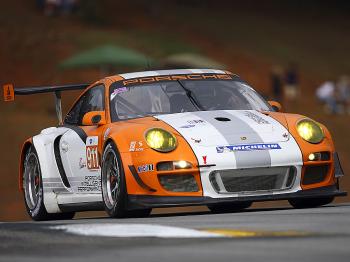
Porsche is continuing this tradition with its Porsche 911 GT3 R Hybrid, a racing machine powered by both a 480-bhp gasoline engine and two 80-hp electric motors. A test bed for new technology, the Porsche Hybrid has been tested in two of the toughest races on the planet—the Nürburgring 24 and Petit Le Mans—and has come through brilliantly.
Last Saturday the Hybrid raced in the U.S. for the first time at Petit Le Mans at Road Atlanta, Georgia, where it finished eighth in class.
“My job at the wheel of our rolling laboratory was a great experience for me,” said Porsche factory driver Timo Bernhard.
“The hybrid system worked perfectly over the entire race distance. We achieved two important goals—to present this unique car to U.S. fans and to further develop the hybrid drive under racing conditions.”
Unique Hybrid System
KERS systems are not new. The idea of using wheel rotation to drive generators charging batteries has been tried and tested. In fact, Porsche has its own high-performance gasoline/battery hybrid, the Porsche 918 Spyder, debuted at the Geneva Auto Show in March.
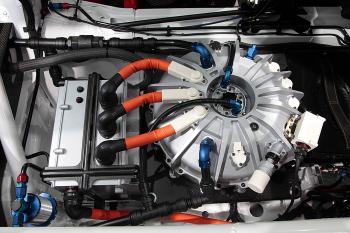
The 911 GT3 R Hybrid uses a very different system, pioneered by the Williams Formula 1 team. Instead of heavy batteries, the Porsche uses a Williams Hybrid Power magnetically-loaded composite flywheel to store energy to power the motors.
This flywheel spins up to 40,000 rpm, storing braking energy mechanically as increased rotation, and releasing that energy as electricity through a pair of high-voltage electronic management modules which deliver power to the electric motors attached to the front wheels.
The electric motors, engaged by a button on the steering wheel, deliver 160 horsepower, for approximately eight seconds, briefly making the Hybrid All-Wheel Drive.
Porsche plans to add hybrid power systems to select road cars once the technology is perfected.
Race Results
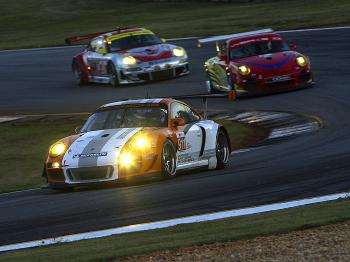
The Hybrid didn’t finish as well at Petit Le Mans, not due to the hybrid system, but because of tire troubles.
Porsche engineers, not having had enough track time to sort things out, put too soft a tire on their car, resulting in two spectacular blowouts.
The combination of Road Atlanta’s fast corners, the Porsche’s greater front-end weight with the pair of electric motors, and the additional load of 180 horsepower from the KERS system ate up the tires much faster than expected. The Porsche crew added harder tires at higher pressure, and the car ran flawlessly for the rest of the race.
“Once again we learned a lot from racing our hybrid car,” said Porsche Motorsport director Hartmut Kristen. “I’m proud that this innovative system ran over nine hours without a single problem. From our standpoint, it is equally as important that our development engineers have again collected a huge amount of important data.”
The Porsche Hybrid’s next challenge will be the final round of the Intercontinental Le Mans Series, the 1000 km race in Zhuhai, China on November 7.
As at Petit Le Mans, the Hybrid will not be competing for points. It will run in the newly created GTH class, racing against the regular GT cars as what the Porsche engineers call a "racing laboratory," to gather knowledge about the hybrid drive under the pressure of a racing environment.
Porsche’s Other Hybrid
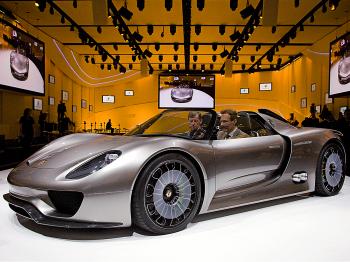
This hybrid, the Porsche 918 Spyder concept car, has the performance of a supercar coupled with the emissions of a compact car. It recharges by plugging into a power station much like other gas/electric hybrids.
Powered by a 500 hp V8 and three electric motors putting out an additional 210 hp, the Spyder hybrid boasts emissions of 70 grams CO2 per kilometer and fuel consumption to 3.0 liters/100 kilometers (78 mpg) according to Porsche’s press release.