
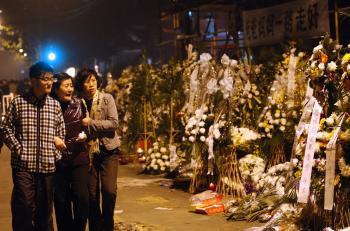
[youtube]D_3IRnewPhg[/youtube] Shanghai City Symphony Orchestra playing “Ave Maria” for the victims of the Shanghai FireIn the first seven days after a high-rise apartment building in Shanghai caught fire, more than 100,000 people came to leave flowers and pay their respects. Six days after the fire, the Shanghai City Symphony Orchestra played Schubert’s “Ave Maria” near the gutted building in a civic, but unofficial, act of mourning.
The mourners’ grief was real but also carried a message. In today’s China, the people find ways to express what may not be openly said. Beneath the Chinese people’s grief at the deaths of 58 lies a mixture of anger and disquiet: anger at the incompetence and corruption of the authorities who rule over them; anxiety that should disaster come again, there will be nothing to keep them safe.
A little after 2 p.m. on Nov. 15, a 28-story apartment building on Jiaozhou Road in the Jin’an District of Shanghai caught fire. For the next several hours, the people of Shanghai watched the whole building engulfed in fire like a huge chimney, while the fire department was helpless to put the fire out.
The authorities reacted quickly to this disaster. Early in the morning of Nov. 16, the State Council set up the Investigative Group for the Shanghai 11.15 Fire Disaster.
No sooner had the investigative group begun its work than it reached a conclusion. At 11 a.m., they announced they had results. At a 5 p.m. press conference, the huge fire was said to have been caused by a criminal negligence of duty. Eight suspects had been detained.
Impressive Fire Drills
The Shanghai Fire Department would seem to have been very well prepared for the Jiaozhou Road fire, with a decade of regular, successful fire drills. On Jan. 25 and again on Nov. 9—the week before the fire—the fire department carried out fire drills, both of which were very successful, according to media reports.
Even though those two fire drills did not focus on high-rise buildings, recent fire drills did. On Nov. 9, National Firefighting Day, in 2008, a fire drill was held at Wandu Center, which is 55-story building more than 200 meters (656 feet) high—twice the number of stories as the Jiaozhou Road apartment building and more than twice its height (the apartment building is 85 meters, or 278 feet high).
The well-trained firefighters used different techniques and special firefighting equipment—including high-tech fire engines—to extinguish the fire in 20 minutes. Similar to the Jiaozhou Road fire, the fire during the drill was started at a lower story, the fourth floor, and then went up all the way to the top.
In another fire drill in 2007, the Shanghai Fire Department successfully extinguished a fire in a building 400 meters (1,312 feet) high. To make the success more dramatic, the authorities claimed that Shanghai had imported more than 40 compressed-air foam fire engines from Germany. The average height that the fire cannons can reach is 200 meters above the ground, with the most powerful reaching 375 meters.
The Actual Fire
There is a difference between a drill and an actual fire. On Nov. 15, where were those well-trained firefighters and more than 40 high-tech fire engines?
According to witnesses, most, if not all, of the survivors were not rescued from the building but escaped by themselves. The firefighters only waited outside to meet them and then escorted them to a safe place.
In video posted on the Internet—thanks to the technology that makes everyone a potential reporter—the water shot from the water cannons curved downward before reaching the building. It took four hours to control the fire and another four hours to fully extinguish it. The result would have been the same even if there were no firefighters and no fire engines; the fire simply burnt itself out.
When Liu Jinguo, the deputy minister of Public Security, said that the rescue was successful, the loss was minimized, more deaths and injuries were avoided, and that the Jiaozhou Road fire was a successful example, people were very angry.
Continued on the next page…
Views expressed in this article are the opinions of the author and do not necessarily reflect the views of The Epoch Times.