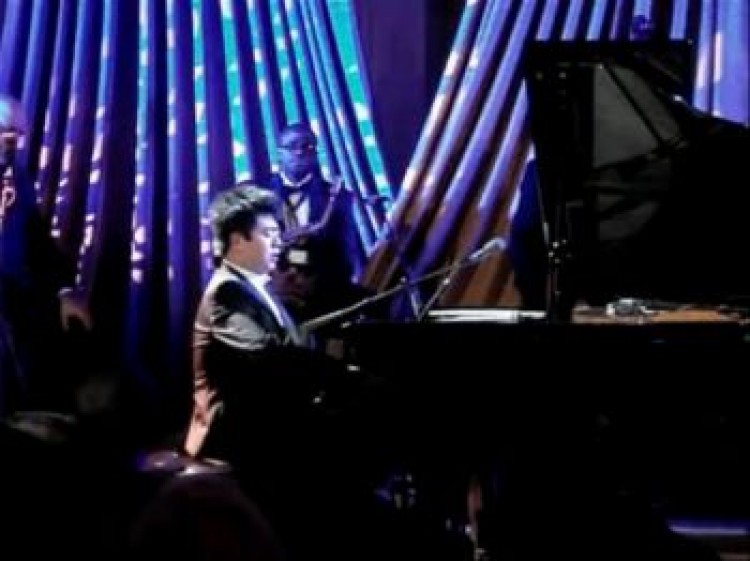
Lang Lang’s performance of an anti-American propaganda song at the White House state dinner for China’s paramount leader Hu Jintao is not an isolated event. That performance is part of a history in communist China of the political uses of music and the feelings it is meant to inspire.
After performing “My Motherland,” Lang Lang wrote in his blog that this was “one of the most beautiful songs in the eyes of the Chinese.” Lang Lang understood himself through his performance to be making a statement “about a powerful China and a united Chinese people.”
He may have learned to view the song in this way one day in 1997, just before he was to leave for the United States to study at the Curtis Institute. Lang Lang went with his parents to visit their close friends, the composers Yin Deben and his wife Jiang Hong, who worked at the Liaoning Opera House.
Yin and Jiang presented Lang Lang with a book of tunes they had arranged for the piano, one of which was “My Motherland.” Lang Lang did not initially like the piece and did not know how to play it. Yin and Jiang determined to help him.
Present that day was Liu Yuanju, who was writing a book on Lang Lang. In “Dad’s Heart Is This Lofty,” Liu described the scene in the rehearsal hall of the Opera House: “Yin Deben emotionally waved his arm and sang the main theme of “A Big River” [the original title of “My Motherland”] loudly. He asked Lang Lang to play with more reverberation, more energy, and more excitement.”
Yin and Jiang had transcribed the piano solo “My Motherland” from the theme song of the famous movie “The Battle of Shangganling.” The movie is about a battle in the Korean War, which is always called in Chinese propaganda the “Campaign to Oppose America and Assist North Korea.” In their arrangement, they added a quotation from the song “Battle Hymn of the Heroes,” which is the theme song for another “Oppose America and Assist North Korea” movie, “Heroic Sons and Daughters.”
The lyrics to the section of “Battle Hymn” that were inserted into “My Motherland” are: “Why is the army’s flag so beautiful? The hero's blood has dyed it red. Why is the spring eternal? Because the hero’s lives are blooming.” In that movie, the hero was a Chinese volunteer Army soldier who killed many U.S. soldiers and himself with the last pipe bomb.
Culture as a Weapon
There is a direct line between Lang Lang’s use of music to inspire feelings about a “powerful China and a united Chinese people” and the policy on culture enforced by Mao Tse Tung.
Yan’an is a place in the mountains of northwest China where Mao’s army hid as the nationalists fought the Japanese Imperial Army. It was the site of the Yan’an rectification movement and may be said to be the birthplace of the modern CCP culture. At Yan’an, Mao ruthlessly enforced adherence to CCP ideology, including the doctrine that all forms of culture must serve the interests of the CCP.
Wang Shiwei was a writer who questioned Mao's cultural and artistic policy. He was beheaded in 1947—two years before the CCP took over China—under orders of the Central Social Bureau, which was directly under Mao's control. After the anti-rightist campaign in 1957, nobody was able to step out of Party's control in this field. Almost every single song or piece of music written during that period has political meaning.
That political meaning may not be obvious, particularly to those coming to communist China from the outside, and harmless or even beautiful words may have hidden meanings. Patriotism, for instance, has a different meaning in today’s China than it has in other nations and cultures. Patriotism is not love of the nation or the people. It is first of all love for the state—in this case the Chinese communist regime. But this is not all. The culture established by the CCP teaches that the love for the state must be expressed in the form of hatred towards its enemies.
One of the CCP's role models is the People’s Liberation Army truck driver Lei Feng. In a famous poem, he described his loyalty to the Party: “(we should) treat our comrades as warmly as the spring, and treat the enemies as ruthlessly as a harsh winter.”
Whether intentionally or not, lyrics in “My Motherland” echo the sentiment of this poem: “When friends are here, there is fine wine /But if the jackal comes/What greets it is the hunting rifle.” The “jackal” is the CCP’s enemy, the United States. But the lyrics of “My Motherland” as whole have a totally different meaning among Chinese than Westerners would understand from reading their translation.
The most popular songs among the Chinese outside China are, “Ode to the Motherland” and “My Motherland.” Both were written during the harshest time of Mao’s rule and neither of them has anything to do with the Chinese nation—with China’s tradition and culture.
Outside China, Chinese students sang these songs to attack those protesting the Olympic Torch relay. The pro-CCP patriot, in the name of loving the country China, can always find someone to hate, which shows their loyalty to the regime.
Most of them don't even realize the meaning of their patriotism. It is in their bones and blood and they were taught as toddlers to think this way. The concept of “enemy” is an abstraction that the Party can use as a weapon as convenient. The “enemy” could be the United States, which has always had a privileged role as the number one enemy, or Taiwan, or the Dalai Lama, or Rebiya Kadeer, or Falun Gong.
Next on page 2: Communist Campaigns
Views expressed in this article are the opinions of the author and do not necessarily reflect the views of The Epoch Times.