
Vexation toward the close to 90 U.S. military bases in Japan has been the focus of heated political debate and unkept promises. After failing to relocate the U.S. Futenma airbase, Japan’s last Prime Minister Yukio Hatoyama gave a public apology in May 2010 before resigning in shame.
The debate carried into the subsequent elections, yet has faded from the political agenda as tensions between Japan and China intensify. Although political interest will likely keep the bases untouched, this has done little to change the perception of the U.S. military in the eyes of Japanese residents. Current events, however, could change this.
After Japan was hit with a magnitude 8.9 earthquake near Honshu, followed by a tsunami on March 11, President Barack Obama spoke with Japanese Prime Minister Naoto Kan.
“On behalf of the American people, I conveyed our deepest condolences especially to the victims and their families, and I offered our Japanese friends whatever assistance is needed,” Obama said, according to the military’s American Forces Press Service. He was joined in announcing aid to Japan by Defense Secretary Robert Gates and Joint Chiefs of Staff Chairman Navy Adm. Mike Mullen.
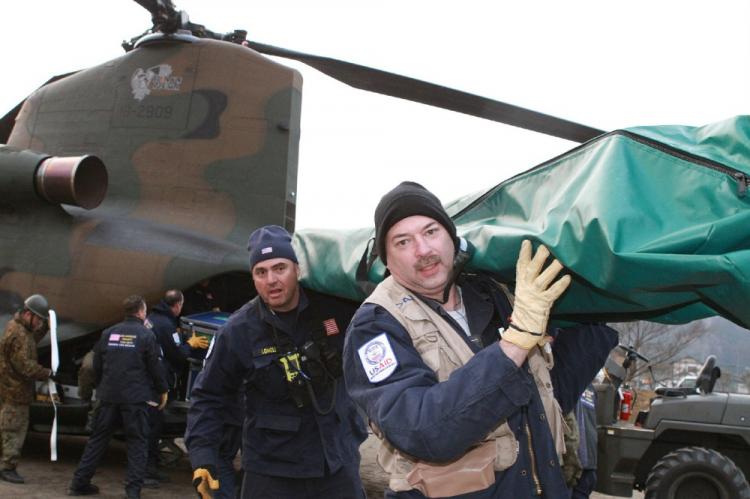
Almost immediately, U.S. forces across Japan were deployed to aid in relief efforts. In addition to the close to 50,000 U.S. military personnel in the country, the United States is sending additional troops to Japan to help.
“Because of the longstanding and close working relationship between the U.S. military and its Japanese counterparts on a daily basis, the United States military has humanitarian assistance capabilities positioned in the affected regions that are ready to support emergency relief efforts and minimize human suffering,” U.S. Ambassador to Japan John Roos said March 12 in Tokyo, according to America.gov, a Department of State media service.
Nonmilitary efforts are also underway. American nuclear experts were appointed to assist Japan amid a nuclear crisis caused by the disaster, the U.S. Embassy in Tokyo gave an initial $100,000 in relief assistance, and two Urban Search and Rescue Teams are helping search for survivors, among additional efforts.
A Change of Opinion
Japanese residents have typically had a negative opinion of the U.S. military presence in the country, which has intensified over the years.
Particularly in Okinawa, the Futenma Marine airbase is not looked on well. The area was home to the last major battle between U.S. and Japanese forces. The Battle of Okinawa killed more people than the bombing of Hiroshima and Nagasaki combined, according to a Japan Policy Institute report.
A 1995 incident in which three U.S. soldiers raped a 12-year-old girl on the island made the situation worse. News of the crime spread throughout Japan and accelerated an already low opinion of the U.S. bases.
“The reaction to that rape throughout Japan and around the world mobilized otherwise inattentive people to the persistence of Cold War-type relationships in East Asia—particularly to the presence of 100,000 American troops,” states a book description of “Okinawa: Cold War Island” by Johnson Chalmers.
This came in addition to complaints of traffic from military vehicles and noise from jets.
Next: Vital Bases







