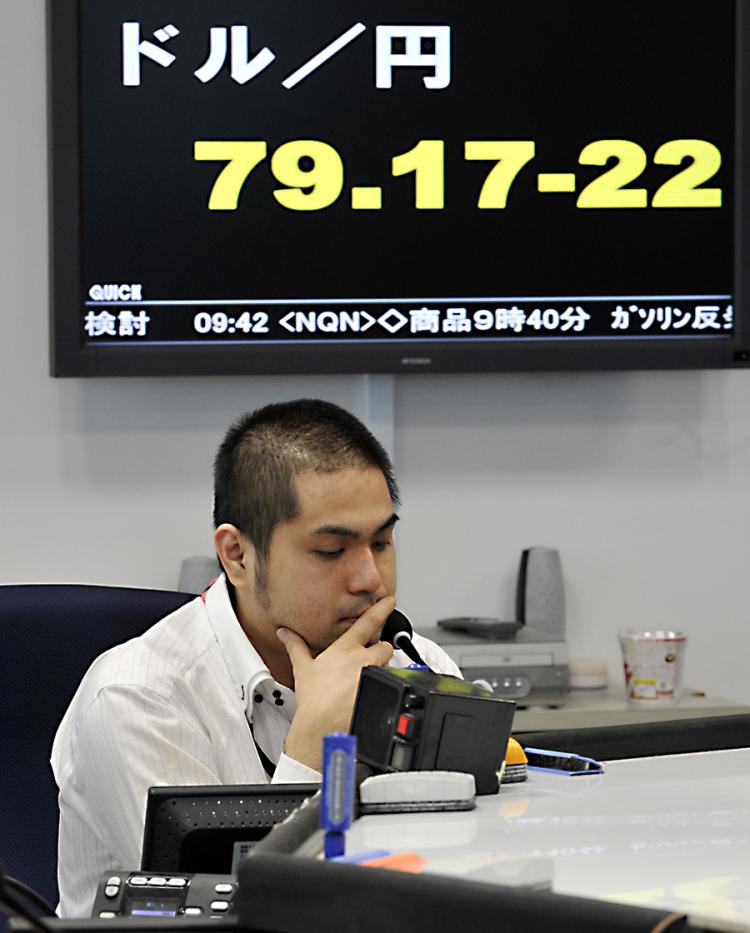
After the severe earthquake and ensuing tsunami devastated the world’s No. 3 economy last week, speculating traders drove up the yen currency, which had reached its highest point against the dollar last week of 76.25 yen per dollar.
Traders speculated that Japanese businesses and investors would be forced to repatriate money back to Japan to fund reconstruction efforts. An excessively strong yen would have been a hindrance to the nation’s recovery efforts.
Central bank presidents of the Group of Seven nations met last week over the phone and decided to sell roughly $25 billion yen, according to some estimates, in an effort to drive down the price of the currency. The intervention measure ensured that the yen closed at more than 80 yen per U.S. dollar last Friday in New York.
In a “concerted intervention in exchange markets,” the Bank of Japan, Bank of England, European Central Bank, and the central banks of the United States and Canada agreed to sell the currency.
“As we have long stated, excess volatility and disorderly movements in exchange rates have adverse implications for economic and financial stability,” according to a statement from the European Central Bank. “We will monitor exchange markets closely and will cooperate as appropriate.”
The G-7 includes the United States, Canada, France, Germany, Italy, Japan, and the U.K.
Strong Currency
In an export-driven economy such as Japan’s, a strong Japanese currency could be detrimental to its corporate sector—as Japanese goods and services would seem more expensive to the world at large.
In addition, the profits at many of the top producers such as Panasonic Co., Sony Corp., and Toyota Motor Corp. would dwindle due to the bulk of their sales coming from overseas.
RBS Securities’ Japanese chief economist Junko Nishioka stated last week in a research note that the country must rely on exports as domestic spending might be weak following the biggest disaster occurring in Japan since World War II.
G-7 Relevance
The G-7 nations around 10 years ago ceded much of the international financial decision-making to the G-20, which includes emerging-market economies.
But after some initial success in cooperation while battling the global financial crisis, which occurred in 2008, the G-20 has recently struggled to come to an accord in its last meeting in Seoul last year. The G-20 nations, outside of determining a rough framework, largely failed to agree on a measure to combat trade deficits, currency manipulation, and other issues during its most recent meeting, which was fraught with infighting and disagreement.
But as the latest yen intervention has shown us, the G-7 still has a lot of clout in its quick decision making and effectiveness.
“The G-20 just can’t act as decisively and quickly as the G-7 has just done,” said Jim O’Neill, chairman of Goldman Sachs Asset Management in London, in a Bloomberg interview.
“In a strange way this has all given the G-7 a rationale for existence for the first time in years.”
No Slam Dunk
According to David Rodriguez from the DailyFX, past G-7 joint interventions in the foreign exchange markets yielded mixed medium- to long-term results.
In 2000, when the euro was a new currency, the G-7 intervened in the market to stem the tumbling euro against the U.S. dollar and the pound.
So far, there have not been any signs that Japanese corporations are ready to repatriate cash yet.
“We would argue that the main factors boosting the yen in the short run are likely to be temporary, provided that the current concerns surrounding Japan, and probably more importantly the Middle East and North Africa, don't undermine the global recovery,” according to an analysis note by Action Forex. “Ultimately, if global recovery continues, the yen can be expected to weaken as yields elsewhere rise, increasing the incentive for capital outflows from Japan.”