In a statement last Friday, exactly one week after the quake, Japanese Prime Minister Naoto Kan announced that so far Japan had received offers of support from 117 countries and regions, and from 29 international organizations.
“I am extremely grateful for these offers of support. With the support of the whole world, we must not allow ourselves to become despondent in facing this, the biggest crisis in our nation's history since World War II.”
“We will rebuild Japan,” said Kan.
But despite Japan’s own finely tuned emergency response infrastructure, and the outpouring of international offers of help, delivering the most basic assistance is proving a challenge.
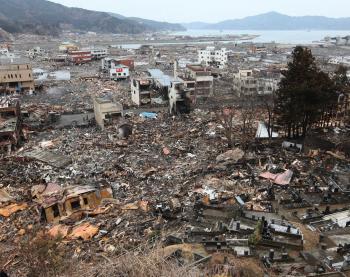
As of Monday, Japan’s National Police Agency had confirmed 8,649 deaths and 13,261 missing, but they expect those numbers to keep rising.
Over 337,000 people are in emergency shelters, either because their homes were destroyed or because they lived within 20 km (12.4 miles) of the damaged Fukushima Daiichi nuclear power station and were evacuated.
Compounding tragedies are making everything difficult for survivors and relief workers.
Accessing Victims

“We have a lot of resources within Japan, but the difficulty is to keep in touch with the affected areas. This is because of the power cuts; the telephone communications are also down, so we cannot find out what the people’s needs are.”
The affected area is vast and fuel is also in short supply because of damaged refineries and oil being needed for backup power to compensate for nuclear power losses.
Stephanie Libby with CARE USA explained via e-mail that in addition to everything else, continuing aftershocks are also an issue. There have been hundreds of aftershocks, almost hourly, since the giant 9.0 quake struck on March 11. At least 250 have been bigger than magnitude 5.0.
U.S.-based Mercy Corps reports that they are still having trouble completing a solid assessment of how best to help, according to Senior Communications Officer Silvia Ross.
Mercy Corps and partner organization Peace Winds are providing shelter, rice, and apples to victims, as well as other small items like pre-paid cell phones.
Ross says their team is strongly hindered in getting the supplies to Kesennuma, one of the hardest hit towns along Japan's northern coast. The 200-mile trip takes approximately 24 hours, describes Ross, because of bad roads and roadblocks. Because there are no safe spots to land a helicopter, airlifting supplies is also a problem. To make matters worse, to get from Tokyo to Kesennuma, they have to fly over the Fukushima nuclear plant, which currently is not possible.
The cold also prevented the team from setting up tents. There was heavy snowfall in the first days following the quake. Now daytime temperatures have risen to about 50 degrees Fahrenheit, but the nighttimes still hover around freezing.
Overshadowing the daunting prospect of cleanup and reconstruction, is the threat of nuclear contamination. The earthquake and tsunami caused explosions and knocked out vital cooling systems at the Fukushima Daiichi nuclear plant. With radiation already seeping into the atmosphere, engineers are desperately trying to keep the exposed spent fuel rods cool to avoid the even greater calamity of a nuclear meltdown.
“The main road going to the north, is 50 km [31 miles] away from the contaminated areas, thus, so far our operations have not been affected by the radiation,” said Matsumoto, adding that JRC workers are using special equipment to treat the contaminated patients, but are not going into the contaminated areas themselves.
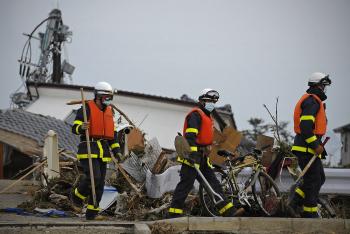
The multiple tragedies people are suffering can be staggering. Matsumoto related the story of the town of Otsuchi. First the earthquake came, then a tsunami washed over the town, then oil spilled from a fishing boat into the water and everything caught fire. “In the end, the town, which was washed out by the tsunami, was also burned down,” she said.
“We have to cope with this tragedy; we have to be helpful and patient. Because the victims of the disaster in the north are having an even more difficult time.”
Red Tape
Despite the great need, in some cases, international organizations have been hampered by red tape more than anything else.
U.K.-based International Rescue Corps (IRC) says they were officially invited by Japan, but when they arrived in Tokyo they were told they had to wait for permits to travel to the affected areas.
According to Julie Ryan, IRC Press officer, the permits could only be issued once the Japanese received an official statement from the British Embassy confirming the IRC as a British charity.
“Sadly, the British Embassy refused to grant this statement therefore we were unable to continue. The statement was eventually granted, but only after we were in the air on our way back home,” wrote Ryan from Glasgow.