
The town of Yangxunqiao in southeastern China’s Zhejiang province is well known for making tin foil. A change in how the tin foil is made—the amount of lead in the foil has been increased—and a lack of safety measures had led to a serious health hazard for workers and local residents.
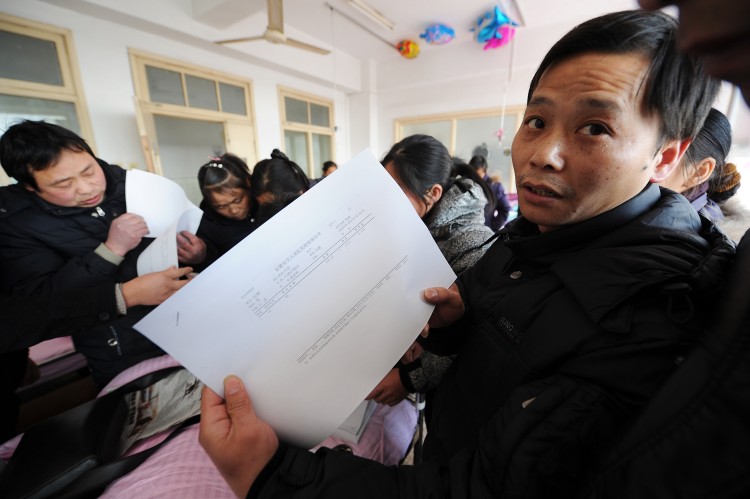
According to a report by the Chinese state mouthpiece media Xinhua on June 12, local health agencies have found that over 600 workers from 25 workshops in Yangxunqiao are suffering from severe lead poisoning. Among these 26 adults and 103 minors are in critical condition since the lead concentration in the blood stream has far exceeded the approved limits. Another 494, though not critical, are nevertheless victims of lead poisoning, subjected to its long term damage.
In a normal healthy adult, blood should not contain any lead at all.
Blood lead level (BLL), is a measure of lead in the body. It is measured in micrograms of lead per deciliter of blood (mcg/dL). According to WHO norms, BLL exceeding 10 micrograms per deciliter is a serious risk to children’s health. In an adult, the permissible BLL is 25 mcg/dL.
According to the Xinhua report, the recent diagnosis shows the alarming data of above 60 mcg/dL per adult and above 25 mcg/dL per child.
Lead interferes with a variety of body processes and is toxic to many organs and tissues. It interferes with the development of the nervous system and is therefore particularly toxic to children, causing potentially permanent learning and behavior disorders.
When exposed to a dangerous amount of lead over a long period, coma, convulsions, and even death can occur
The U.S. Center for Disease Control(CDC) states that a BLL of 10 mcg/dL or above is a cause for concern even for adults.
The cases of lead poisoning in Southern China are increasing recently. In May alone, two lead poisoning cases had been reported, one in Zhejiang Province and another in Guangdong Province.
The town of Yangxunqiao has a 100-year long history of Tinfoil processing, with most being traditional family workshops. According to statistics, there are approximately 2500 direct employees, and a total of 290 workshops. These workers live under the peril of chronic exposure to lead poisoning.
The Xinhua report said that in recent years, in order to reduce cost and increase production, some workshops have increased the lead content in their tinfoil.
Residents Protest
Ever since the blood test results for local migrant workers and villagers in Yangxunqiao came out on June 1, there has been a scare among the local residents. The majority of the test results showed far above normal blood lead levels, including many children, with the youngest being only two years old.
On the morning of June 8, more than a 1,000 villagers marched to the township authorities to protest, demanding the authorities resolve the environmental pollution problem as soon as possible.
Ms. Zhang from Jiangtao Village told The Epoch Times, “The pollution here is quite serious.”
“I had complained several times to the Environment Protection Bureau,” she said, disclosing that the villagers now insist on closing down these tinfoil plants and demand free medical treatment and compensation.
Zhang said that the township authorities, in response, sent a large number of police into the village since June 9 to stop the villagers from making appeals. There are still many police stationed near the village.
Mr. Hong from Miaoshang Village told The Epoch Times that while most people with high blood lead levels are migrant workers, there are also many villagers. “They make fake tinfoil,” Hong said, “mixing in lead. There are many such tinfoil plants here.”
Another Tainted Milk Scandal?
Pu Zhiqiang, a lawyer from Beijing told the Voice of America (VOA) that with the lead poisoning cases gaining wide attention, there is hope for villagers to get compensation and medical treatment. He said, “But if the incident gains notoriety like the tainted milk scandal, it may escalate to something else and under the circumstances, it is hard to tell which direction it will go.”
Pu points out that China is currently experiencing instability in many areas due to human rights violations, low wages and lack of environmental protection. “The so-called development follows a predatory pattern of exploiting the resources which can result only in a dead end. If the government can realize that it is under scrutiny and take measures, it is still possible to safeguard the interests of economically developed regions such as Jiangsu and Zhejiang provinces.”