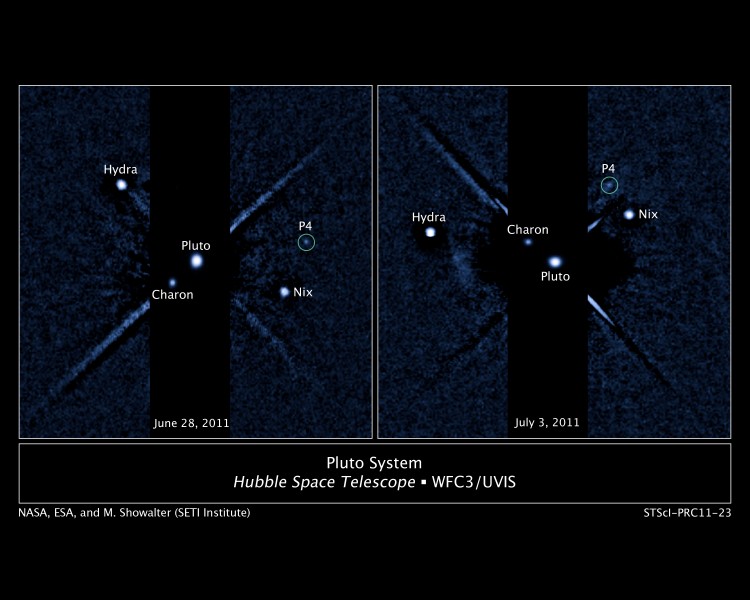
NASA astronomers have stumbled upon a fourth moon orbiting Pluto whilst using the Hubble Space Telescope to search for rings around the dwarf planet.
"This surprising observation is a powerful reminder of Hubble’s ability as a general purpose astronomical observatory to make astounding, unintended discoveries," said NASA’s Jon Morse in a press release.
The new moon, temporarily named P4, is located between the orbits of two other moons, Nix and Hydra. P4 is currently the smallest known Pluto satellite with an estimated diameter of 8 to 21 miles. Charon, Pluto’s largest moon, is 648 miles in diameter, while Nix and Hydra both range from 20 to 70 miles in diameter.
It is believe that Pluto collided with another same-sized planet in early history, producing a plethora of debris that fused with satellites around the dwarf planet to form its current moons.
Hubble’s mapping of Pluto’s surface and observations of its satellites plus the newly discovered P4 are all crucial data for planning NASA’s New Horizons mission, scheduled for 2015. The mission’s goal is to fly through the Pluto system and to provide new knowledge about the far side of our solar system.
"Now that we know there’s another moon in the Pluto system, we can plan close-up observations of it during our flyby." said principal investigator Alan Stern of the Southwest Research Institute in
Boulder, Colo. in the release.
P4 was actually first seen in a photo taken on June 28, but overlooked due to its small size. It was not until astonomers saw pictures received on July 3 and July 18 that P4 was identified.
"I find it remarkable that Hubble’s cameras enabled us to see such a tiny object so clearly from a distance of more than 3 billion miles” said Mark Showalter, leader of Hubble’s observation program, in the release.