
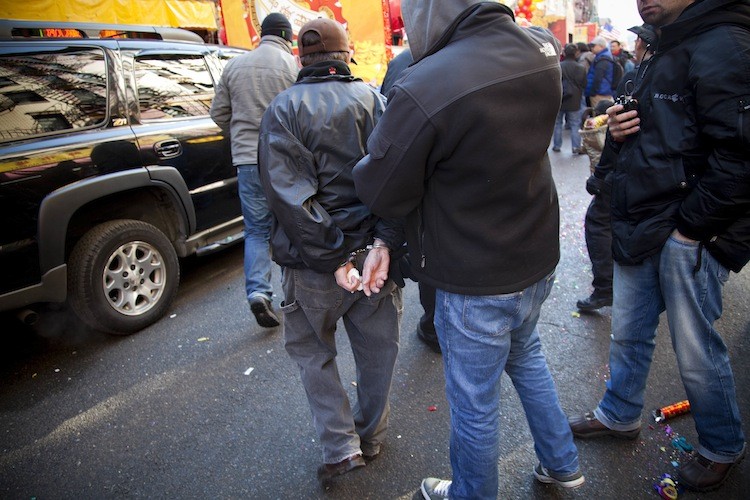
A Miranda warning is a statement from the police that advises a suspect on his or her rights. Richard Rogers, a psychology professor at University of North Texas who presented the study said, “The public, police, and sometimes courts wrongly believe that people in custody understand their rights.”
A 25-question true-false survey was systemically developed and rated by three Miranda experts and taken by 149 defendants detained in jail awaiting trial and 119 undergraduate students in a mock-crime study.
The results showed that 58 percent of the defendants and 38 percent of the students wrongly thought if they asked for something to be “off the record,” it was protected. Not all defendants realized police could lie during questioning, or that interrogation should stop while they were waiting for an attorney. Other common misconceptions were, “Once you give it [silence] up, it’s gone,” or “If you don’t sign a Miranda waiver, what you say is protected,” and 31 percent of the defendants and 36 percent of the undergraduates wrongly thought their silence could be used as incriminating evidence as well.
“These false beliefs strike at the heart of highly valued constitutional rights,” Rogers said.
Rogers found in a previous study that 944 of 945 sampled Miranda warnings did not inform the suspects that their silence could not be used against them. Over 800 versions of Miranda warnings are used, and vary from a second grade to post-college reading level.
“We need to eliminate the most problematic versions of Miranda warnings,” Rogers wrote in an e-mail. “Giving a 12-year-old a warning that requires a year of college education is simply nonsensical.”
Of the 9.2 million arrests made in 2009, Rogers estimates that 976,000 cases, including 360,000 arrests of adults with mental health disorders, 305,000 adults without mental health disorders, and 311,000 juveniles, were compromised—and this is a conservative estimate.
“I think we need to first acknowledge the magnitude of the problem—as long as we are incognizant of the issue, no appreciable change is possible,” Rogers wrote. “Therefore, training of attorneys and mental health experts in Miranda issues must become a priority.”
“The next step is the development and validation of Miranda measure based on rigorous research,” Rogers wrote.
Miranda rights only apply when a person is in police custody and being interrogated. After an interrogation has begun, a suspect may invoke his Miranda rights and then the interrogation must stop. A suspect may also stop questioning in process by requesting a lawyer, and the police must stop asking questions until the attorney is present. The rights were revised in 2010. They are named after the 1966 Supreme Court ruling, Miranda v. Arizona.
The American Psychological Association (APA) will publish the study in November.