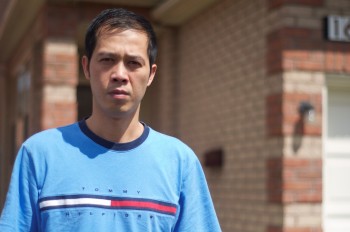

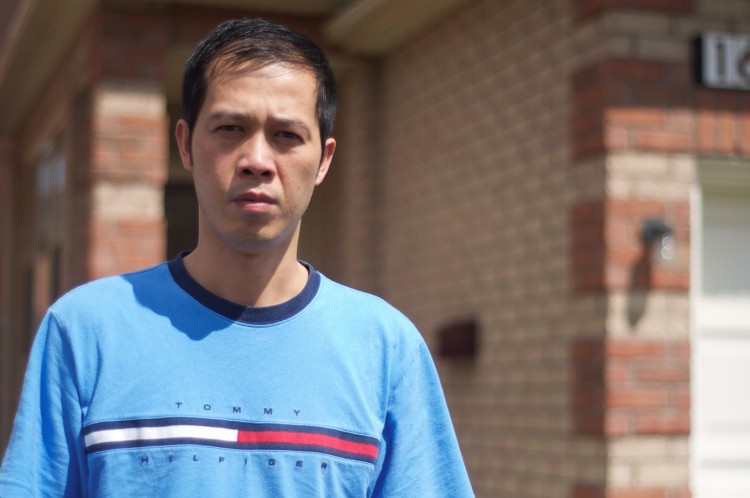
There is a heavy quiet about the house, though Chou’s twins, Sharon and Samuel, play in a room next to the living room.
“They’re just four years old,” he said. “I don’t know what to tell them.”
When The Epoch Times tried to call him earlier that day, Chou was supposed to be at the airport, dropping off his wife Wei Li Ruan to be deported to China. Instead, she went into hiding.
After years of travelling the world, looking to create a good life, they thought their dreams had come true in Canada. Now everything is broken.
The couple arrived in Canada in 2006 with only a few hundred dollars left to their name after trying to make a life in Honduras, and then China, both to no avail.
They are homeless in a way few can imagine. Though both are originally from China, the regime’s draconian house registration system and chaotic records system has left them anonymous. With no family left in China and no official records of their existence, neither can work there nor can their children go to school without paying heavy fees.
They thought it wouldn’t matter.
Chou left China when he was 19 and opened a convenience store in Honduras. He was robbed more times than he could count but not because he was Chinese, he said. “Everybody gets robbed.”
It was tough, but he brought his parents to Honduras; they still live there as do two siblings. He hasn’t told his parents what happened, about how he must figure out how to care for his children and find money to live now that his wife is on the run. It was just too hard to say that the good life they’d built in Canada had been shattered. “They’re old, 70,” he explained.
Honduras wasn’t safe, but it gave Chou what he needed: a pocket full of cash, and a beautiful wife. It was there that he met Ruan, and there that they married. She too brought her family. But Chou wasn’t wise to a crucial bit of international relations, and when his Chinese passport expired, and with no Chinese Embassy in Central America, he took up a Taiwanese passport, a preferred passport to visit the U.S., he explained. “If you come with a Chinese passport, they reject you … Taiwan is better.”
Taiwan used to grant Chinese citizens non-residence passports, which can be used to travel as a pseudo-Taiwanese citizen but do not grant the holder the right to live in Taiwan. But returning to China with a Taiwanese passport was a mistake, he now realises. He blames that political faux-pas for their inability to get proper identification in China today.
While Honduras was rough, China was no easier. The couple returned there in 2006 but after a few months of watching their money disappear and having no success getting the regime to give them the documents they needed to work and live, they had to make a decision.
There wasn’t much choice. They had some time left on a U.S. Visitors visa and used it, landing in California with a few thousand dollars. Staying at a hotel, wondering what to do next, they spent half their remaining money, $1500, to get a ride in a minivan to the Canadian border. The Chinese man who drove them promised the Canadian government would help them out.
It did. Shortly after arriving, their children were born. Chou worked as a mover, pulling in a modest $22,000 a year while his wife waited for the twins to go to school full time so she could also work. They were hopeful for the future, he explained. Now nothing is certain.
Citizenship and Immigration is now trying to arrange travel documents to send Chou to Taiwan, though he won’t be welcome when he arrives. If that happens, he doesn’t know what to do with the twins. Hopefully his sister will take them, he says. “She’s still thinking about it.”
Better to be apart from his children than have no idea how to feed them or where they will live after being deported, he says. Just like it is better for his wife to be on the run in Canada than alone in China with no family, money, or way to work.
Immigration agents came to his door Wednesday. They told him it would be better for them if Ruan reported to the government for deportation. The investigation is still ongoing, they said. There is no warrant to arrest her yet.






