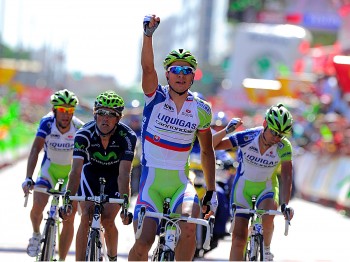
Liquigas prodigy Peter Sagan outsprinted Movistar rider Pablo Lastras in the final surprise of a surprise finish to the stage.
Liquigas, which had taken over the stage with five kilometers to go, had planned to give the win and the 20-second time bonus to defending champion Vincenzo Nibali, but at the last moment Lastras ruined all that.
Sagan had to sprint to keep the Movistar rider from getting the stage and the biggest bonus, which thoroughly annoyed Nibali. Still, better a teammate take the time than an opponent, eh?
Nibali’s frustration arose from the fact that had he been able to win the stage, the time bonus would have earned him the race leader’s red jersey. Instead, he ended up third in GC.
Supposed Sprinters' Stage
Stage Two, 193 km from Úbeda to Córdoba ran downhill for the first 15 kilometers, then rolled up and down small hills for another 140 km before hitting the Cat Two Alto del Catorce por ciento 20 km from the finish.
After a fast descent the route offered a three-kilometer flat for sprinters’ teams to catch any lone attackers—or such was the plan.
The stage started with a crash in the neutral zone, which would seem almost funny if it were not for the severity of the injuries sustained by Matti Breschel. The Rabobank rider broke two bones in his hand and had to withdraw.
Several large groups escaped and were pulled back in the first 125 km before four riders— Aleksejs Saramotins (Cofidis,) Adrián Palomares (Andalucia-Caja Granada,) Martin Kohler (BMC,) and Yukihiro Doi (Skil-Shimano) escaped. This group opened an 8-minute gap but no one thought they might stay away.
Leopard Trek led the chase, aided by Garmin Cervelo, and caught the escapees 26 km from the finish. Martin Kohler lasted longest but his solo attack was hopeless.
Leopard Trek, riding for Jakob Fuglsang, set an extremely high pace heading towards the climb, splitting the peloton before the ascending began.
David Moncoutie of Cofidis launched an attack on the lower slopes of the climb, followed in a couple kilometers by HTC’s Tony Martin. This par was chased up the slope by two more riders, Kevin Seeldaeyers of Quick Step and David de la Fuente of Geox. This quartet joined just over the crest and blazed down the descent, pursued by Pablo Lastras halfway down the hill.
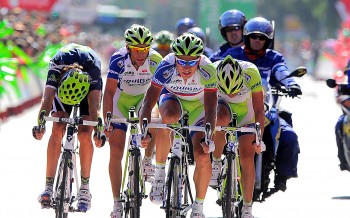
Lastras managed to ruin the Liquigas plan; if Nibali had won the stage he would have slept in red Thursday night. Instead Sylvain Chavanel and Daniele Moreno kept the top two spots.
What's to Come
Stage Seven is a pure sprinters’ stage, with no categorized climbs, just a lot of lumps.
The next two stages could be the scenes of vicious battles for the red jersey, or might be given over to breakaways, as the top GC contenders rest their legs for the Stage Ten time trial.
Stage Eight features a Cat One and two Cat Two climbs pus an uphill finish which rises more than a kilometer in the final four kilometers. The final climb could be the site of some big attacks; but with Stage Nine also ending is a big climb, the top riders might sit up for this one. Someone like Joaquin Rodriguez or Jürgen Van Den Broeck might throw down the gauntlet here.
Stage Nine starts with a cat Three climb, offers along flattish middle for everyone to rest, and then finishes up the Cat One Sierra de Béjar to La Covatilla ski resort. The final climb is about 20 km long though only half of that is considered to be part of the categorized climb. Expect the pure climbers who might not time-trial well to look for time here.
Stage Ten, the last before the first rest day, is a 47-kilometer time trial which rises slightly for the first half, drops slightly for the second half, and then kicks up slightly at the start of the last kilometer. That slight incline is the sort many riders might misjudge—some riders might run dry a few hundred meters short because the last little kick caught them off guard.
|
2011 Vuelta a España Stage Six |
|
General Classification after Stage Six |
||||||
|
1 |
Peter Sagan |
Liquigas |
4:38:22 |
1 |
Sylvain Chavanel |
Quickstep |
22:41:13 |
|
|
2 |
Pablo Lastras |
Movistar |
4:38:22 |
2 |
Daniel Moreno |
Katusha |
0:00:15 |
|
|
3 |
Valerio Agnoli |
Liquigas |
4:38:22 |
3 |
Vincenzo Nibali |
Liquigas |
0:00:16 |
|
|
4 |
Vincenzo Nibali |
Liquigas |
4:38:22 |
4 |
Joaquin Rodriguez |
Katusha |
0:00:23 |
|
|
5 |
Eros Capecchi |
Liquigas |
0:00:03 |
5 |
Jakob Fuglsang |
Leopard Trek |
0:00:25 |
|
|
6 |
Jakob Fuglsang |
Leopard Trek |
0:00:17 |
6 |
Fredrik Kessiakoff |
Astana |
0:00:41 |
|
|
7 |
Joaquin Rodriguez |
Katusha |
0:00:17 |
7 |
Maxime Monfort |
Leopard Trek |
0:00:44 |
|
|
8 |
Marzio Bruseghin |
Movistar |
0:00:17 |
8 |
Jürgen Van Den Broeck |
Omega Pharma-Lotto |
0:00:49 |
|
|
9 |
David Moncoutie |
Cofidis |
0:00:17 |
9 |
Sergio Pardilla |
Movistar |
0:00:49 |
|
|
10 |
Sylvain Chavanel |
Quickstep |
0:00:17 |
10 |
Marzio Bruseghin |
Movistar |
0:00:57 |
|