
According to David Arkless, president of Corporate and Government Affairs for Manpower Group, the app measures an individual’s “slavery footprint.” The State Department plans to broadly promote the app next year, he said.
The survey to measure how many slaves may be supporting a person’s lifestyle starts with the question, “Where do you live? And says, “There are at least 27 million slaves worldwide. That’s roughly the combined population of Australia and New Zealand. Crikey!”
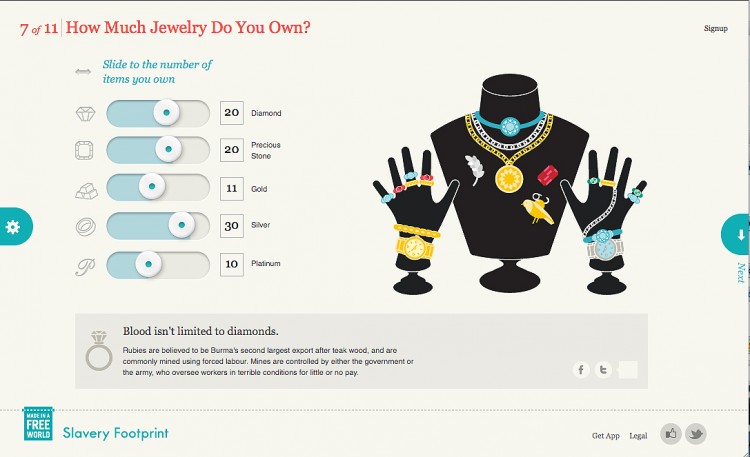
Questions address food, jewelry, housing, and “What is your relationship with electronic devices? Each section gives a fact, like this one: “Coltan is an effective superconductor found in electronics.” A U.S. State Department official was interviewed about Coltan mining in the Democratic Republic of the Congo. He pointed to the reporter’s smartphone and said, “The likelihood that one of these was not touched by a slave is pretty low.”
The final question is if one has paid for sex. It says it won’t really make you answer such an embarrassing question, but, “If you participate, your slavery footprint is inestimably bigger,” because the demand fuels human trafficking, and the industry is based on coercion and violence.
People who take action by sharing their results, donating to the nonprofit slaveryfootprint.org, sending notes to companies and other things earn “Free World Points,” meant to reduce their “slavery footprint,” based on the idea behind carbon offsets.
Scores are not linked to specific brands. They are composites based on the likelihood of forced labor being used to create products and services people use. The app gives detailed explanations of its methodology. It used information from Freedom House, the Department of State “Trafficking in Persons Report 2011,” the Department of Labor (DOL) “List of Goods Produced by Child Labor or Forced Labor 2010,” and more.
On Android, the mobile app was buggy and balky. On a laptop it worked fine. Mobile check-ins and the ability to scan products and then express concern to the companies that made them are part of the mobile app.