
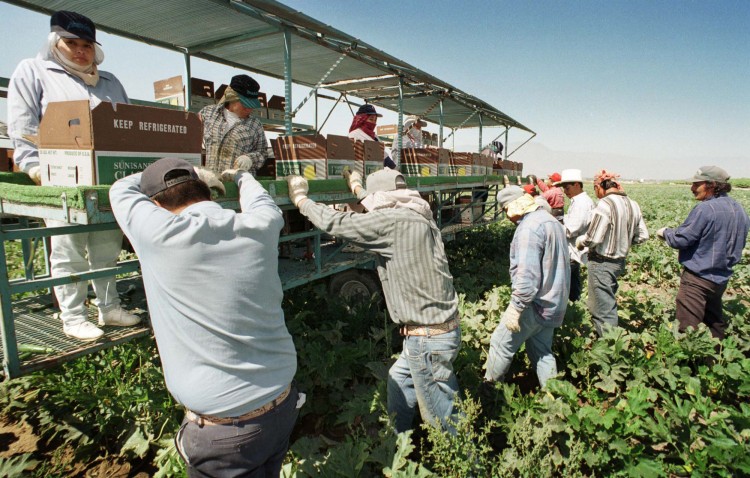
Georgia’s immigration law brings heavy human and economic costs, according to experts who spoke at a telephone press conference on Oct. 4.
While Georgia’s Agriculture Commissioner testified to legislators in Washington, a think tank released a report about the effect of H.B. 87, Georgia’s immigration law. Signed into law this spring, it has cost the state millions, and could ultimately cost it much more, according to Tom Baxter, a veteran journalist from Georgia.
Baxter wrote “How Georgia’s Anti-Immigration Law Could Hurt the State’s (and the Nation’s) Economy” for the Center for American Progress. The “report is a warning for all states. I do not think there is any state with such a healthy economy they can afford to leave millions on the table,” said Angela M. Kelley, Vice President for Immigration Policy and Advocacy at the Center for American Progress, in the press conference.
According to the executive summary of the report, “It is true that putting an exact figure on economic losses is difficult with the remarkable diversity of agricultural products, seasonal cycles, and size and sophistication of farming in Georgia. But we already have a sense of just how devastating H.B. 87 will be to Georgia’s economy with evidence trickling in that migrant workers are bypassing the state because of its immigration law.”
Kelly said that 200 agribusiness leaders had asked Georgia not to pass the law. Legislators still passed it, and because migrant workers avoided the state, blueberry growers, for example, had to leave a half million dollars worth of crops in the field. For a state with a $1.3 billion budget shortfall, the loss of revenue could be painful.
The logical question is what would it take to replace migrant laborers, but the answers are not easy, she said. One way is to switch to crops that can be harvested mechanically, like cotton and peanuts. This has drawbacks.
Baxter said, “There have been tremendous losses; it’s been established.” One way of estimating the economic value of a crop is the “farm gate value” meaning what a farmer sells it for. For blueberries, which must be picked by hand, it’s $6,268 per acre. For onions, which also must be harvested by hand, it’s $9,705 per acre.
“Even if a handpicked crop can be replaced by another mechanized crop, the difference is considerable,” said Baxter. If Georgia farmers replaced all their 134,000 acres of handpicked crops such as peaches, blueberries, and onions, with peanuts, “the value loss is a whopping $796 million,” he said.
Georgia is famous for a certain kind of onion, the Vidalia. It is planted in the fall, harvested in the spring, and therefore allows the farmers to have a second crop of something. Switching to a mechanically harvested crop also forfeits that opportunity, according to Baxter. That kind of cost was not figured in, making the loss estimate very conservative.
Paul Bridges was born in Vidalia, the town in middle Georgia famous for its sweet onions. He is the Republican mayor of Uvalda, Georgia, population 600. He joined a coalition of groups in a lawsuit seeking to overturn H.B. 87. He had given very few interviews since the suit was filed, on the advice of the coalition’s lawyers.
He spoke of the human and economic price of the law.
He said he had read the report twice and: “It’s really spot on. The premises in the report are absolutely correct.
“When the governor signed it into law, many skilled laborers who had been here many years left.
People who had been coming into our area every season did not come. We fell really short, way short of the number of skilled hands we had had in previous years,” Bridges said.
He said he had seen families torn apart, and communities had lost good people because of the law. Families in which some were citizens and other were not “left to live in a safer state.” Now the homes they had lived in were vacant, lowering the town’s tax base.
Bridges said it bothers him when people say immigrants do not pay taxes, because they increase the value of the places they live. He went to a blueberry grower who told him his workers did not come that day. So Bridges went to the neighboring county where he knew they lived and found them packing up to move away.
“This family had bought trailers, and planted plants. They had really nice landscaped yards. One of the children was a senior in high school. It does not just affect one person, but also the friends and other family members. It separates families. We have a rip in our social fabric. We are separating families based on the fear of this law.
“In my little town we had houses that were dilapidated and bought by a Latino family. They fixed them up,” Bridges added.
According to Kelly, the national immigration debate is likely to get worse before it gets better. Though representatives of the tourism, hospitality, and agriculture industries need and want a way to have comprehensive, rational immigration reform, the political climate is so polarized that little progress can be made. “We have not had many signs of hope.”






