
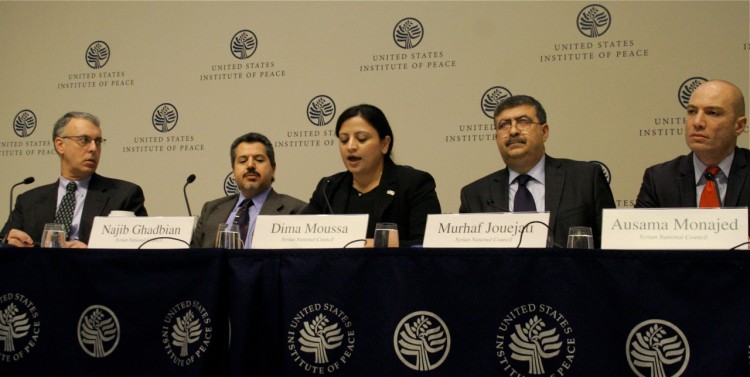
The voices for change have had to work through a fractured Syrian opposition, composed of many diverse interests and power blocs. Finally, a coalition of Syrian opposition leaders on Sept. 15 announced the formation of the Syrian National Council (SNC) to unify the opposition under one banner and leadership. Giving representation to Syria’s many ethnic and religious minorities, youth and women, and political groups required an intensive process of negotiations over several months.
The SNC official statement said it will “serve as a political umbrella for the Syrian revolution in the international arenas and support the just cause of the Syrian people, who yearn to be liberated from tyranny and create a civil democratic state.”
The SNC has a long road ahead to achieve international recognition, win the support of the Syrian people, and become a legitimate replacement for the Assad regime.
To provide some insight into the situation, four members of the SNC were invited to the U.S. Institute of Peace (USIP.)
A fifth speaker, Riad Seif, a well-known Syrian dissident and leader in the SNC, resides in Syria and was to participate via Skype. But the USIP’s fears of reprisal by the regime forced a cancelation. Seif was recently beaten by Syrian security operatives, resulting in a broken arm and other injuries. USIP was afraid Seif, who has spent 8 of the last 10 years in jail as a political prisoner, might become the target of “one of the regime’s assassination squads,” said Dr. Steven Heydemann, moderator of the USIP discussion.
Despite many Western countries welcoming the unification of the opposition, the Syrian regime said it will retaliate against any country that recognizes the SNC, according to the Project of Middle East Democracy (POMED). Syrian Foreign Minister Walid al-Moualem threatened, “We will take tough measures against any state which recognizes this illegitimate council.”
POMED noted that the Foreign minister added, “I am not interested in what they are trying to achieve.” This may indicate the fear that the regime has that the council will play a similar role as the TNC (Transitional National Council) in Libya that ousted Gadhafi and led to his death.
“No Western government has, as yet, recognized the SNC’s leadership of the Syrian uprising,” according to the USIP.
Impetus for the Council
For a long time there has been agreement among those opposing the Bashar al-Assad rule.
Their demands include eliminating the emergency rule that has been in place for 48 years, and the release of political prisoners. In addition, opponents view their movement as inspired by the Arab Spring.
As a non-ethnic, non-sectarian movement, it is “a revolution against 48 years of single-party rule and against 41 years of family rule,” said Dr. Murhaf Jouejati, professor of Middle East studies at the National Defense University and member of the SNC. He mentioned the arrest of teenagers for anti-regime graffiti on a wall in Daraa in March, which was when the uprising went into high gear. When their fathers went to get their children back, they were told “to go make other kids,” he said.
The “spark” that drove the opponents of the regime to finally form the SNC was seeing the “brave” young people take to the streets and emphasize national unity, said Dr. Najib Ghadbian, member of the SNC, associate professor of Political Science and Middle East Studies, University of Arkansas.
He said they were “shocked by the level of response of the Assad regime, when it opened fire and killed peaceful demonstrators.”
Over 3,000 killed in the peaceful protests, 45,000 political prisoners, mutilated bodies and torture— “the amount of grief and sorrow is unimaginable,” said Ausama Monajed, a member of the SNC and a coordinator between protest organizers across Syria, and of volunteers abroad, who is collecting information and footage for media release.
“The country is anguished with missing husbands, raped daughters, humiliated elders, and dead sons,” Monajed said.
We want to see civil society revived and “bring political life back after it has been frozen for three decades by [Bashar] Assad’s father [i.e., Hafez Assad],” said Ghadbian.sd
A document that Ghadbian had signed, called the Damascus Declaration, provided a basis for many:
“The authorities’ monopoly of everything for more than 30 years has established an authoritarian, totalitarian, and cliquish regime that has led to a lack of [interest in] politics in society, with people losing interest in public affairs. That has brought upon the country such destruction as that represented by the rending of the national social fabric of the Syrian people…” (Oct. 16, 2005)
It had become clear that Bashar Assad, who became ruler in 2000, would not bring about reforms they wanted. The regime is unwilling to share power, Jouejati said. In the elections in February, he said any criticism of the government could be fined $25,000. Most Syrians believe regime change, not reform, is needed, he said.
“The Assad regime will collapse. There is too much blood and the distance between regime and society is too wide,” said Jouejati.
The SNC shows a commitment to a rejection of military action or foreign intervention. The deserters from the Syrian army that have formed the Free Syrian Army only fight defensibly. They will not take volunteers, said Monajed.
Continued on the next page … Composition of the Council






