
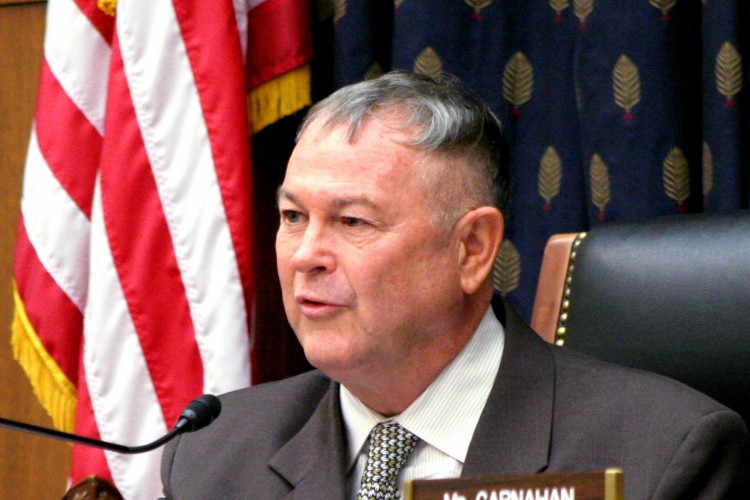
WASHINGTON—Critics of the administration’s willingness to engage the Chinese regime in matters involving space exploration and science and technology more generally jousted with defenders of the administration’s policy at a recent congressional hearing. A hearing of the House Foreign Affairs subcommittee on Oversight and Investigations was chaired Nov. 2 by Dana Rohrabacher (R-CA.) to discuss “the inherent dangers of transferring America’s leading edge science to China.”
The first witness was none other than Congressman Frank Wolf (R-Va.), who normally speaks from the dais with his colleagues. Wolf is the chairman of the House Appropriations subcommittee that funds NASA, the Office of Science and Technology, and the National Science Foundation.
“I have been very troubled by this administration’s apparent eagerness to work with China on its space program and willingness to share other sensitive technologies. I want to be clear: the United States has no business cooperating with the People’s Liberation Army (PLA) to help develop its space program.”
Rohrabacher preceded Wolf with the admonition, “China has aggressively sought our technologies through legal and illegal methods for decades. Anything that allows China any access to our technology or planning raises major counterintelligence issues.”
Rohrabacher and Wolf do not see China as a friendly nation with our interests at heart. “The Chinese Communist Party is aggressively using its military, economic, and political power to extend its influence and diminish ours,” said Rohrabacher. The People’s Liberation Army (PLA), which oversees China’s space program, “is not our friend, as evidenced by their recent military posture and aggressive espionage against U.S. agencies and firms,” said Wolf.
Rohrabacher mentioned the “Hughes and Loral scandals,” during the early 1990s and the lessons that NASA and OSTP should draw from them.
Two American satellite companies, Hughes Electronics Corp. and Loral Space & Communications, pursuing commercial ventures with the Chinese, provided their space engineers with technical rocketry data and tips on fixing problems after the Long March space launch vehicle (SLV), carrying U.S.-made satellites, crashed on two separate occasions destroying the payloads.
The State Dept., the Pentagon, and a special House panel headed by Representative Christopher Cox (R-Calif.) concluded that they damaged national security and the companies were fined.
The Chinese regime does not separate civilian and military programs in the same way NASA and the Defense Department are here, said Rohrabacher. “China’s space facilities are all manned and operated by the PLA,” said Rohrabacher.
The Chinese regime did not acknowledge that leadership of its manned space program rested with the PLA, specifically the Director of the General Armaments Department (GAD) of the Central Military Commission, until 2001—about 15 years into its space program, said Richard D. Fisher, senior fellow, International Assessment and Strategy Center, in written testimony.
Fisher said China’s space program is “barely transparent,” and how the PLA leads the space program is a mystery, but that GAD controls the space companies and research institutes and so any regime space official or university expert “is ultimately responsible to the PLA.”
Congressional Prohibition
Rep. Wolf felt so strongly about preventing the United States from providing technology to China that he authored Section 1340(a) of the Fiscal Year 2011 Continuing Resolution which banned the Office of Science and Technology Policy (OSTP) and NASA from using federal funds “to collaborate or coordinate bilaterally in any way with China or any Chinese-owned company.”
The provision was clear and unambiguous, said Wolf. It received bipartisan support in both houses, passed, and was signed into law by President Obama in April.
However, in defiance of the prohibition, in May 6-10, OSTP held a series of meetings in Washington with Chinese officials on “Innovation Dialogue” and the U.S.-China Strategic and Economic Dialogue. The OSTP director Dr. John Holdren met with the Chinese Minister of Science.
The Government Accounting Office (GAO) ruled that Dr. Holden and OSTP’s meetings in May were in violation of Wolf’s provision. The GAO is an arm of the Congress, nonpartisan, which investigates “allegations of illegal and improper activities.” Thomas H. Armstrong, managing associate General Counsel , GAO, testified at the hearing.
The GAO also found that OSTP’s hosting of a dinner to honor Chinese dignitaries, incurring costs of $3,500, violated the Antideficiency Act, because there were no funds made available to OSTP for bilateral activities with China.
Dr. Holdren, who was a witness at this hearing, refused to be drawn into discussions on the violation of Congress’s prohibition, saying that he was a scientist and not a lawyer. He was advised by the Department of Justice to say: “OSTP’s activities in bilateral diplomacy with China on Science & Technology issues fall under the President’s exclusive constitutional authority to conduct foreign diplomacy,” and thus override Section 1340(a).
Holden’s testimony was not unexpected. He had testified in May before the House Appropriations Committee saying that President Obama favors discussions and exploring joint programs with China, such as expensive human exploration missions to Mars or cooperating with China on detection and tracking of orbital debris, according to MSNBC.
Next…Cooperation Debated