
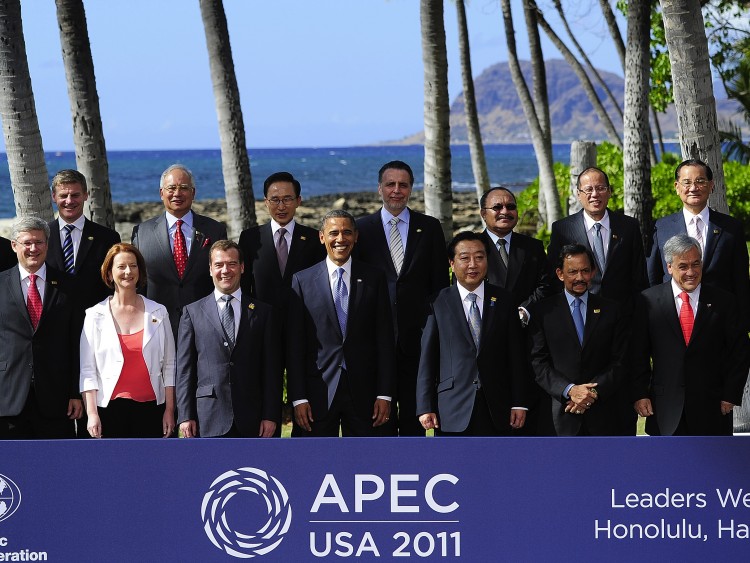
The CEOs of some of America’s largest companies were in attendance at the 21-member Asia-Pacific Economic Cooperation (APEC) Leaders Summit, embracing the Obama’s administrations push in the region.
Speaking at a business summit at the APEC meeting in Honolulu over the weekend, CEO of Boeing, Jim McNerney, said the opportunities on “both sides of the Pacific” were extraordinary, noting, “Few forums are watched more closely by those of us in the business community than APEC,” he said.
McNerney noted that Asia-Pacific countries accounted for just over half the global GDP and that the region was growing significantly faster than the global average.
Boeing International predicted in Singapore last month that aircraft purchases from Boeing in the Asia-Pacific would account for more than a third of the world demand by 2030, with a market value of around $1.5 trillion, or 37 percent of the global total, Agence France-Presse reported.
President Obama said the region was “vital” to U.S. growth. Conscious of economic concerns at home, he said the administration was there for “business” creating a new range of initiatives to facilitate trade in the region.
“We’re here to create jobs. We’re here to promote exports. And we’ve got a set of tangible, concrete steps that have been taken that are going to make our economy stronger,” he said at the outset of the APEC summit.
Trade Benefits Economy
The U.S. economy is dependent on trade and integrally connected to the global economy, Obama said, noting that he had been to Europe for G-20 meetings the week before.
If Europe’s economy declines, it would have a direct impact on U.S. growth and jobs. “The same is true out here. If we’re not playing out here in the world’s largest regional economy and the world’s fastest regional economy, if we’ve abandoned the field and we’re not engaged, American businesses will lose out and those jobs won’t be in the United States of America,” he said in a transcript of the press briefing.
Exports Mean Jobs
Business executives agreed. Bill Weldon, CEO for health care supplier Johnson and Johnson, said health care was the largest sector of the global economy, and at a time of economic uncertainty it was important to focus on new trade.
“We support efforts to deepen America’s trading ties with Asia, thereby expanding U.S. export opportunities,” he said at an APEC press briefing.
Also at the briefing, Rich Lavin, CEO for Caterpillar, said the world’s largest heavy machinery manufacturer company was reliant on exports.
“The work that’s being done in association with APEC is absolutely critical,” he said.
Already well connected in Asia, he cited one new investment alone of $150 million in Indonesia that will produce truck bodies and chassis for the region.
More trade, he said, created more jobs in the United States, noting two new facilities, one in North Carolina and another in Illinois that would create 1,400 new jobs.
Eric Schmidt, CEO of Google, said the United States was presently in a job crisis, but the best way forward for both the United States and the Asia-Pacific region was through exports.
He noted the soft power aspects of trade saying, “I think in many ways, America’s best export is its companies, because when we operate in their countries, we operate by American rules. We treat women on an equal basis. We have free expression rules, and so forth and so on,” he said.






