
President Obama’s eight day tour to the Asia Pacific region may not immediately impact U.S. domestic issues but there were encouraging economic and strategic gains for both U.S. and international interests.
In hosting the annual APEC leaders meeting in Hawaii, Obama highlighted the strengthening of regional institutions and U.S. engagement in the region, sealing a Trans-Pacific Partnership (TPP) free trade agreement and attending for the first time, the East Asia Summit.
“The United States is a Pacific power and we are here to stay,” Obama told the Australian Parliament during a visit squeezed in between regional forums.
Conscious of economic concerns at home, Obama talked up the potential for trade, jobs, and growth during the trip, noting that the Asia-Pacific was one of the fastest growing regions, accounting for 55 percent of the world’s economic output.
The trip stimulated in excess of $25 billion worth of business for the United States, the administration said in a statement, which could bring in an estimated 127,000 U.S. jobs.
While a large percentage of that income would come from aircraft and engine sales to Indonesia and Singapore by U.S. corporate giants Boeing and General Electric, the administration noted trade initiatives also involved “an increasing number of small- and medium-sized enterprises.”
Firmer on China
In a response to complaints from U.S. businesses that China was making trade for foreign companies increasingly difficult, Obama delivered his most strident criticism of China’s behavior.
Speaking at the close of APEC, the president welcomed “the peaceful rise of China” but accused the communist state of trying to “game the system.”
He listed a range of trade concerns, the “most famous” of which was China’s currency, which he said had been undervalued by around 20 to 25 percent.
Acknowledging that much of China’s economic success had been driven by exports, and that, accordingly, there were domestic issues at stake, Obama said, “I get it.”
However, the United States and other countries “feel that enough is enough,” he concluded.
The president also referred to intellectual property rights, saying he hears constant complaints from those doing business in China that intellectual property is not being protected.
“That’s a problem,” he said.
While China could have been forgiven 20 years ago when it had little impact, it was no longer the case. China had to learn to play by the rules.
Business leaders participating in the regional forum welcomed the harder line.
“The message about support for U.S. businesses was clear,” said Rich Lavin, CEO of heavy equipment manufacturer Caterpillar, adding that it was good news that regional forums like APEC were being used “to ensure that the rules of trade are clear.”
Strategic Alliance
China became much more of an issue as the president toured. The more he engaged with other nations in the region, the more “bipolar” it became, as one U.S. official said.
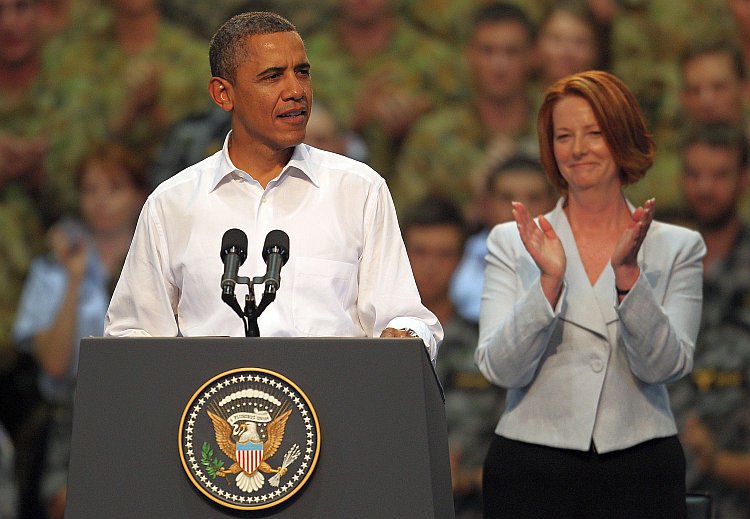
On his brief visit to Australia as part of the 60th anniversary of the ANZUS Alliance—a 1951 security pact between Australia, New Zealand, and the United States—Obama announced a rotating deployment of U.S. forces at Australian bases in the north of the country.
The move was described as a continuation of the alliance, and while welcomed by Australia’s Prime Minister Julia Gillard as facilitating a response to natural disasters and humanitarian assistance, the “new initiative is about stability,” she said.
Chinese media issued a veiled threat; seemingly justifying the view that increased U.S. engagement in the region is “hedging” against China’s military expansion.
“If Australia uses its military bases to help the U.S. harm Chinese interests, then Australia itself will be caught in the crossfire,” said a Web editorial in English from state mouthpiece The People’s Daily.
Australian Foreign Minister Kevin Rudd, a fluent mandarin speaker, was swift to respond saying increased U.S. presence involved Australia’s “national security” and that was for Australia to decide.
Security concerns in the region were again echoed at the East Asia Summit, where Obama, and also Russia, attended for the first time as part of the regional ASEAN meetings.
Much of the discussion surrounded the South China Sea, which China increasingly claims as its own, much to the consternation of other nations who claim sections.
While the maritime disputes have continued for decades, ASEAN has had little success in resolving the issue.
Quoting an off-the-record discussion with an official present at the AEASN meetings, however, the New York Times reported that countries one after another brought up the issue of maritime security in the South China Sea at the weekend meetings.
Leaders of Singapore, the Philippines, and Vietnam—countries with the most at stake along the crucial seaways—led the discussion, according to the official. Other countries followed including Malaysia, Thailand, Australia, India, Russia, and Indonesia.
The discussions have been widely seen as a coup for the Obama administration, that had identified earlier that the South China Sea was one of the main issues to be addressed at the East Asia Summit.






