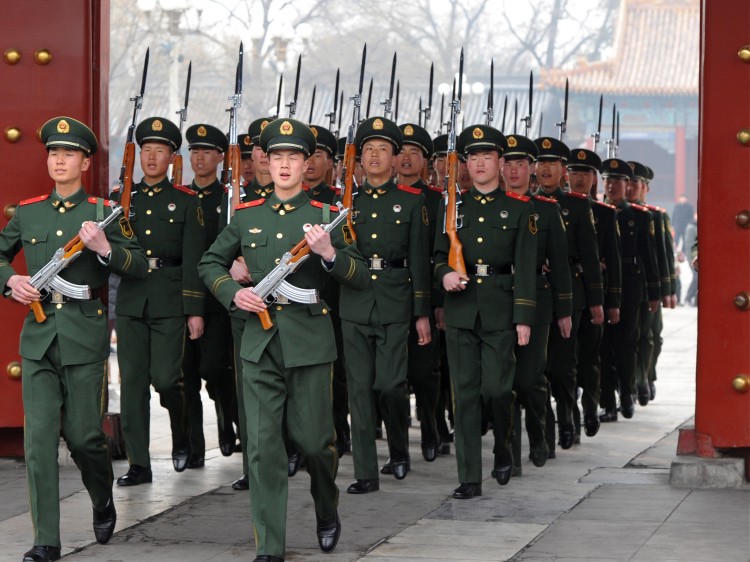

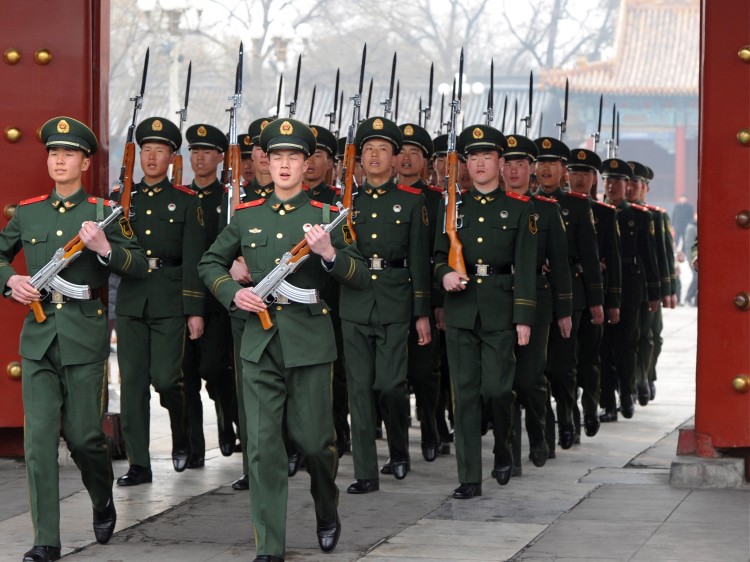
In ancient China the role of the “Nine-Gates Provincial Military Commander”—the official who controlled the military forces in the capital—was vital to the security of the emperor. Control of that position meant the power to prevent, or stage, a coup.
And so it is in communist China. Control of the Beijing Military Region is vital for the Chinese Communist Party (CCP) leadership to prevent other officials in the apparatus from seizing power.
This background explains an otherwise unremarkable speech by Hu Jintao, General Secretary of the CCP, in late May. Hu spoke at the Beijing Military Region’s 10th Party Congress, where Xi Jinping, heir apparent to the regime and Vice Chairman of the Central Military Commission, along with other military officials, were present. Hu was dressed for the occasion, in a Mao suit, according to photographs.
“The strategic position of the Beijing Military Region troops is extremely important,” Hu said, in remarks that were paraphrased by Xinhua, the regime’s mouthpiece. “The historical burden it shoulders is extremely glorious.” In recent years, he said, the Region has “resolutely implemented the Party Central committee and Central Military Commission’s policies and orders and loyally followed the sacred mission given to it by the Party and the people.”
Zhang Hui, a U.S.-based writer who often authors columns on elite Party politics, said that Hu’s message to the world was that the Beijing Military Region is firmly under his control. It was also meant to send a message to what has been termed the “bloody hands faction,” that is, officials aligned with former regime leader Jiang Zemin—most notably Zhou Yongkang.
This is further suggested by the list of attendees: in particular Guo Boxiong, vice chairman of the Central Military Commission, whose loyalties have been in question over the last several months, and also Fang Fenghui.
Fang, according to widely understood Party lore, gave a helping hand to Hu Jintao when he needed it in 2009, during the 4th Plenary Session of the 17th CCP Central Committee. He prevented certain personnel changes that Jiang Zemin was pushing for, therefore showing his loyalty to Hu and further cementing Hu’s control over armed forces in the capital.
The control of the Beijing Military Region is the latest conquest in a series of internal victories that Hu Jintao and Wen Jiabao have had in wresting power from Jiang Zemin’s men.
In August 1994 Jiang appointed the trusted aide You Guixi to chief of the Central Guard Bureau, which serve as the personal bodyguards of Party leaders.
In 2002 when Hu came to power, he inserted his own loyalist, Sun Yuangong, to be responsible for daily operations, leaving You Guixi as a figurehead. In September 2007, during another personnel shuffle, You was deposed and a Hu stalwart inserted in his place.
Ling Jihua, another trusted member of Hu’s faction, was made chief of the General Office of the Central Committee, which oversees the Central Guard Bureau. This effectively makes him a kind of “chief of staff” for Hu Jintao.
Another quiet personnel change drew attention: Li Runtian, the deputy-director (or former deputy-director) of the Central Guard Bureau, used to be the personal protector for Wen Jiabao. State reports show that he accompanied Wen during the Two Meetings in March. After the ouster of Bo Xilai, rumors surfaced that Li was one of Bo’s men. By April 4, he had been replaced.
With research by Susan Tan and Zhang Xingjian.
Click www.ept.ms/ccp-crisis to read about the most recent developments in the ongoing crisis within the Chinese communist regime. In this special topic, we provide readers with the necessary context to understand the situation. Get the RSS feed. Get the new interactive Timeline of Events. Who are the Major Players? 
The Epoch Times publishes in 35 countries and in 19 languages. Subscribe to our e-newsletter.







