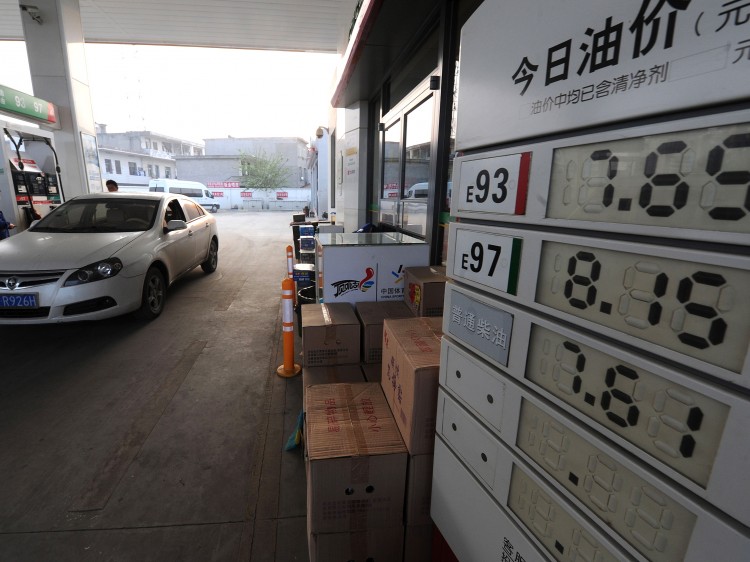

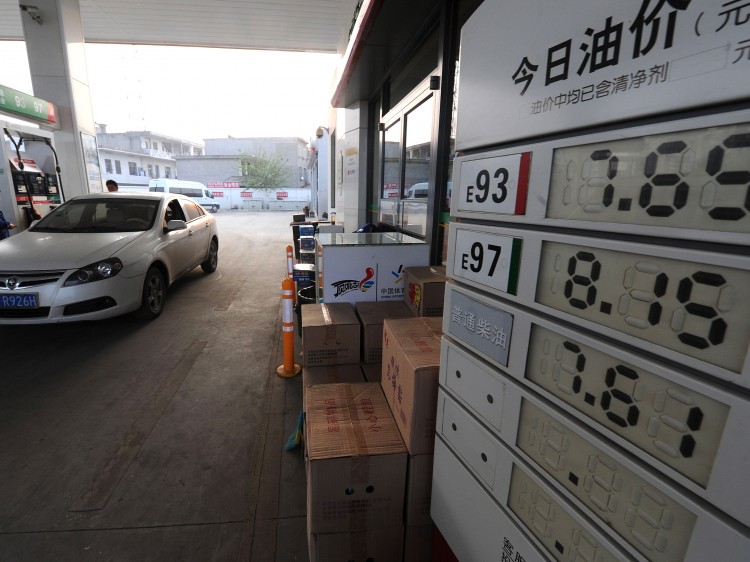
After the recent fall in China’s oil prices did not measure up to the sharp decline in global oil prices, Hong Kong-based economist Larry Lang responded with an article seeking to expose the reasons why. He argues that China’s crude oil markets are monopolized by two major state-owned corporations, who are allowed to reap huge profits, or rents, through their near-absolute control over oil prices in China.
As of June 9, midnight, gasoline and crude oil prices in China have been lowered by 530 and 510 yuan ($80 and $83), respectively. This has been the largest drop in its oil prices that China has experienced in the last three years.
However, the price falls were far smaller than what analysts had estimated. Had the drops been on the same level as the observed 9 percent drop in the three primary oil benchmarks, Chinese oil prices would have been reduced by 750 to 800 yuan ($118 to $126) instead.
The adjusted Chinese oil prices were still higher than U.S. oil prices. For example, the oil price for Chinese 93 RON (a rating of the octane level) gasoline was lowered by 0.43 yuan to 7.64 yuan per liter. However, U.S. gasoline prices now stand at $3.54 per gallon, the equivalent of 5.96 yuan per liter.
Statistics show that the income of an average Chinese citizen is about one-tenth of the income of an average American.
Lang attributed this differences to taxes, setting out four arguments.
Firstly, he says that half of the price of oil in China is due to taxes, or rents. If taxes were not included, Chinese gasoline would be cheaper than U.S. gasoline by one yuan per liter. However, excessive taxes in China have resulted in higher oil prices compared to U.S. prices by a margin of one yuan.
Secondly, China’s retail oil prices are not merely based on international oil prices, but rather a consideration of the “appropriate profits” for two state-owned corporations: China National Petroleum Corporation (CNPC) and the China Petroleum Chemical Corporation (Sinopec). The “appropriate profits” are controlled by the regime’s National Development and Reform Commission (NDRC).
Third, the two corporations hold the exclusive rights to import crude oil into China, so private oil refineries are unable to import their own crude. They have no choice but to live with the prices controlled by the two corporations. Since the corporations are the only supply of crude oil for private refineries, they cannot compete against the corporations by selling their refined oil products at cheaper prices, no matter how efficient their refinery processes may be. Otherwise the corporations would simply refuse to sell crude oil to them, Lang said.
Fourthly, the two corporations have not only monopolized the wholesale market of oil products, but also own most of China’s retail gas stations. And no matter how efficient private gas stations may be, they do not dare to lower their prices out of fear that the corporations could cut off their supply of oil at any point in time.
A NDRC official once admitted that Chinese gasoline is taxed at about 30 percent. In comparison, U.S. gasoline is only taxed at about 13 percent.
According to a 2011 report released by the China National Petroleum Corporation, China has become the second largest importer and consumer of oil behind the United States.
According to the report, in 2011 China consumed 490 million tons of oil, 3.5 percent higher than the previous year. Of that, 204 million tons were produced domestically, a 0.3 percent increase from 2010; 254 million tons of crude oil were imported, which was a 6 percent increase; 40.6 million tons of refined oil were imported, which was 10.1 percent increase. The dependency on foreign oil rose 1.7 percentage points, reaching 56.5 percent.
Read the original Chinese article.
The Epoch Times publishes in 35 countries and in 19 languages. Subscribe to our e-newsletter.
Click www.ept.ms/ccp-crisis to read about the most recent developments in the ongoing crisis within the Chinese communist regime. In this special topic, we provide readers with the necessary context to understand the situation. Get the RSS feed. Get the new interactive Timeline of Events. Who are the Major Players?