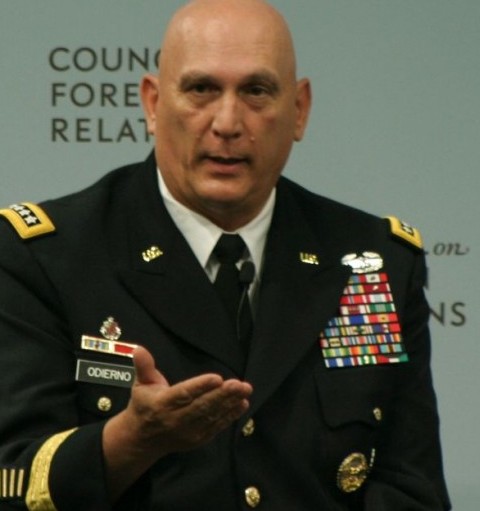
WASHINGTON—The future U.S. Army will have a broader focus than what it has now, according to U.S. Army Chief of Staff Gen. Raymond T. Odierno.
The current focus on counterinsurgency and counterterrorism is not going away, nor will it be diminished in the foreseeable future, Odierno says. But the nature of warfare is changing and so “we must think about how we are going to change with it.”
Several adjustments are in store, according to the general. In the next decade, the U.S. military will see a shift in priorities from the Middle East to Asia. It will also have to learn to do more with less, as Defense Department budgets decline.
The Council on Foreign Relations (CFR) interviewed Odierno and published his commentary, “The U.S. Army in a Time of Transition.” The article is featured in the May/June issue of Foreign Affairs—an influential publication on international issues published since 1922.
Odierno, 57, became Army Chief of Staff nine months ago. He commanded the 4th Infantry Division during Operation Iraqi Freedom from April 2003 to March 2004, and later was commanding general of multinational and U.S. forces in Iraq.
He also served as assistant to the chairman of the Joint Chiefs of Staff, when he was the primary military adviser to Secretaries of State Colin Powell and Condoleezza Rice.
A thorough review of the total force was recently conducted when the joint chiefs and combatant commanders simulated “well-developed scenarios” to find the optimal solution for a smaller force. Odierno said that the primary question asked was, “Do we have the forces—ground, air, sea, and maritime—to anticipate the need?”
In January 2013, the Budget Control Act is set to trigger a series of cuts, called the sequestration, which Odierno said is not the right way to allocate resources. He says that cutting every item 10 to 15 percent means doubling the already painful $487 billion loss the Defense Department will face over the next 10 years. He warns of defaults on contracts resources and “chaos within our system” if the automatic cuts were to take effect.
Odierno writes that the Army’s active-duty reductions in force are painful but necessary, and can be done responsibly.
“Today’s force is qualitatively different from the Army of a decade ago … It is more combat seasoned, more tightly integrated with the other military services and with special operations forces, and more technologically advanced,” he writes.
According to the general, today’s Army depends more than ever on backup from the Army National Guard and Army Reserve. Although the Reserves were developed at the end of the Vietnam War, they were rarely deployed. During the Cold War, reserve soldiers were disparagingly called “weekend warriors,” for their once-a-month duty requirements.
Reserve soldiers were originally meant to serve only in the event of a third world war. That changed in the 1990s, when there weren’t enough active duty soldiers to cover operational deployments in Iraq, Haiti, Somalia, Bosnia, and Kosovo, according to John Nagl and Travis Sharp, authors of the Center for New American Security’s “An Indispensable Force.”
Reserves have performed well in the Middle East Theater, and officials believe they can rely on them more. Besides Army Reserve and Army National Guard units, equivalent reserve components exist for the Air Force, Marines, Navy, and Coast Guard. By September 2010, one-fifth of military casualties in Iraq and Afghanistan were reserve and guard units, according to a GAO 2010 report.