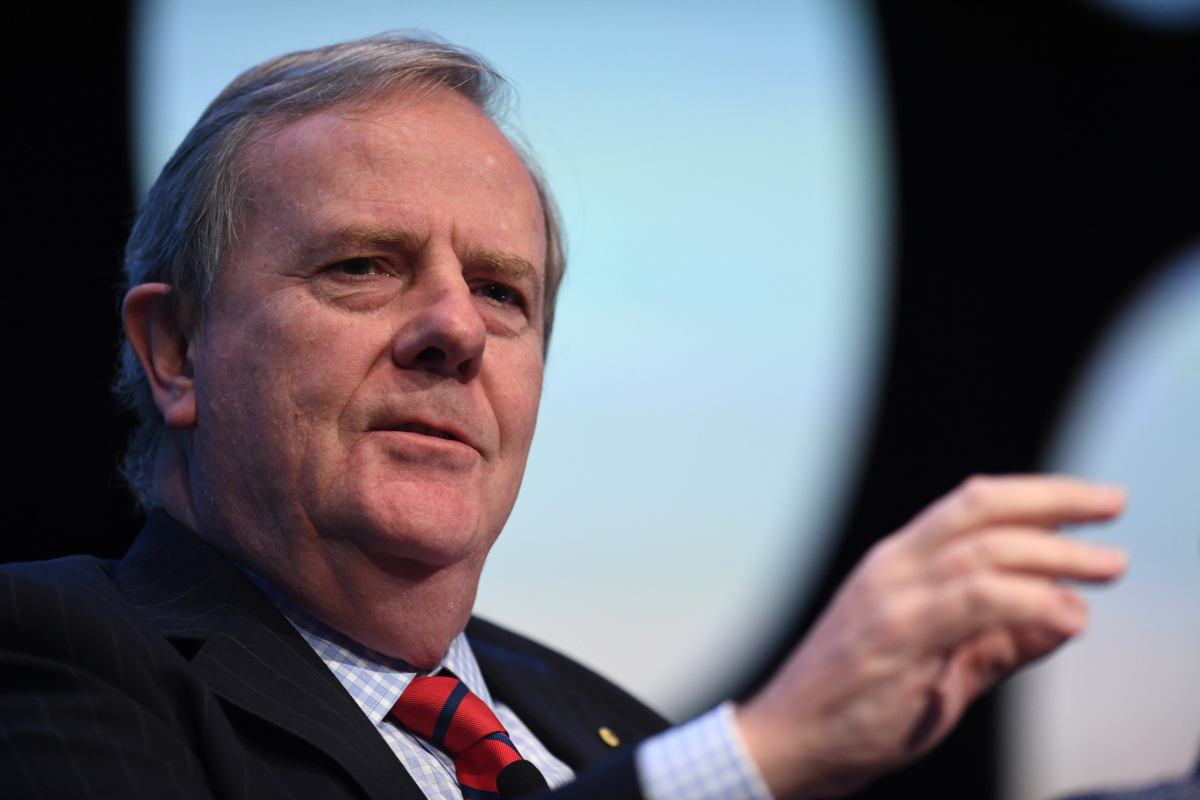

MELBOURNE, Australia—Australia’s industrial relations laws and the awards they produce are overly complex and represent a trap for otherwise well-meaning employers, says Peter Costello.
The country’s longest-serving treasurer, who held the role from 1996 to 2007, told the H.R. Nicholls Society annual conference that in many cases it was taxpayers who paid the cost, while the entire nation paid in terms of lost productivity.
Across the OECD, average growth in labour productivity between 2010 and 2024 was a “paltry” 0.9 percent, he said, yet Australia managed to average only 0.5 percent in that period.
“By contrast, in the decade between 1995 and 2005, labour productivity grew at 2.2 percent per year. [And] it underpinned real wage increases year-on-year. During the 11 years I was treasurer, average real wages grew 21.5 percent,” Costello said.
“You look at the last 11 years in Australia, average real wages have fallen; 2025 real wages are at the level they were back in 2012. No wonder people feel they can’t get ahead.”
Taxpayers End Up Paying
Labour disputes were now regularly costing both the public and private sectors, with taxpayers eventually bearing the cost in the former.
“In Victoria, taxpayer-funded projects run tediously late and massively over budget. Organised crime has infiltrated building sites and is extracting protection money. All this is built into the cost, which is ultimately paid by the taxpayers,” he said.
“In Sydney, an ABC radio host contracted to fill in on five shifts was taken off the air after three; she sued for political discrimination and was awarded $70,000 in damages. The ABC tells us it has spent $2.5 million on that case. That’s an expensive couple of shifts. Of course, taxpayers pay for that too.”
Citing newspaper reports, Costello noted that, since announcing in 2022 that addressing systemic non-compliance in the university sector was a priority, the Fair Work Ombudsman has entered into enforceable undertakings with La Trobe University, University of Sydney, University of Melbourne, University of Technology Sydney, the University of Newcastle, Charles Sturt University, and Griffith University.
The universities in question have paid back the 50,000 employees $128 million in owed wages, in what the National Tertiary Education Union has described as a $278 million scandal.
Despite the scale of the incident, Costello believes the universities did not deliberately withhold wages from their staff.
“Universities are run by highly intelligent people with enormous resources. They have HR departments and lawyers on tap. How is it that all these universities fail to comply with the laws? Do you suppose these universities, the citadels of work, sat down and tried to think up a cunning plan of how to cheat their employees? Hardly likely,” he said.
“These are non-profit organisations funded with taxpayers’ money. Complying with an award wouldn’t cost any person in university management anything at all. It wouldn’t cost a shareholder. It wouldn’t cost an investor. They have no incentive to cheat. This was not malevolence.
What happened was that the universities “got caught” by the confusing complexity of the modern award system, which outlines the minimum entitlements for employees.
“These are so vague and so complex that, despite best efforts, no one is really sure how to comply with them … There is nothing modern about these awards. A better name for them would be arcane,” he suggested.
The risk is worse for small firms without HR departments that can’t afford legal advice until after something goes wrong, he pointed out.
“Let me repeat, no one is trying to cheat anybody here. These businesses run the risk of non-compliance because sane, rational people cannot clearly work out what it is they have to do to comply,” he said.
Real Problems Left to Gather Dust
He criticised Treasurer Jim Chalmers’ recent productivity roundtable for failing to put forward the system’s complexity as an issue to be discussed.
“Was our system of workplace relations even raised? You can imagine that, having created the framework, the government would not be keen to have [it] measured for its productivity outcomes,” Costello said.
He’d been told, he said, that the Productivity Commission didn’t raise industrial relations at that meeting “for tactical reasons” because it “doesn’t raise things likely to get a hostile reaction from the government.”
“Does our Productivity Commission think that arcane awards, ‘same job, same pay’ legislation, [the right to] work from home, right to disconnect laws, the state of commercial building sites have [no] effect on productivity?
“These days, the PC (Productivity Commission) has gone PC (politically correct),” said Costello, who introduced legislation establishing the Commission, an independent agency, when he was treasurer.
“If the [Commission] is not going to use its statutory independence to tell inconvenient truths, then it is not going to be of much use,” he said.
“The roundtable came up with no outcomes that significantly boost our productivity. It managed to avoid talking about the things that might make a difference, things like lower energy costs for business [or] real tax reform, as opposed to smash-and-grab rates for revenue, ending wasteful government spending or reforming workplace relations.
“How can we hope to break the productivity drought when there is no honest analysis of the factors contributing to it?” Costello asked.