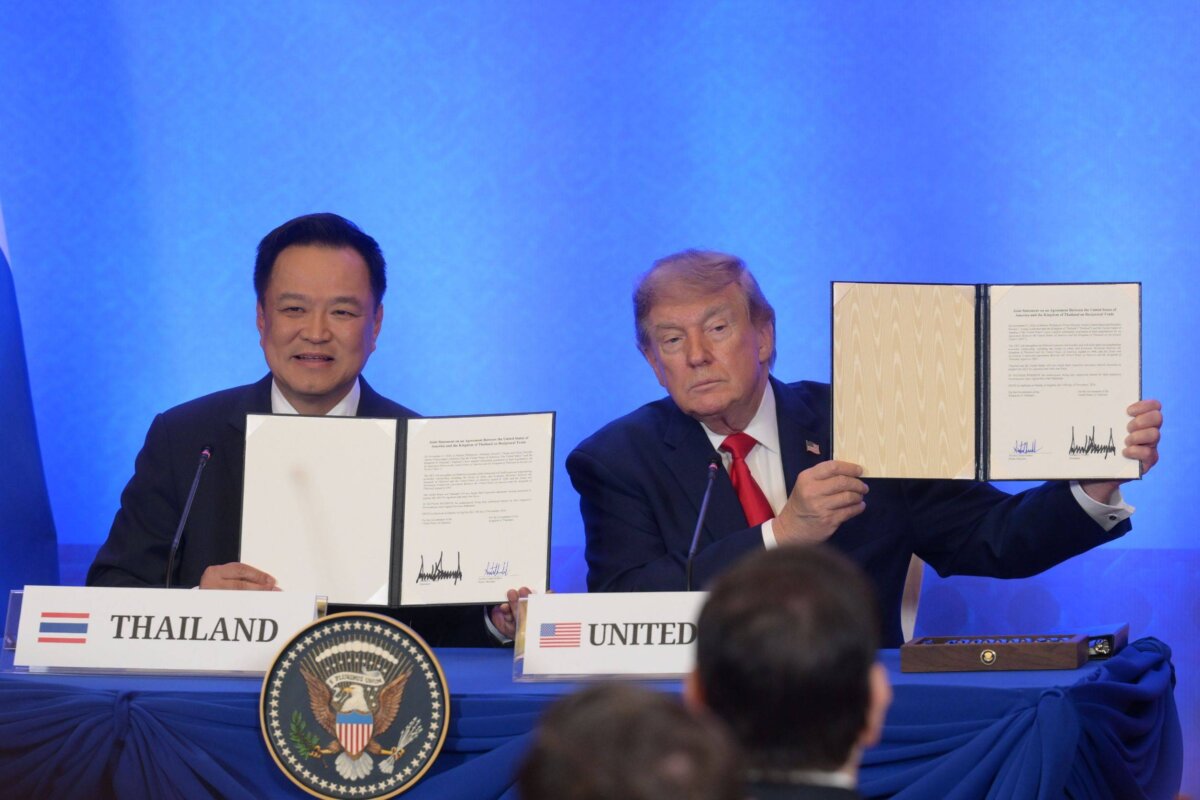

U.S. President Donald Trump and Thai Prime Minister Anutin Charnvirakul signed a joint statement on Nov. 17 advancing a U.S.–Thailand trade agreement, just four days after Bangkok signed a series of economic and security cooperation documents with Beijing.
The statement, signed in Manila, confirmed that the two countries had substantially concluded negotiations on a reciprocal trade agreement. The final agreement has yet to be signed or take effect.
The development followed Chinese Premier Li Qiang’s visit to Thailand, during which the two governments signed eight cooperation documents covering trade, agriculture, automotive manufacturing, education, and security.
Thailand has extensive economic ties with both countries. In 2024, China was its largest trading partner, while the United States was its largest export market, according to the U.S. International Trade Administration.
The proposed U.S. agreement goes beyond lowering tariffs. It also calls for cooperation on supply chains, export controls, investment security, and preventing companies from evading import duties—issues that feature prominently in Washington’s economic disputes with Beijing.
US Seeks Wider Access to Thai Market
At the signing ceremony, Trump said Thailand would eliminate all tariffs on American exports and remove other barriers affecting U.S. vehicles, medical devices, pharmaceuticals, ethanol, and poultry.
He also said Thailand would purchase an estimated $2.6 billion in additional American agricultural products.
The remarks followed a trade framework announced in October 2025, under which Thailand committed to eliminating tariffs on approximately 99 percent of goods, including American industrial and agricultural products.
Under that framework, the United States would maintain a 19 percent reciprocal tariff on qualifying Thai imports, while allowing certain products to receive a zero percent reciprocal tariff rate.
The framework also included commitments to address restrictions on American products and investment in Thailand.
Its economic security provisions called for the two governments to cooperate on export controls, investment security, and preventing companies from evading tariffs by routing products through other countries.
The document also called for action against unfair trade practices by third countries. It did not name China.
Thailand’s government said on Nov. 16 that existing tariff measures would remain unchanged until the final agreement was signed.
Anutin said Thai negotiators had worked to address sensitive provisions that could impose restrictions or practical difficulties on Thailand, proposing alternatives and concessions to reach acceptable terms.
He said Thailand would sign the final agreement only if its terms benefited the country and were mutually acceptable to both sides.
China Expands Trade and Security Cooperation
The U.S. trade negotiations advanced as Thailand was expanding cooperation with China in several of the same industries.
On Nov. 13, Anutin and Li witnessed the signing and exchange of eight cooperation documents at the Government House in Bangkok.
One agreement covered cooperation in electric vehicles, advanced automotive technology, battery manufacturing and recycling, and automotive supply chains.
Other documents addressed agricultural exports, including measures to maintain Thai durian exports to China and open the Chinese market to fresh Thai salak fruit.
The two foreign ministries also signed a memorandum of understanding on cooperation under Beijing’s Global Security Initiative, introduced by Chinese leader Xi Jinping in 2022 as part of an effort to reshape global security arrangements and challenge U.S.-led alliances.
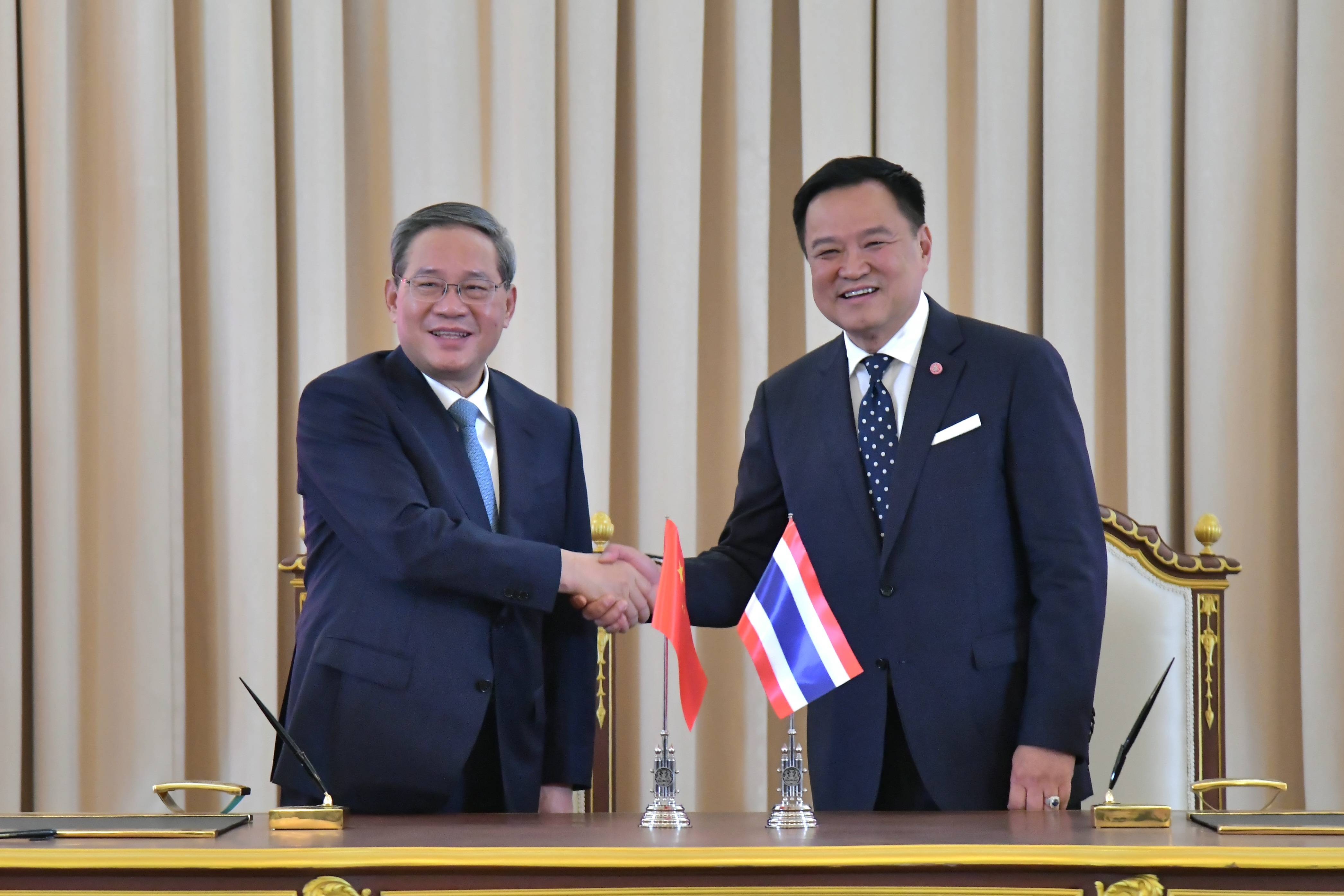 Chinese Premier Li Qiang (L) shakes hands with Thai Prime Minister Anutin Charnvirakul at Government House in Bangkok on Nov. 13, 2026. The two leaders witnessed the signing and exchange of eight bilateral cooperation documents during Li’s official visit. (Courtesy of the Royal Thai Government)
The November agreements followed Anutin’s visit to China in July, when he met Xi and Li.
In a July 20 joint statement, the two governments agreed to establish regular talks involving their foreign and defense ministers, expand cooperation in advanced industries, and advance railway connections linking Thailand with China through Laos.
The agreements with Washington and Beijing cover overlapping economic sectors but contain different commitments.
While Beijing’s latest documents focus on industrial cooperation, agricultural trade, and security ties, the U.S. framework calls for Thailand to cooperate with Washington on trade enforcement and measures addressing unfair trade practices by third countries.