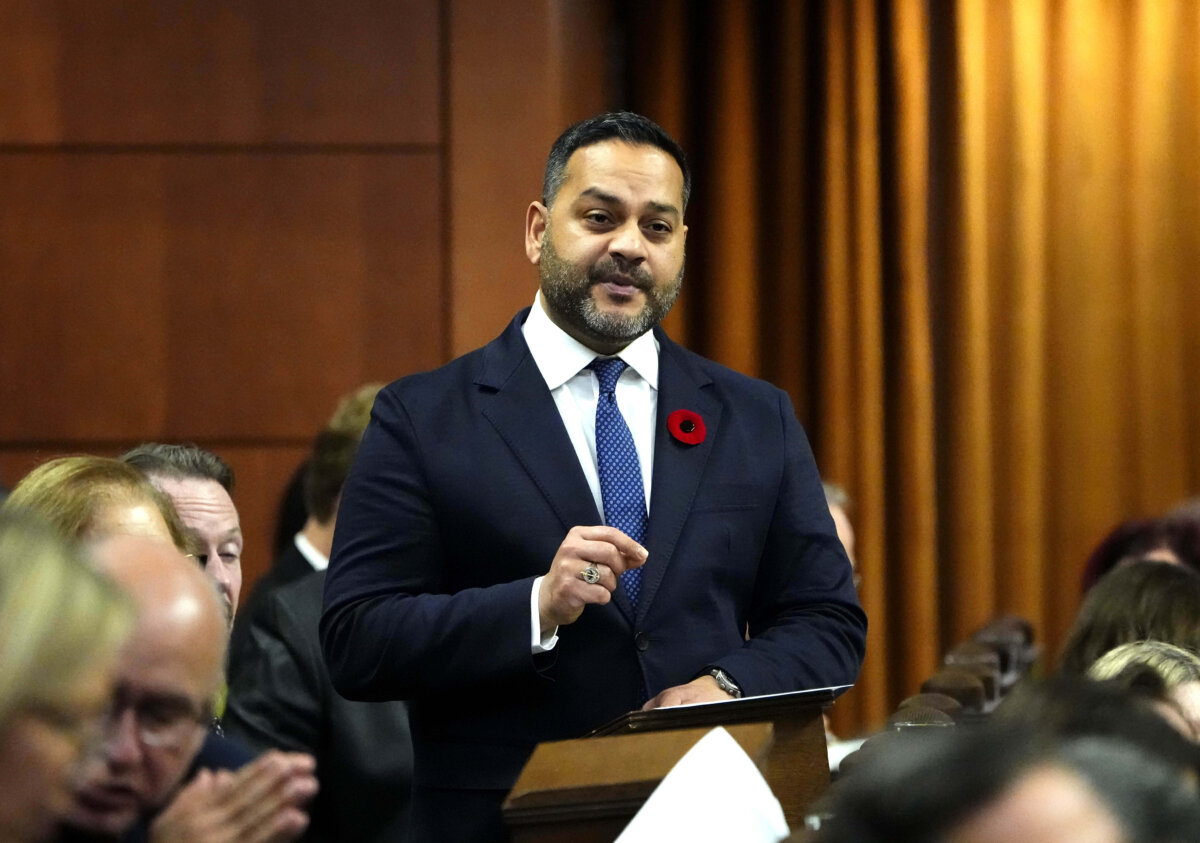

Conservative MP Shuvaloy Majumdar, shadow minister for Canada-U.S. relations, is urging the two countries to strengthen trade and security cooperation, warning that tensions between the longtime allies risk distracting them from the shared threat posed by China.
Beijing’s challenge to North American sovereignty, prosperity, and security calls for a renewed dedication to free enterprise and increased cooperation between Canada and the United States, Majumdar said during a recent discussion with Hudson Institute senior fellow Matthew Boyse.
He told Boyse, a former senior U.S. diplomat, that Beijing has used commerce as leverage, taken advantage of economic dependencies, and used state-directed industry to advance its strategic ambitions, to the detriment of both North American countries.
“I obviously would recommend to Washington and anybody else to approach Beijing very sensitively,” Majumdar said. “We did not build collectively over the last half century a market-capitalist free-enterprise model only for a state-backed one to come and then colonize and dominate it.”
Majumdar advocated for a return to tariff-free trade between Canada and the United States as a means to “establish the strengths that we need in this age of rivalry that is upon us.”
“The more we go after each other with tariffs that cost both our countries, I find it distracts us from the actual rivalry we must confront together,” he added, referring to China.
His comments were made before Prime Minister Mark Carney’s meeting with President Xi Jinping in China this week, where Carney sought to deepen economic and financial ties with Beijing.
Carney and Xi met in Shenzhen on Nov. 17 ahead of the APEC Economic Leaders’ Meeting, where the leaders agreed to extend and expand an existing trade arrangement, providing roughly $400 million in additional annual tariff relief for Canadian pork and seafood exports in exchange for extending and expanding tariff exemptions for certain Chinese steel and aluminum products through the end of 2028.
Carney also announced this week that Canada and China are connecting their “economies more closely,” adding that it “includes the digital and financial plumbing that makes trade possible.”
The announcement came the same day the prime minister said that some progress had been made toward a trade deal with the United States, but “we’re not there yet” in finalizing an agreement.
Majumdar said in a blog post accompanying the video that while it’s important for Canada to diversify its trading relationships, it should not mistake China for an alternative to the United States.
Threats to Canada
Majumdar said China poses a threat to Canada on several fronts, from interference in elections and transnational repression to intellectual property theft, fentanyl trafficking, and Arctic security.
He discussed his concern regarding growing military and strategic cooperation between China and Russia in the Arctic. Majumdar said Beijing’s growing military and technological alignment with Moscow directly challenges Canadian sovereignty and North American defence.
Both Russia and China operate vessels, uncrewed systems, and scientific platforms in the High North that serve civilian research and military intelligence-gathering purposes.
“We know that they partnered up with the Russian military in the production of Arctic fleet capabilities, surveillance through our sovereign Arctic space, testing our mettle and NORAD’s mettle fairly regularly,” he said.
He also cited Beijing attempting to acquire strategic dual-use infrastructure in Greenland.
China’s efforts to acquire the former naval port at Grønnedal was blocked by Denmark, Greenland, and the United States, which formalized an updated defence agreement in September, barring Chinese and Russian investment in strategic Greenlandic infrastructure.
Majumdar warned that China’s commercial ports “never stay commercial” and “become military fairly quickly.”
Aside from partnering with Russia, he said China is also behind the fentanyl precursors flooding North America.
North American authorities and lawmakers have widely identified China as the primary upstream source of the chemical precursors used to manufacture illicit fentanyl in North America. The issue also reflects broader security concerns raised by officials such as Majumdar about Beijing’s impact on North American stability.
He noted that fentanyl overdoses have claimed more Canadian and American lives than both World Wars combined.
“It’s a huge issue for both our countries,” Majumdar said.
The Tory MP also highlighted foreign interference and transnational repression.
He pointed to Canadian citizens Michael Kovrig and Michael Spavor being detained by Chinese authorities in December 2018 for 1,019 days as an example. Their detention was in apparent retaliation for the arrest of Huawei CFO Meng Wanzhou at Vancouver International Airport on a U.S. extradition warrant for Huawei’s business dealings in Iran.
He also accused China of being instrumental in the downfall of Canadian multinational telecommunications giant Nortel Networks. The company went out of business in 2009.
Some security officials and intelligence experts say a decade-long state-sponsored cyber espionage campaign from China severely undermined the company while helping propel Huawei onto the global stage.
“Think about how much the world would look differently had Canada been contributing to its data infrastructure through Nortel, had Nortel been allowed to grow into what it was before the CCP stole it,” Majumdar said.
Beijing has also operated unauthorized overseas police service stations in Canada to monitor, intimidate, and coerce members of the Chinese diaspora and has interfered in back-to-back federal elections in Canada, Majumdar said.
The MP said the best defence against Beijing’s tactics are “free enterprise, tariff-free trade among allies, and closer cooperation on continental and Arctic security.”