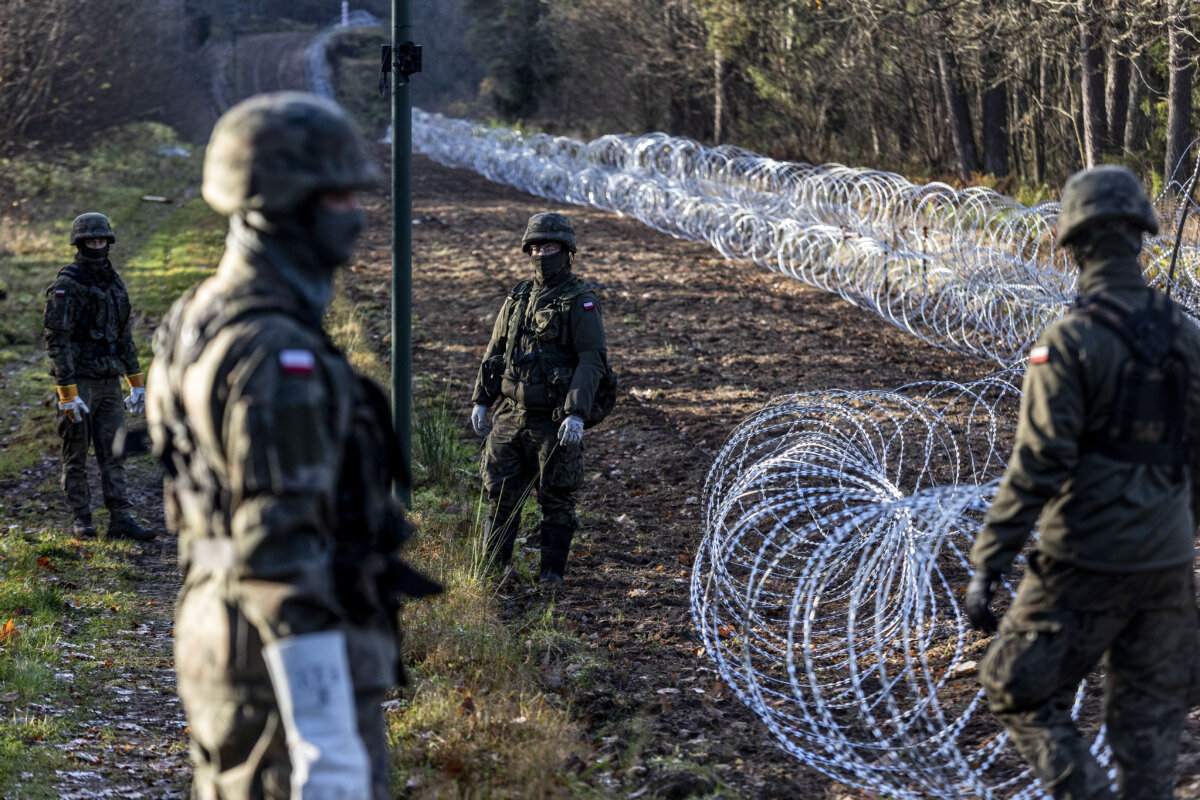

Polish Prime Minister Donald Tusk claimed on Nov. 3 that security forces had thwarted a suspected provocation along the border with Russia’s Kaliningrad exclave.
Speaking at a Council of Ministers meeting on Nov. 3, Tusk said that he received a report from the border guard that suspicious movements had been observed on the Polish–Russian border, just after midnight.
“Individuals with flashlights,” he said. “We very quickly mobilized the appropriate forces and resources there, and managed to prevent a provocation.”
Tusk said it was not possible to confirm with full certainty that the incident was an attempted provocation.
Kaliningrad is a flashpoint for diplomatic tensions between Moscow and NATO allies. The heavily militarized exclave is separated from the rest of Russia and sandwiched between NATO members Lithuania and Poland.
Tusk said no major tragedy had been averted, but he also said, “The tension and escalation from Russia may continue, and we must remain focused and ready to prevent any possible provocations.”
“We have been receiving information for some time from our services and from allies’ services that … acts of diversion or more serious provocations on the border with Russia, or even sabotage acts orchestrated by hostile services, could occur,” Tusk said.
The prime minister said the warnings had become more specific, including intelligence suggesting that armed individuals could attempt to cross into Polish territory during the first half of November.
He also said that U.S. Gen. Alexus Grynkewich, NATO’s supreme allied commander Europe, had warned him of possible escalation.
A spokeswoman for Poland’s national police chief, Gen. Marek Boron, told The Epoch Times in an email that preventive measures were being undertaken in response to threats involving sabotage, hybrid criminal activity, and the actions of Eastern intelligence services.
She said the operations were taking place in the Warmia-Masuria and Podlaskie police regions in cooperation with the Border Guard, military, and intelligence services.
“The police always respond to any information and, depending on the threats, take appropriate action,” she said.
Boron told Polish radio RMF FM on Nov. 2 that the deployment was linked to concerns about sabotage and the activities of foreign intelligence agencies.
“A large number of police officers are operating there,” Boron said. “Some police units have been redeployed, and counterterrorism officers are also involved in the operation. We are cooperating with the military, Border Guard and intelligence services.”
Boron denied that the border security mobilization had anything to do with the recent Constitutional Tribunal issue in Warsaw.
Tusk accused Russia on Nov. 3 of seeking to fuel “instability” in Poland after protests broke out outside Poland’s Constitutional Tribunal on Oct. 30 following the top court’s announcement that its president, Bogdan Swieczkowski, had been suspended amid disagreements over judicial appointments.
Russian politicians, including former Russian President Dmitry Medvedev, the deputy chairman of Russia’s Security Council, described the Tusk government’s moves in the dispute over the tribunal as “a coup.”
In a Nov. 1 post on X, Medvedev mocked Western accusations of Russian interference, writing: “I love this mantra! Elections in the US? It’s Russians. Migrants in Spain? It’s Russians! Constitutional coup in Poland? Of course, it’s Russians! Thank you! Nothing unites us better than our might! Well, you know the rest… we are coming!”
Kaliningrad serves as the headquarters of Russia’s Baltic Fleet.
Its location provides Russia with the ability to project military power into central and northern Europe.
At the same time, being positioned between two NATO members makes it vulnerable. If the alliance were to act against the territory, Moscow would find it difficult to maintain supply lines.
Russia warned on Sept. 29 that any UK or NATO attempt to blockade or strike Kaliningrad could trigger nuclear retaliation.
In a Sept. 29 Telegram post, the Russian Embassy in London referenced Sky TV’s recent four-part documentary-drama series “The Wargame,” in which a fictional British Cabinet considers striking Russian territory, including Kaliningrad, after a simulated attack by Moscow on the UK.
Moscow also mentioned a recent article in the British newspaper, the iPaper, which said on Sept. 26 that the territory “once seen as a threat to NATO could now be a weakness for Vladimir Putin that is waiting to be exposed.”
Victoria Friedman, Aldgra Fredly, and Reuters contributed to this report.
Correction: An earlier version of this article misstated Kaliningrad’s status among all of Russia’s year-round, ice-free ports. The Epoch Times regrets the error.