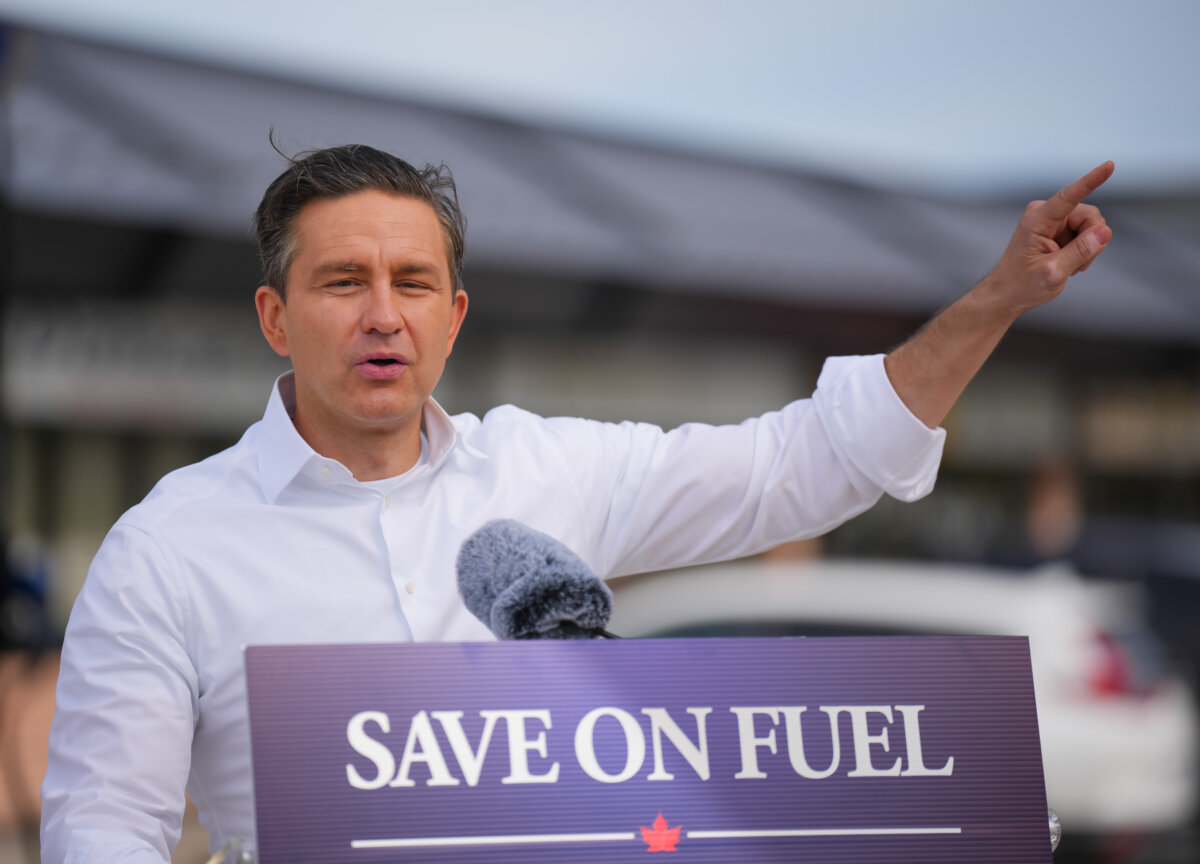

Conservative Leader Pierre Poilievre is calling for cuts to government spending and further suspension of fuel taxes ahead of the Nov. 5 tabling of Budget 2026.
Poilievre said he wrote a letter to Prime Minister Mark Carney to express concerns over the rising cost of living and government spending, saying it adds to inflationary pressures.
“Canadians cannot afford the extra costs you’ve added to groceries, gas, and homes. Enough is enough,” Poilievre said at a press event held by the Canadian Taxpayers Federation in Ottawa on Nov. 1.
A debt clock ticked up in the background during the event. Poilievre said the next generation would inherit rising government debt.
He also expressed concern that higher interest costs are eating into people’s household budgets, particularly through mortgage payments.
“Conservatives have budget demands to save you money,” he said. “We’re calling on the prime minister to do the following things: First, cut wasteful inflationary spending. Reducing the cost of government will reduce the cost of living.”
Poilievre also said Ottawa should cut expenditures on consultants and the associated bureaucracy, eliminate what he considers wasteful foreign aid spending, and honour its promised debt anchors, fiscal rules set out to help the government manage spending and debt levels to ensure they remain within certain limits.
The federal government had outlined two such anchors in Budget 2025, released last November, one being to maintain a declining deficit-to-GDP ratio, and the other being to balance day-to-day operating spending with revenues by 2028–29.
Poilievre said the Conservatives are also calling for the GST and the excise tax to be suspended till “at least Canada Day,” saying that reducing fuel costs would bring down other costs.
“If you got it, a truck brought it,” Poilievre said.
The Canadian Taxpayers Federation has also written on numerous occasions about high fuel costs, urging Ottawa to continue suspending the fuel excise tax.
Ottawa suspended the excise tax on gasoline and diesel effective April 20, 2026, in response to rising fuel prices caused by global conflict and supply disruptions in the Middle East. The measure eliminated the federal tax of 10 cents per litre on gasoline and four cents per litre on diesel, providing immediate relief to motorists and reducing transportation costs for businesses.
The suspension was initially set to expire Sept. 7, but Ottawa extended it until Jan. 31, 2027, with legislation receiving royal assent on Oct. 29.
During debates in the House of Commons on Oct. 28, Poilievre said Carney had “doubled the deficit that [former prime minister Justin] Trudeau left behind, increased government spending to the highest share of GDP since 1996, and is threatening to add $700 billion more in debt.”
Carney responded that the Bank of Canada had made it clear about the global causes of inflation and had said Canada’s growth will pick up next year and the year after, “the strongest in the G7.”
“Let us be clear about the fiscal record of the government: the lowest net debt in the G7, the second-lowest deficit in the G7, operational spending down from 8 percent to 2 percent, a 10 percent cut in the civil service, and a 20 percent cut in consultants, $60 billion of savings. That is even before the budget next week,” Carney said.