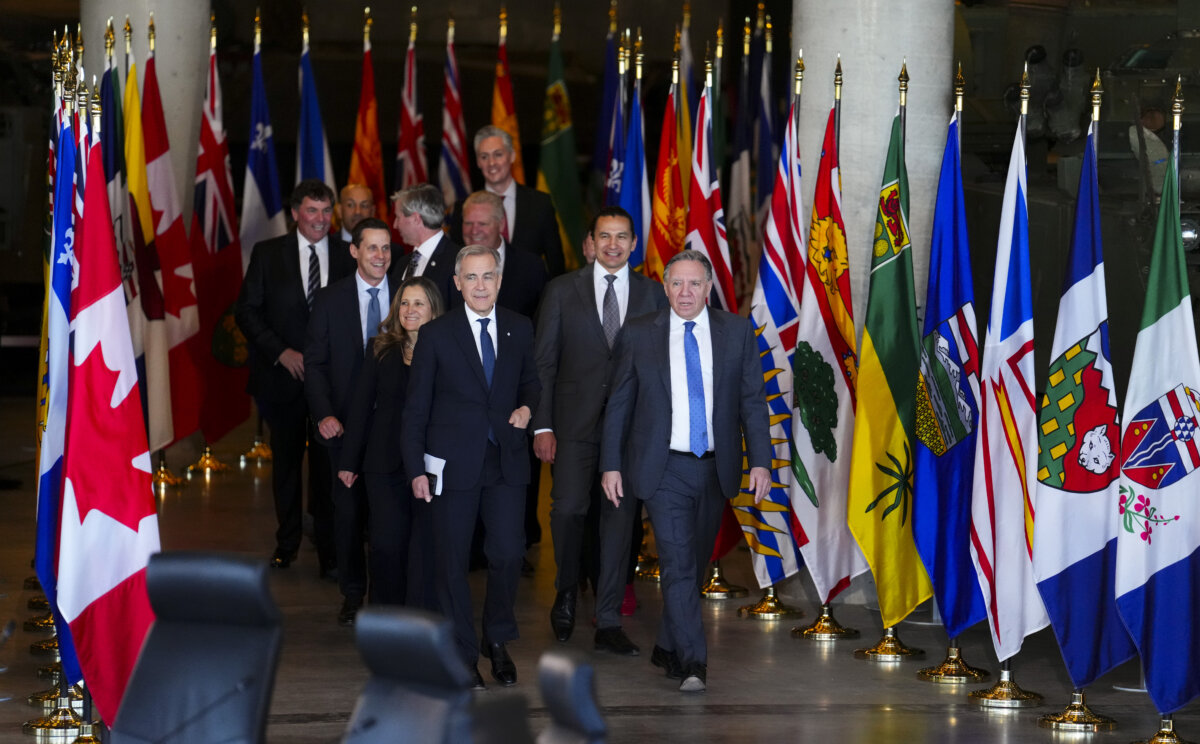
Canada’s premiers and the prime minister will hold a special meeting July 22 in Muskoka, Ont., to discuss U.S. President Donald Trump’s latest tariff threat, according to a July 11 post from Ontario Premier Doug Ford.
The news of the upcoming special first ministers meeting comes the day after Trump sent a letter to Prime Minister Mark Carney saying he will impose a blanket 35 percent tariff on Canadian imports.
“I’ve asked and Prime Minister Carney has agreed to an in-person First Ministers’ Meeting on Tuesday, July 22 in Huntsville ahead of the Council of the Federation meeting with Canada’s premiers,” wrote Ford, who is chair of the Council of the Federation this year. “Together, we’re going to remain united as we protect Ontario and protect Canada.”
Alberta Premier Danielle Smith said Trump’s most recent tariff threat would be a “tax on the American people,” adding that the tariffs “would also hurt Canadian and American businesses and workers, and damage one of the most important trading and security alliances on earth.”
Smith also said that retaliatory tariffs won’t work, writing, “Retaliatory tariffs by the federal government to this escalation would constitute a tax on Canadian consumers and businesses and only weaken Canada’s economy further.”
Smith added that “Trudeau-era anti-resource development laws” need to be dropped and Canada needs to start approving “multiple pipelines, rail expansions and transmission lines going west, east and north to diversify and grow our export markets around the world.”
B.C. Premier David Eby also reacted to Trump’s tariff threat, saying the American president’s “letter is flailing and factually incorrect,” Eby wrote. “Just one more reminder of why Canadians need to come together, to grow our economy and stand strong. British Columbians are leading the way on that work.”
Canada is currently subject to a 25 percent tariff on all products that don’t fall under the United States-Mexico-Canada trade agreement. It has also been hit with sectoral tariffs applied on all countries by Washington, including the 50 percent tariffs on steel and aluminum.
Carney has called the U.S. tariffs “unjustified,” and said that it is a “top priority” for his government to make a new trade deal with the United States.
Minister of Energy Tim Hodgson said on July 11 that Canada’s critical mineral resources will play a key role in how Ottawa responds to escalating trade tensions with the United States.
Hodgson added that “global economies and markets are more volatile than they’ve been at any time since the Second World War,” and that “President Trump’s tariffs are disrupting trade and impacting our natural resources, energy, mining, manufacturing, and many other sectors.”
First ministers last met June 2 in Saskatoon, where they issued a joint statement about removing trade barriers and advancing Bill C-5, the One Canadian Economy Act, which prioritizes and fast-tracks major projects deemed to be in national interest. Bill C-5 received royal assent and became law on June 26.
“First Ministers agreed to continue to work collaboratively and address the priorities of all Canadians in every region of the country. To that end, they will meet regularly to drive action on shared priorities vital to Canada’s security and economic resilience,” read the release.