
Paraguay’s Congress began proceedings to remove President Santiago Peña after a digital bank collapsed, sparking angry protests and widespread calls for his resignation.
A two-thirds majority of lawmakers participating in the session is needed to begin impeachment proceedings against Peña, who was a shareholder in the group that controlled the collapsed lender, Ueno Bank, until last year.
Peña is a former International Monetary Fund economist who, until the scandal, had enjoyed the support of the country’s most powerful politicians and was welcomed in Washington just weeks ago as a key ally of the Trump administration.
Calls for impeachment grew by Thursday as both the congressional President Basilio Nuñez and Colorado Party leader Horacio Cartes withdrew their support for Peña, leaving him increasingly isolated.
Paraguay’s Congress convened an extraordinary session late on Wednesday to debate the president’s future, after 35 lawmakers submitted impeachment articles in the 80-seat lower house.
Lawmakers accuse Peña of conflicts of interest, misusing pension funds, and institutional cover-ups, all linked to Ueno’s collapse.
Millions of Paraguayans were left without access to their bank accounts this week, with workers, pensioners, and savers scrambling to recoup their unpaid wages and frozen funds.
A judge on Thursday ordered six Ueno executives, including founder Miguel Vázquez and bank President Juan Manuel Gustale, to be jailed pending trial, while two others were placed under house arrest.
 Deputy Carlos Pereira speaks during a discussion on the impeachment of President Santiago Peña in Paraguay’s lower house of Congress in Asunción, Paraguay, on Nov. 5, 2026. (Jorge Saenz/AP Photo)
Fraud Charges
Prosecutors have charged 27 bank officials and associates with breach of trust and attempted fraud.
Gustale’s lawyer told local media, “The president or board is not responsible for deciding who receives a particular loan.”
Peña offered his resignation in a recorded message posted to social media on Nov. 5, with the lower house, the Chamber of Deputies, voting unanimously to impeach him moments later.
Both houses declined to accept Peña’s offer to resign, with the upper house, the Senate, instead deciding to press ahead with a trial that could remove the president from office.
Opposition lawmakers argue that allowing him to resign would preserve his eligibility to become a senator for life, with legal protections that could prevent his prosecution if criminal charges are filed against him.
Paraguay’s Attorney General Emiliano Rolón Fernández has ordered three criminal investigations into the Ueno Bank crisis, including the allegations involving the president and other current and former government officials, the prosecutor’s office said on Thursday.
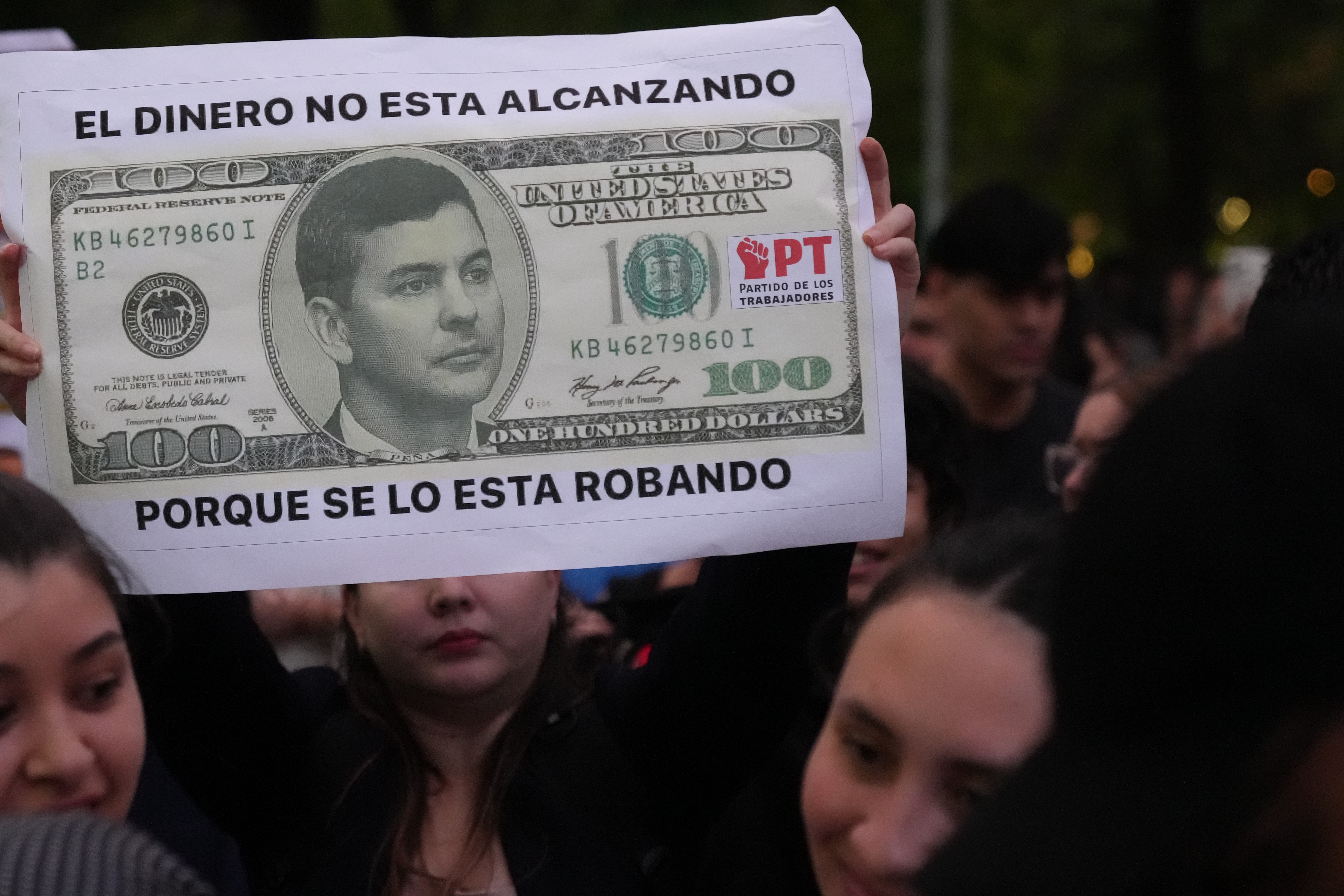 A demonstrator holds a mock U.S. dollar bill depicting Paraguayan President Santiago Peña during a protest against the government and Ueno Bank, which Paraguay’s central bank seized amid a solvency crisis, in Asuncion, Paraguay, on Nov. 4, 2026. (Jorge Saenz/AP Photo)
‘Responsibility and Respect’
Peña said he would cooperate with the investigation, which will examine authorities’ oversight of the lender, how they handled its collapse, and the placement of public funds in the bank.
“Whatever the outcome of this process, I will act with responsibility and respect for the Constitution,” he said in a post on X.
In the video statement, he said he was stepping down in the interests of “the stability of our country, social peace and the need to preserve our democratic institutions.”
While he expressed regret, the president stopped short of accepting responsibility for the turmoil.
“I want to apologize to the people if I have failed them at any point,” he said. “It was never my intention to betray the trust they placed in me.”
If he is removed from office, Vice President Pedro Alliana would replace him as Paraguay’s leader.
Ueno Bank went from obscurity to becoming a household name in less than five years, drawing more than 60 percent of adults in Paraguay as customers.
Ueno’s Rapid Rise
The digital bank, a rebranded version of a decades-old finance company, attracted customers with generous cash-back offers on groceries as it expanded to more than 70 locations and sponsored Paraguay’s national soccer team.
This meteoric rise has led to questions about the proximity of Peña’s party to the country’s financial regulators and business elite, in a country with one of South America’s most stable economies. The World Bank says Paraguay has “maintained macroeconomic stability for the past two decades” and notes public debt remains among the lowest in Latin America and the Caribbean.
Despite its relative economic stability, only Venezuela ranks worse than Paraguay in South America on Transparency International’s latest index of perceived corruption.
Peña appointed Carlos Carvallo, president of Financiera Ueno, the predecessor to Ueno Bank, to run the central bank, which supervises the digital lender.
As of last month, Ueno reported holding about $800 million in public deposits, roughly a quarter of its total, including money from the state pension and health fund and the operators of Paraguay’s giant hydroelectric dams.
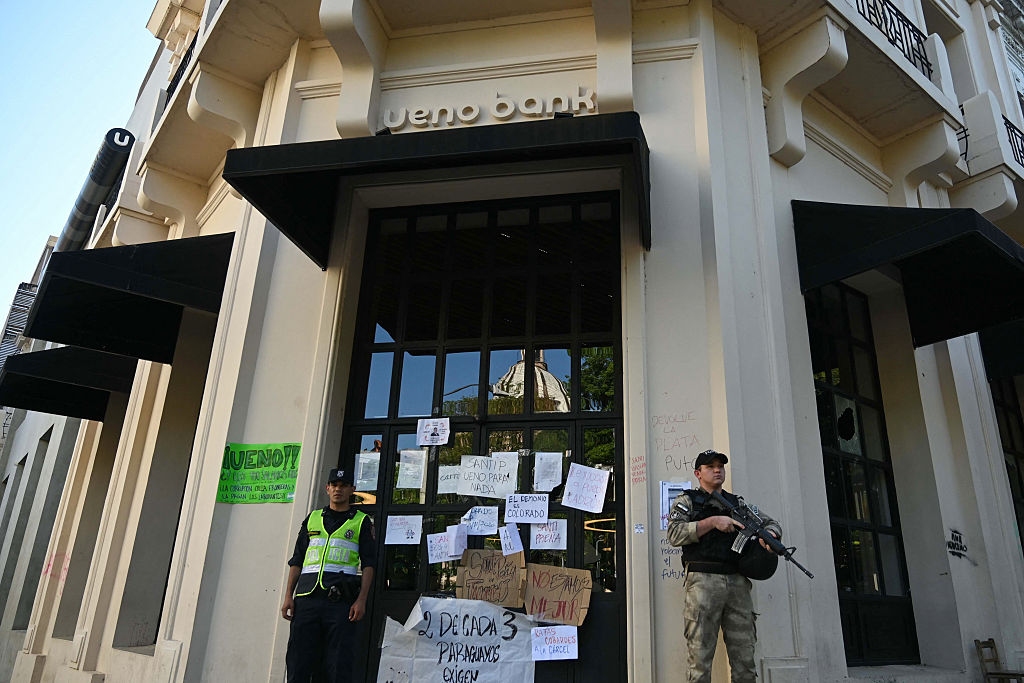 Police stand guard outside a Ueno bank branch covered with banners and graffiti in downtown Asuncion on Nov. 6, 2026. (Daniel Duarte/AFP via Getty Images)
The central bank announced the lender’s seizure on Tuesday and began transferring deposits and recoverable assets to other banks before liquidating the remainder.
Ueno’s app went dark, while its branches locked their doors and all card transactions failed, leaving frustrated customers lined up outside.
A rush to open new accounts elsewhere crashed other banks’ mobile apps on Wednesday, fueling public panic.
In a bid to calm fears, Congress on Wednesday rushed through a law guaranteeing the state fund must repay stranded depositors within five business days, starting Thursday, for small accounts of up to about $1,600.
The fund insures up to about $36,000 per customer, which the central bank said will cover the full balances of about 97 percent of all Ueno’s clients.
Reuters and The Associated Press contributed to this report.