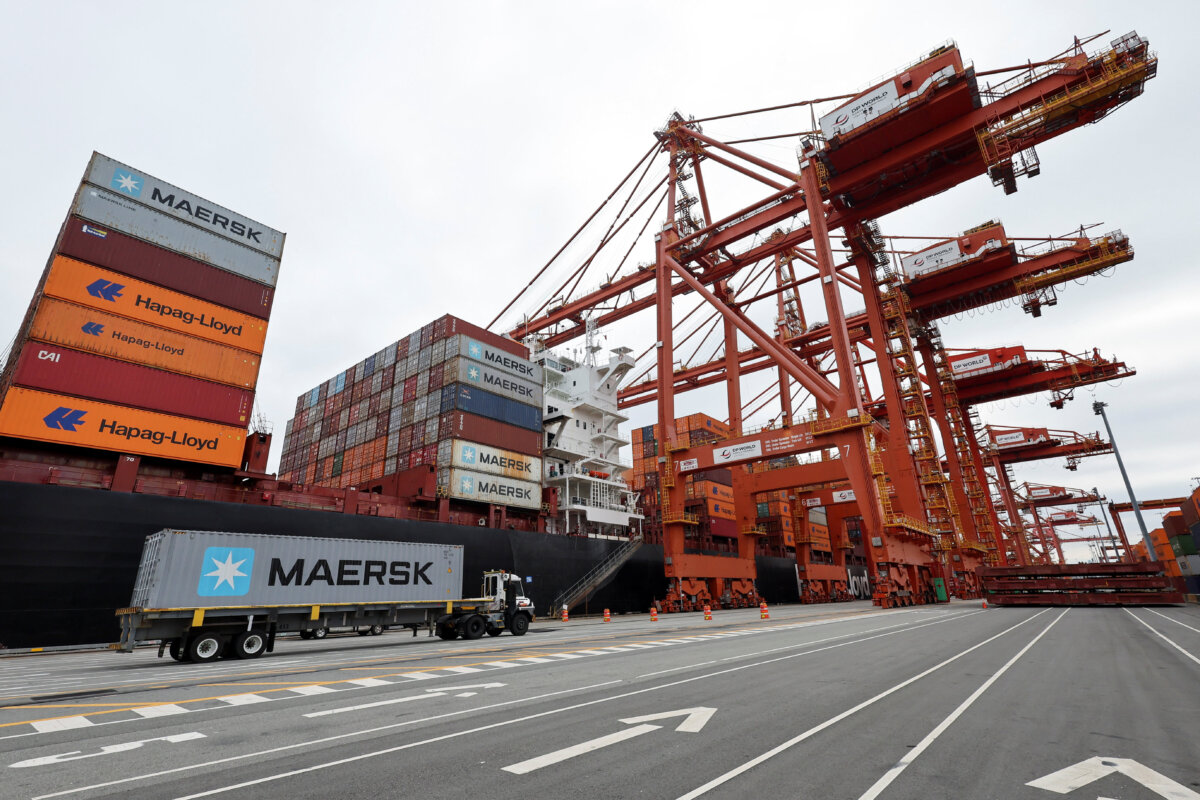

The federal government has listed the Roberts Bank Terminal 2 in Delta, B.C., as a “project of national interest,” saying it will strengthen Canada’s ability to trade with new partners.
“Getting goods to market quickly and reliably is essential to Canada’s economic success. Roberts Bank Terminal 2 will add much-needed capacity at our largest port, reduce bottlenecks and strengthen the transportation links Canadian businesses count on,” said Transport Minister Steven MacKinnon.
“Listing this project as a project of national interest gives us greater certainty to move it forward and build a stronger, more efficient trade gateway on the West Coast.”
Projects designated as being of national interest receive streamlined federal approvals. Certain authorizations are granted in principle, while federal regulators still review the project to establish binding environmental, safety, and other conditions, according to the government.
The Vancouver Fraser Port Authority will lead the $5.9 billion expansion at the Port of Vancouver. Commercial operations are now expected to begin in 2035 instead of 2039. Ottawa expects to make a final decision on outstanding project requirements by mid-2027.
MacKinnon said during an Oct. 30 news conference in Delta that the project had already undergone years of federal environmental assessments, but some permitting decisions are still outstanding. He said the new designation would provide greater certainty about the project’s timeline while maintaining environmental protections.
“When you’re dealing with projects of this scope and size and cost, time is money,” he told reporters.
The expansion is expected to add 2.4 million containers of annual capacity to the Port of Vancouver, increasing its container capacity by roughly 50 percent and supporting up to $100 billion in annual trade.
As Canada’s largest port and a major gateway to Indo-Pacific markets, the Port of Vancouver handles roughly a third of Canada’s non-U.S. trade and connects Canadian businesses to more than 170 international markets.
Ottawa said the expansion would help address projected capacity shortages, reduce congestion, and avoid nearly $900 million in annual shipping and transportation costs due to contraints. The government also estimated that the project would cut delivery times between Vancouver and Toronto by roughly 17 percent and reduce container import costs by nearly 25 percent.
The government said the expansion would support roughly 17,000 jobs across Canada’s supply chains, contribute approximately $3 billion annually to GDP, and generate more than $630 million in annual tax revenue.
The Vancouver Fraser Port Authority has selected TerraMarine as its preferred construction partner following a competitive procurement process.
The expansion has also raised environmental concerns, particularly about endangered southern resident killer whales.
During the news conference, MacKinnon said the project is subject to environmental safeguards. He noted that Ottawa had announced nearly $260 million in whale-protection measures this year, including initiatives to reduce vessel noise and protect marine habitats.
MacKinnon also said the port authority had signed 27 mutual benefit agreements with First Nations to support environmental management and the project’s economic opportunities. He said Ottawa had consulted indigenous communities, the provincial government and federal permitting departments before designating the expansion as a project of national interest.
The announcement follows roughly 13 years of planning, environmental assessments and regulatory reviews.
Port authority CEO Peter Xotta welcomed the announcement, saying the lengthy process had created uncertainty about whether the expansion would proceed.
“Boy, there’s been times that even we didn’t think it would happen,” he said, adding that the port authority had assembled its construction team and was preparing to move forward with the project.
Conservative transport critic Dan Albas said ahead of the announcement that his party supported the expansion but urged Ottawa to demonstrate the designation would accelerate construction.
“If the government is moving forward with [the designation] today, the Official Opposition will note that we support getting things done faster, but the government has to show more than just simply a designation—it needs to show a plan for acceleration,” Albas told reporters on Parliament Hill on Oct. 30.
He noted that the project had already spent roughly a decade going through the permitting process.
The Roberts Bank Terminal 2 expansion is among the latest major infrastructure projects to receive national-interest status under the Building Canada Act, which allows the federal government to streamline project approvals.
Ottawa designated the proposed Pacific Link oil pipeline between Alberta and British Columbia on Oct. 1. Several other projects, including the Mackenzie Valley Highway in the Northwest Territories, the Grays Bay Road and Port project in Nunavut, and a nuclear waste repository in Ontario, are being considered for the designation.