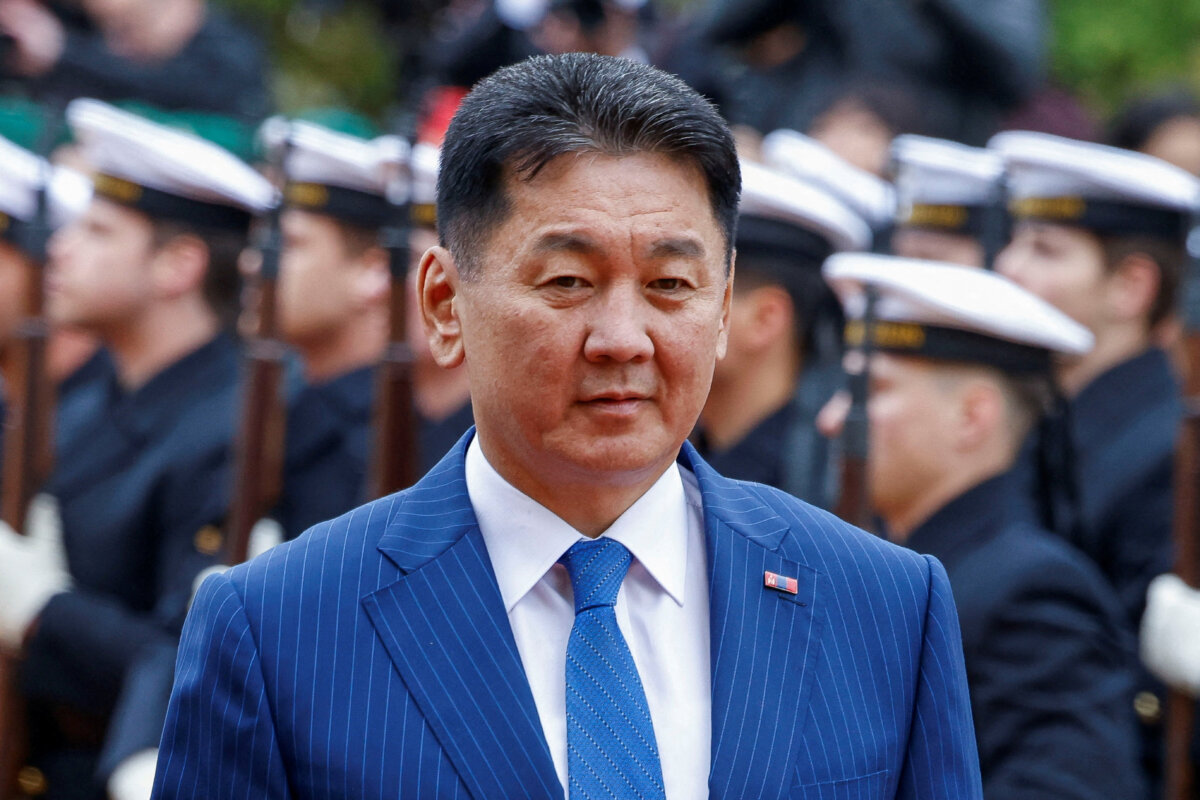
Mongolian President Khurelsukh Ukhnaa has announced he would resign, pledging to clear his name after the opposition party accused him of corruption, the state-owned news agency Montsame said on Tuesday.
The Democratic Party has accused Khurelsukh and other leaders of the ruling Mongolian People’s Party (MPP) of corruption linked to the Mongolian conglomerate Bodi International.
“The Democratic Party has said that I should step down from my duties so that the truth can be established,” Khurelsukh said.
“I agree with this. I will therefore hand over my duties as President of Mongolia. I will be investigated and will have my honor restored.”
“For more than a month now, actions have been taken that defame and insult the President of Mongolia,” Khurelsukh said in a statement, according to Montsame.
“The President is the person who embodies the unity of the people. Therefore, an attack on the President’s reputation is an attack on the reputation of the people.”
Khurelsukh said his good name was linked to Mongolia’s reputation on the world stage.
Former Ulaanbaatar Mayor Khishgee Nyambaatar, a member of a rival faction within the ruling Mongolian People’s Party (MPP), accused him of handing a railroad contract to Bodi International in 2019—without a competitive tender—in exchange for bribes. Khurelsukh denies wrongdoing.
Bodi denied in a statement that it had paid any cash bribes to senior government officials and civil servants.
Khurelsukh became president in 2021, but his government has struggled to overcome widespread corruption allegations, and protests occurred in the capital, Ulaanbaatar, in April 2022.
Mongolia’s deputy minister of justice and home affairs, Munkh-Erdene Dembereltseren, and the head of the Cabinet secretariat, Enkhbayar Battumur, also said they would resign on Tuesday.
Tuvshin Banzragch, chair of the Democratic Party caucus in Mongolia’s parliament, said it was unclear whether a political party or a criminal group had run the country in the past decade.
‘All Kinds of Theft’
“Over the past 10 years, our country’s economy has not improved,” Banzragch said. “During this period, those holding power have been embroiled in all kinds of theft.”
Banzragch also demanded all offtake agreements involving the country’s biggest coal mining company, Erdenes Tavan Tolgoi, be made public.
The Epoch Times reached out to Erdenes Tavan Tolgoi for comment but did not receive a response by publication time.
Under Mongolian law, the State Great Khural, the 126-member parliament, must approve the president’s resignation.
Lee Yeau-Tran, an adjunct professor at the Graduate Institute of Development Studies at National Chengchi University in Taiwan, told The Epoch Times in March that Mongolia suffered from severe cronyism.
“Corruption remains an intractable problem, and the independence of the judiciary has come under question,” Lee said. ”Amidst a sluggish economy, the gap between rich and poor is widening.”
On March 30, Mongolia appointed its third prime minister in nine months, Uchral Nyam-Osor, following political turmoil within the MPP.
He replaced Zandanshatar Gombojav, who resigned on March 27 after the Democratic Party boycotted parliamentary activity for a period, citing concerns about the ruling party’s concentration of power.
Mongolia Exports Coal to China
Lee said 90 percent of Mongolia’s trade is with China, and most of its exports—particularly coal and copper—go to the Chinese market.
Corruption allegations and protests ousted Luvsannamsrai Oyun-Erdene in 2025, and Shen Ming-shih, a research fellow at Taiwan’s Institute for National Defense and Security Research, told The Epoch Times that former prime minister Zandanshatar also failed to ease public concerns.
The modern state of Mongolia—formerly known as Outer Mongolia—was established in 1921 with help from the Soviet Union’s Red Army and was run by a communist regime, making it one of Moscow’s satellite states.
The Chinese Communist Party established the Inner Mongolia Autonomous Region on May 1, 1947, before the PRC was founded on Oct. 1, 1949.
After the fall of the communist bloc led by the former Soviet Union, Mongolia became a liberal democratic state in the early 1990s, with a multiparty system, and has tried to maintain good relationships with Western countries, as well as China and Russia.
The Associated Press and Reuters contributed to this report.