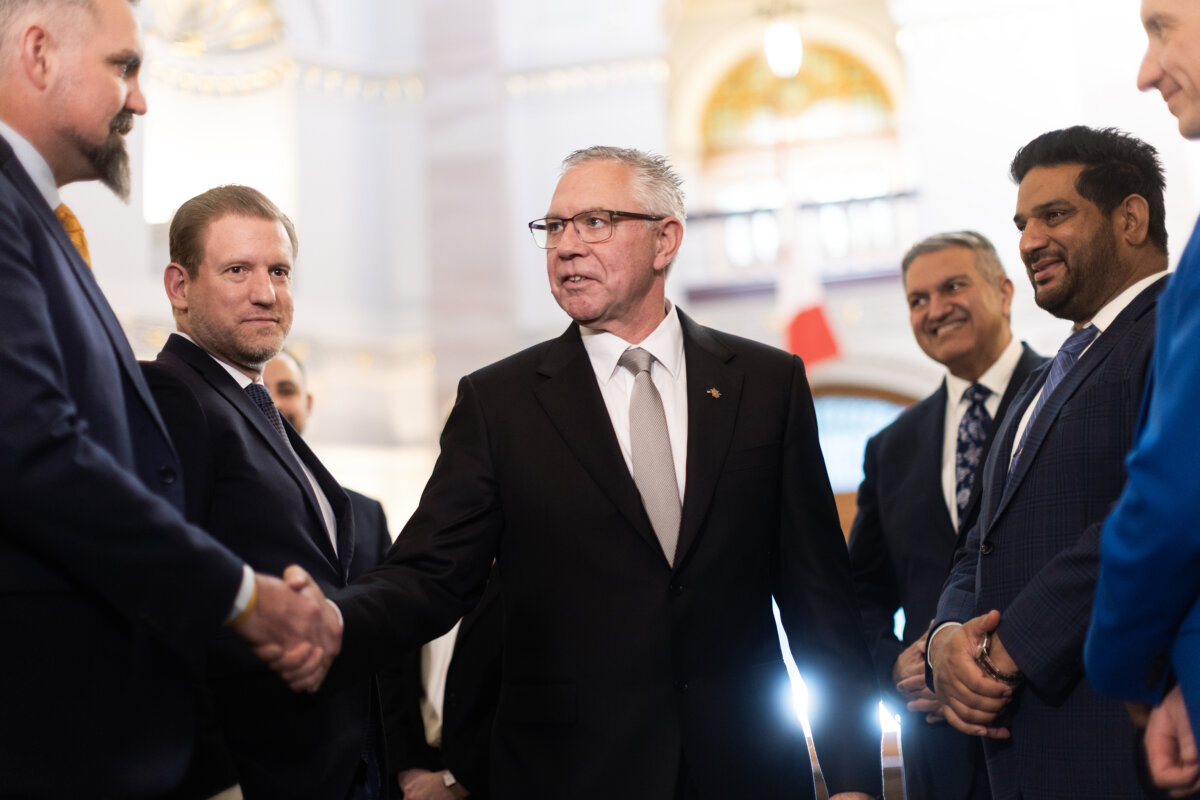

Lorne Doerkson was sworn in as British Columbia’s 38th premier on Nov. 20, taking the helm of a new Conservative government and unveiling a cabinet smaller than that of the outgoing NDP government.
The new cabinet was sworn in during a ceremony at Government House in Victoria on Nov. 20, with Lt.-Gov. Wendy Cocchia administering the oaths of office.
Doerkson said his government would work for all British Columbians, move quickly to deliver on its election promises and remain accountable for its decisions.
He also said the government would work with municipalities, elected officials and First Nations, while travelling across the province to hear residents’ concerns.
“Our goal is to make British Columbia the most prosperous province in Canada, where our children don’t have to leave to find opportunity, because they can build a good life and a family right here in this beautiful province,” he said.
The Conservatives won 64 seats in the Oct. 24 provincial election, their largest caucus in more than 25 years, although two ridings remain subject to a judicial recount. The party’s victory marks its return to power in British Columbia for the first time since 1933.
Doerkson’s cabinet comprises 25 members, including the premier, compared with 28 in the cabinet appointed by former premier David Eby following the 2024 election.
Around half of the Conservative caucus is new to the legislature, with only one member previously holding a cabinet role.
Cabinet
B.C. Premier Lorne Doerkson has appointed 18 ministers and six ministers of state to his new cabinet, compared with 23 ministers and four ministers of state in the previous NDP government.
Caroline Elliott was named attorney general, while Claire Rattée was appointed minister of social development and deputy premier. Peter Milobar will serve as finance minister, and Jessy Sahota was named minister of public safety and solicitor general.
Other appointments include Á’a:líya Warbus as environment minister, Ian Paton as agriculture minister, Scott McInnis as minister of indigenous relations and reconciliation, and Trevor Halford as minister of transportation and infrastructure.
Kristina Loewen was named minister of children and family development, Bruce Banman will oversee citizens’ services and technology, and Gavin Dew was appointed minister of economic development and tourism.
Lynne Block was named minister of education and child care, Larry Neufeld will lead the energy, mines and petroleum resources portfolio, Kiel Giddens was appointed forests minister, and Ryan Peterson will serve as health minister.
Other appointments include Cathie Ounsted as minister of local government, housing, sport and culture; Korky Neufeld as minister of post-secondary education and labour; and Donegal Wilson as minister of water, land and natural resource operations.
Six ministers of state were also appointed: Carson Binda for red tape reduction, Anna Kindy for rural development, Pete Davis for mining, Zeeshan Wahla for housing, Harman Bhangu for labour, and Ward Stamer for emergency management.
Doerkson also appointed 12 parliamentary secretaries to oversee specific files. They include Rosalyn Bird for armed forces and veterans affairs, Margareta Dovgal for children and youth with special needs, Steve Kooner for the Insurance Corporation of British Columbia, Misty Van Popta for infrastructure, Megan Knight for Metro Vancouver and Tracy St. Claire for rural health.
The remaining parliamentary secretaries are Sharon Hartwell for seniors, Mandeep Dhaliwal for sport and culture, Sacha Peter for technology and innovation, Jody Toor for tourism, Harj Dhaliwal for TransLink, and Bryan Tepper for urban policing.
Doerkson has said there will be no fall legislative session, to give his new cabinet members time to familiarize themselves with their portfolios. Ministers will begin work on the government’s priorities and prepare a legislative agenda for the spring.
Government Agenda
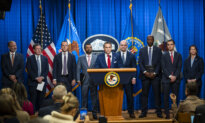
Speaking to reporters following his swearing-in ceremony on Nov. 20, Doerkson outlined some of his government’s priorities.
He said he would introduce legislation during the spring session to raise the basic personal income tax exemption to about $32,000. He said he hoped the change could be backdated to Jan. 1, 2027, although he was unsure whether that would be possible.
“People are going to pay less taxes here. I am absolutely committed to that,” he said.
Doerkson also reaffirmed his campaign commitment to repealing B.C.’s Declaration on the Rights of Indigenous Peoples Act (DRIPA), arguing that the legislation had failed to resolve disputes involving First Nations.
Asked whether his government would introduce replacement legislation mirroring DRIPA, he said it would not. He argued that progress with First Nations should instead come through “genuine conversation, respect and partnerships,” including economic partnerships.
Doerkson said his cabinet would discuss the province’s sexual orientation and gender identity (SOGI) education resources the following week, but did not confirm whether his government would repeal them. He said announcements about the government’s initial priorities would also come next week.
On economic development, the premier reiterated his campaign commitment to establish a 120-day approval process for projects worth more than $250 million. He said the government also wanted to reduce red tape holding up developments, including housing subdivisions.
Asked about B.C.’s projected $14.1 billion deficit, Doerkson said his party’s plan had anticipated bringing the figure down to about $10.8 billion. However, he said he was unsure whether the $14.1 billion projection would remain unchanged and that his government would have a better understanding of the province’s finances the following week.
He said economic growth was necessary to improve the province’s financial position, adding that residents could not afford further tax increases.
On public safety, Doerkson was asked about his party’s promise to eliminate supervised consumption sites. He said he intended to work with municipalities and would take direction from councils that believed a different approach was preferable. He said that the sites had been associated with crime and other problems in communities.
The premier said his first order of business would be a cabinet meeting, where he planned to discuss several matters and consider orders in council.