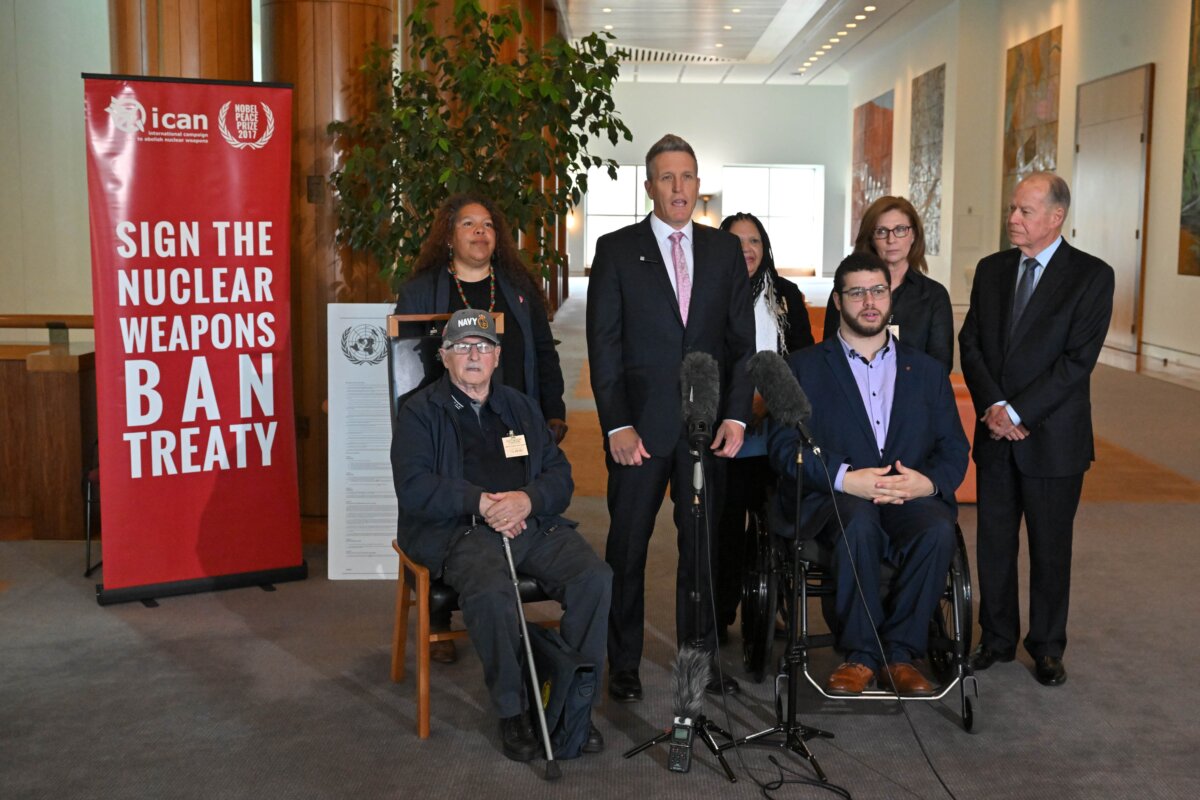

The Albanese Labor government is under mounting pressure to live up to an election promise and sign a United Nations treaty banning nuclear weapons.
A group of independent parliamentarians including David Pocock, Allegra Spender, Helen Haines, Andrew Wilkie, and Zali Steggall have called on Prime Minister Anthony Albanese to honour Labor’s promise to sign the United Nations Treaty on the Prohibition of Nuclear Weapons (TPWN).
The UN treaty, which was adopted in 2017 and came into force in 2021, has been signed by 97 nations.
Signatories are prohibited from developing, testing, producing, acquiring, possessing, stockpiling, using, or threatening to use nuclear weapons.
The lawmakers urged the Labor government to sign the treaty “without delay.”
“We urge the government to advance its signature and ratification of the ban treaty without delay, to bring Australia in line with our Southeast Asian and Pacific island neighbours, and the international majority on the illegality of nuclear weapons,” they said in a statement.
“This is something we can, and must do.
“Every nuclear weapon that exists is a humanitarian catastrophe waiting to happen … Nuclear weapons do not promote security, they undermine it.
“We don’t accept the everlasting presence of these weapons. We must all work to put them in the past.”

Australia, with a long-standing commitment to reject nuclear weapons, has signed the Treaty on the Non-Proliferation of Nuclear Weapons (NPT) in 1970. Labor first committed to further sign the TPWN at its National Conference in 2018. It reaffirmed the commitment in 2021 and in 2023.
However, the TPWN is opposed by Australia’s closest ally, the United States, among other countries equipped with nuclear weapons.
AUKUS Not Break of Promise
In September 2021, Australia signed the trilateral security pact with the United States and United Kingdom (AUKUS), which is to equip Australia with at least eight nuclear-powered submarines to enhance its ability to deter threats and maintain stability in the Indo-Pacific region.
Australia’s Defence Department said that the AUKUS security pact would not lead to the greater proliferation of nuclear material, as the “nuclear” aspect of the submarines pertained only to propulsion, rather than weaponry.
Edward Obbard, the nuclear engineering program coordinator at University of New South Wales (UNSW), supports this view.
“I think we have to overcome this idea that everything called nuclear is the same—such as nuclear energy, or nuclear submarines, or nuclear medicine, or nuclear weapons—because it really isn’t,” he said at a UNSW panel discussion in 2022.
Prof. Obbard argued that “nuclear weapons are totally different to pressurised water reactors” and “require very, very large national infrastructure that is also very, very expensive.”
“The only way that any country obtains nuclear weapons is by making a very, very clear decision right from the start that that’s what they want. You simply can’t stumble into that position,” he said.

The first meeting of TPNW States Parties took place in June 2022 in Vienna, Austria, while a second meeting of countries will take place from Nov. 27 to Dec. 1 at the UN headquarters in New York.
Foreign Affairs Minister Penny Wong said in April the TPNW was “of substantial normative value.”
“In terms of the TPNW, I think the fact that so many states have signed it demonstrates the frustration that there has been insufficient progress in the context of the NPT, and if this can spur more progress in that arena, that is a good thing,” she said in a National Press Club address.
“Labor has a proud history of championing practical international non-proliferation and disarmament efforts, having ratified the Treaty for the Non-Proliferation of Nuclear Weapons—and will ensure we continue to meet its obligations to the highest and most rigorous standards.”







