
PARIS—“The thing is, when I’m throwing rocks, I can’t be snapping,” a 21-year-old accused of participating in the Oct. 17 Paris riots said in a Snapchat voice message. “I’m in the heat of the action, I can’t show it.”
As the recording was played at the Paris criminal court on Oct. 21, Ryad K. told the court he had said it “just like that,” to say he “did nothing.”
The presiding judge replied that his choice of words was “nonetheless telling.”
Four days after the worst urban violence France had seen in years, the Paris courthouse was still working through the arrests. Police officers brought in one defendant after another, in a courtroom packed with journalists, relatives, and members of the public.
Nationwide, some 2,500 people had been taken into custody between Oct. 17 and Oct. 21, 917 of them referred to prosecutors and 174 jailed, according to French Justice Minister Gérald Darmanin.
In Paris alone, about 300 suspects had been referred to prosecutors by Oct. 20, and the court had doubled its daily fast-track hearings, known as immediate appearances, from two to four.
‘It Was for a Laugh’
Ryad K., a French citizen of North African descent with no criminal record, works as a security guard. He told the court he had come up to Paris from the south of France to “pick up some things.”
The judge asked why he had made the trip at a time when, in her words, “even foreigners are being advised not to come to Paris anymore because it is so dangerous, because the image being projected of [the] city, of [France], is so disastrous.”
The court went through videos of Ryad K. that were taken with his phone and recovered by police.
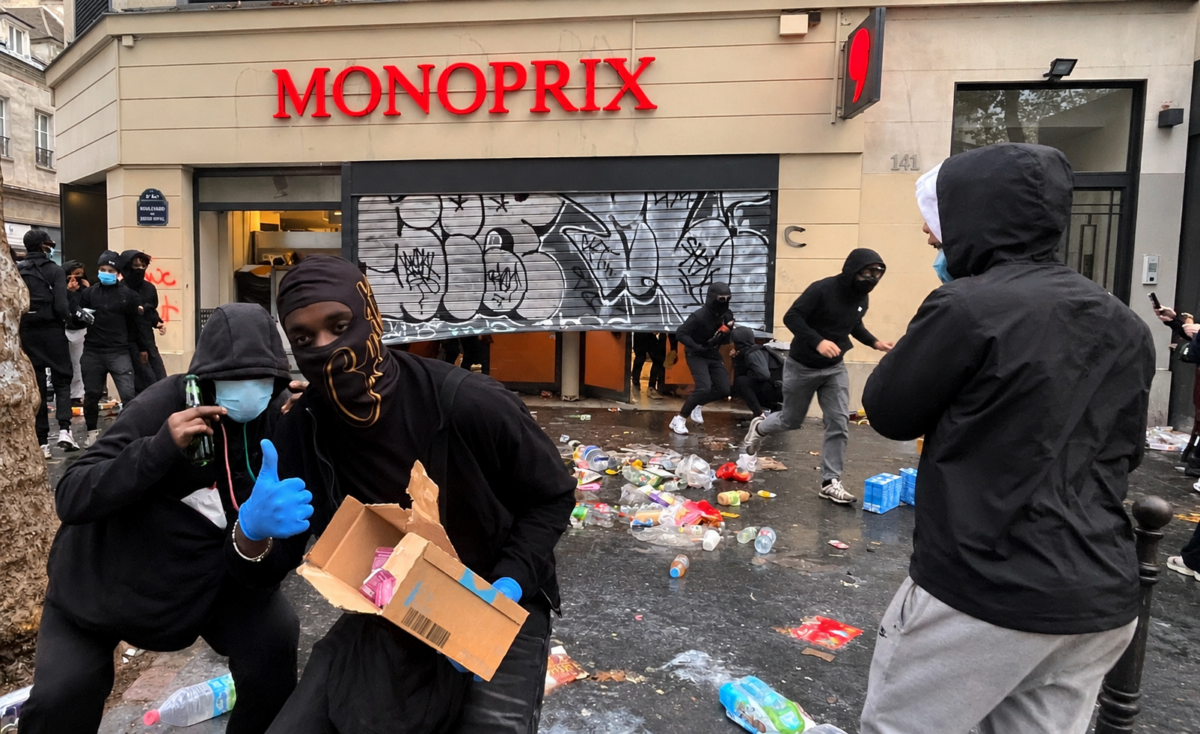
In one video, he cheers as a group of men loots a Monoprix supermarket. In another, he says, “Wallah, it’s going to hit the Louvre,” before another video in which he is seen heading to the famous museum.
In one social media message, he wrote, “[The police] can’t find us—we’re too well organized.”
Asked whether he took pleasure in seeing “delinquency prevail over respect for others and for other people’s property,” he said that his comments were a joke and were “for a laugh.”
He admitted to throwing a shoe “in the direction of the police” but denied aiming at the officers. He also said that the balaclava he wore was actually a neck warmer and that he inflated his role in the riots in his social media messages in order to project a certain image.
“Hearing a security guard tell me ‘I got caught up in a crowd effect’ worries me,” the prosecutor said. “We were appalled to see the images of what Paris has become. We are the laughingstock of the world and the shame of this country.”
The prosecutor requested an 18-month prison sentence, with 12 months suspended.
Ryad K.’s lawyer portrayed his client as an immature young man who regretted his actions.
“He is into bravado, building a character,” the lawyer argued.
“At that age, you haven’t yet learned all the social norms that allow people to live together harmoniously.”
He described the prosecution’s sentencing request as “disproportionate” and urged the judges not to “judge in the heat of emotion.”
The court ultimately sentenced Ryad K. to 100 day-fines of 150 euros ($168) each, amounting to 15,000 euros ($16,830), with imprisonment possible if the fines go unpaid. He also received a criminal conviction and a two-year ban from Paris.
Other cases heard that day concerned looting and vandalism at stores including Foot Locker, Louis Vuitton, and Coach, as well as insults and assaults directed at police officers.
Most defendants contested the accusations against them. Among those observed by The Epoch Times, all were either French citizens of North African or sub-Saharan African descent or foreign nationals from those regions.
Immigration Enters the Debate
The profile of the rioters has become part of a political debate over who was behind the Oct. 17 violence. The French right has blamed the ultra-left for setting it off, but it has also pointed a finger at people from immigrant backgrounds.
U.S. President Donald Trump also weighed in on the debate.
“France is burning!” he wrote on Truth Social on Oct. 18, blaming “the immigration of people from an entirely different world” and urging France to close its borders.
The following day, he described France as being “conquered, looted and burned to the ground by migrants, jihadists and communists,” stating that the unrest was about “immigration, not schools.”
French President Emmanuel Macron pushed back sharply against the claims during a visit to Doha, Qatar, on Oct. 21.
He condemned what he called “unacceptable and even stupid” remarks by foreign leaders who, he said, were “campaigning at France’s expense.”
“We have people who have claimed that we were invaded by hordes of migrants and Islamists, which is totally false,” Macron said.
Macron confirmed when pressed by reporters that Trump was among those he was talking about.
“All the people who are speaking ill of our country right now are people who do not love our country,” the French leader said.
Macron has instead attributed the violence to “factious elements from ultra-left splinter groups, joined by many delinquents.”
Facing criticism over its handling of the unrest, the French government is now counting on the judicial response to send a message to would-be looters ahead of another round of protests planned for Oct. 24.
“Our judges render justice in your name, and they know what you expect,” Macron told the French public in his Oct. 18 address.
Darmanin has called on prosecutors to show a “greatest firmness” to those involved in the violence.
However, defense lawyers told The Epoch Times that the rush to hold fast-track hearings for hundreds of defendants risks a judicial approach that doesn’t take into account each defendant’s individual actions and could involve prosecuting some on circumstantial evidence.
The government “clearly” wants to show that something is being done about the looters, even if it leads to “hasty judgments,” lawyer Julié told The Epoch Times. Lawyer Delage said that the government was operating a “numbers policy.”
Nevertheless, some of the first sentences handed down have prompted accusations of excessive leniency.
Darmanin told French broadcaster CNews on Oct. 20 that he was “not satisfied” with some of the rulings and had asked prosecutors general to appeal them.