

Budget 2026 proposes simplifying how Canadians manage their retirement savings by eliminating the requirement to convert registered retirement savings plans (RRSPs) into registered retirement income funds (RRIFs) at age 71.
The proposal, included in the federal budget tabled on Nov. 5, would create what Ottawa calls an “RRSP for life.” You could keep your existing account while continuing to make mandatory withdrawals after age 71.
The move would reduce your paperwork, but it wouldn’t change the minimum amount you must withdraw each year, and those withdrawals would still be taxable.
But the budget doesn’t explain how the proposed changes would affect pension income splitting, tax withholding and existing RRIFs. Those details could affect how much retirement income you keep.
What’s Actually on the Table
Under current rules, you must wind up your RRSP by Dec. 31 of the year you turn 71. Most people convert their savings into an RRIF, while others buy an annuity or withdraw the balance as taxable income. An RRIF requires a minimum annual withdrawal starting the year after it’s opened.
Under the proposal, the conversion requirement would disappear. You could keep your RRSP, but the mandatory withdrawal rules after age 71 would remain in place. That would mean avoiding new account forms, investment instructions and potential transfer delays.
The budget doesn’t propose changing the contribution deadline, so contributions still stop at the end of the year you turn 71. The minimum withdrawal rules after 71 would also stay the same.
It’s not yet clear when these changes would take effect. The Finance Department is taking submissions on the proposal until Jan. 8, 2027. Parliament would have to pass legislation, and details could change before they take effect.
Minimum Withdrawals Would Remain
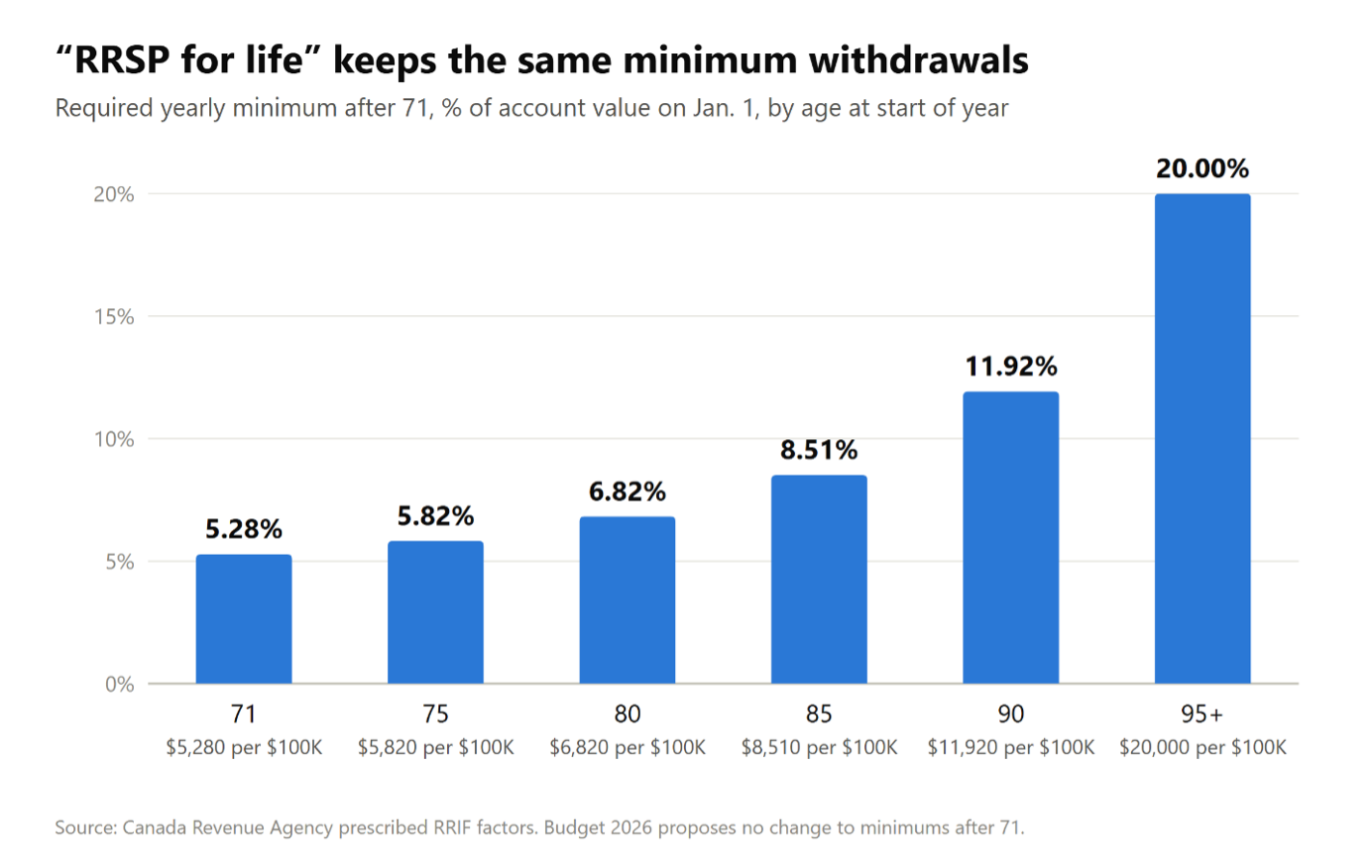
Under current RRIF rules, your minimum annual withdrawal is calculated as a percentage of the account’s value on Jan. 1. The percentage rises with age.
If you’re 71 at the beginning of the year, the minimum is 5.28 percent. It increases to 6.82 percent at age 80 and 11.92 percent at age 90. From age 95 onward, the minimum is 20 percent.
For example, if you’re 71 and have $400,000 in a RRIF at the beginning of the year, you would have to withdraw at least $21,120.
Under the proposal, you would still have to withdraw the money and pay tax on it. You would simply face less paperwork.
Pension Income Splitting Rules Unclear
Once you’re 65, RRIF payments generally count as eligible pension income. You can allocate up to half to your spouse or common-law partner for tax purposes, and you may be able to claim the federal pension income amount on up to $2,000 of qualifying income.
Ordinary RRSP withdrawals don’t qualify. That’s why some couples open an RRIF at 65, years before they have to.
If RRIFs stop being separate accounts, it’s unclear how pension income splitting would work. The budget doesn’t address the issue.
Until it does, don’t delay opening an RRIF at 65, on the strength of the proposal. For a couple with unequal incomes, splitting can be worth thousands of dollars a year, and more if it keeps the higher earner’s Old Age Security from being clawed back.
Tax Withholding
Minimum RRIF withdrawals are not subject to withholding tax, although they’re still taxable. Outside Quebec, RRSP withdrawals and RRIF withdrawals above the minimum are generally subject to withholding tax of 10, 20 or 30 percent, depending on the amount withdrawn.
The budget doesn’t explain how withholding would work under the proposed RRSP for life.
Existing RRIFs
It isn’t clear whether accounts that have already been converted would change or whether the new rules would apply only to people who turn 71 after they take effect.
If you’ve already converted your RRSP into an RRIF, the proposal doesn’t require you to take any immediate action. The minimum withdrawal rules would remain unchanged.
A Proposed Change for Surviving Spouses
The budget also proposes letting a surviving spouse or common-law partner become the successor holder of an RRSP. The account could stay open until the surviving spouse dies, without its value being included in the deceased holder’s income at death.
The budget says details are still being worked out, so this part is less settled than the age-71 change.
Under current rules, an RRSP left to your spouse can generally be transferred without immediate tax consequences, provided certain requirements are met. However, the transfer involves administrative steps.
If you have an RRIF, you can already name your spouse or common-law partner as successor annuitant, allowing the account to continue after your death.
It’s worth checking whether your spouse is named as a beneficiary or successor annuitant. Ask your institution which designation you have and whether a change makes sense.
A Change for Retirees Living on Minimums
Retirees whose income has no tax withheld, often because they live mostly on RRIF minimums and government pensions, can get caught by quarterly instalments. Right now, the Canada Revenue Agency asks for them when your net tax owing is more than $3,000 this year and in either of the previous two years.
The budget proposes raising that threshold to $7,500, starting with the 2028 tax year. For a retiree who owes a few thousand dollars each spring, that could mean one payment at filing time instead of four quarterly ones.
What to Do Now
-
Turning 71 this year? Convert or wind up your RRSP by Dec. 31 under the current rules. The proposal isn’t law.
-
Contributing? Make any final RRSP contribution by Dec. 31 of the year you turn 71. If your spouse is younger and you still have room, you can keep contributing to a spousal RRSP until the end of the year they turn 71.
-
Between 65 and 71? Have your accountant price an RRIF for pension splitting under today’s rules.
-
Already have an RRIF? Check whether your spouse is named as successor annuitant or only as beneficiary.
-
No tax withheld? Note the higher instalment threshold, if it’s passed, from 2028.
The views and opinions expressed are those of the authors. They are meant for general informational purposes only and should not be construed or interpreted as a recommendation or solicitation. The Epoch Times does not provide investment, tax, legal, financial planning, estate planning, or any other personal finance advice. The Epoch Times holds no liability for the accuracy or timeliness of the information provided.