
PARIS—France will build its own strategic stockpiles of rare earths, as the Macron administration considers that the European Union is not moving fast enough to reduce its dependence on China.
President Emmanuel Macron presented the plan on Nov. 23 at a closed-door meeting with industry leaders, and called on the European Commission to “move in the same direction.” Paris decided to move ahead, judging Brussels too slow to act, French daily Le Figaro reported.
The Commission said in December 2025 that an EU stockpiling pilot would be operational in early 2026. It opened the selection of an operator for that pilot in September.
Modeled on strategic oil reserves, France’s stockpiles will be managed by state-owned Caisse des Dépôts and cover about 20 of the 34 raw materials the EU considers critical. To continue receiving public aid, defense, aerospace, and automotive manufacturers will have to outline plans to diversify their suppliers and reduce their reliance on China.
Gérard Vespierre, a French geopolitical analyst and researcher, told The Epoch Times that France’s decision “is a positive move that will make sure that Europe speeds up.”
Emmanuel Dupuy, president of the Institute for European Perspective and Security Studies, said in an interview with The Epoch Times that Macron wants to take the issue “out of a purely administrative logic” of tenders and lengthy purchasing procedures. “We therefore have to extend and step up this effort, and go faster,” Dupuy said.
Advisory Council Backs Franco-European Model
On Nov. 25, France’s Economic, Social and Environmental Council, a constitutional advisory body often described as the Republic’s third assembly after the National Assembly and the Senate, voted 129–0 in favor of combining national reserves with a shared European stockpile.
The opinion argues that a stockpile kept solely at the national level for every material would be expensive and not very effective.
Sylvain Boucherand, a member of the council’s Environment and Nature group who coauthored the opinion, told French broadcaster Radio Classique that the presidential plan “shows the way forward” but that everyone in Europe would need to be brought on board.
“There will be no sovereignty [in Europe] without rebuilding refining, processing, and recycling capacity in France,” the opinion argues.
How the West Offshored Refining to China
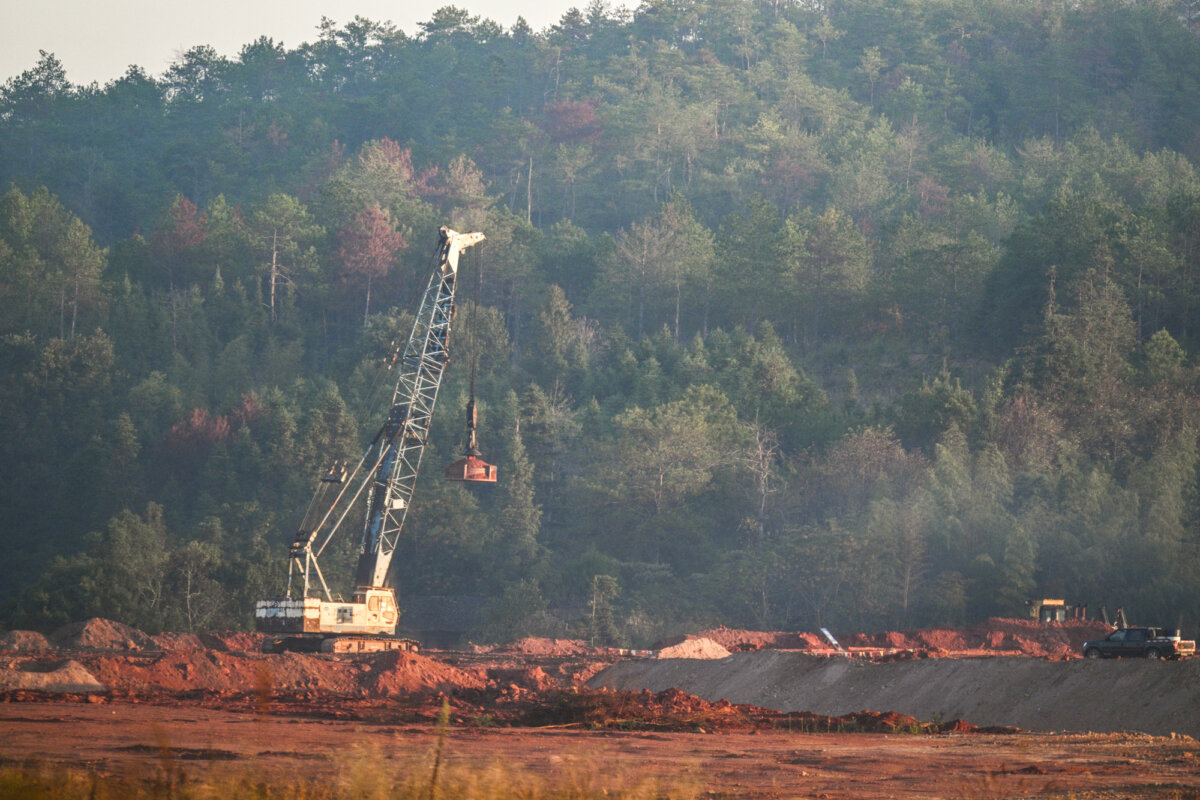
China accounts for about 60 percent of global rare earth production and an estimated 91 percent of refining, according to the opinion. The EU obtains all of its heavy rare earths and 98 percent of its permanent magnets from China.
For both economic and environmental reasons, European countries began in the 1990s to shift rare earth extraction and processing to countries with cheap labor and looser environmental rules, chiefly China, an annex to the opinion states.
In France, a Rhône-Poulenc chemical plant in the Atlantic port of La Rochelle processed monazite, a rare earth ore containing radioactive thorium, until 1994. According to the French Court of Accounts, it accounted for 50 percent of global production and exported 90 percent of its output.
However, environmentalist groups and local left-wing politicians strongly protested the facility’s activities, and the company ultimately gave up the ore for environmental reasons. Its successor, Solvay, later set up rare earth production and separation in China, according to a 2016 parliamentary report.
In the United States, California’s Mountain Pass was for decades the world’s leading rare earth mine. However, after leaks of mildly radioactive wastewater into the Mojave Desert brought regulatory action in the 1990s, mining was suspended in 2002 and processing shifted to China, which did it at lower cost.
“The problem is not that China holds immense resources in its rare earth mines,” Vespierre said. “You have rare earths in Australia, in Canada, in France, pretty much everywhere. The problem is refining.”
“China now refines 90 percent of the world’s output,” Dupuy said.
He said that bringing refining back to French soil would set off local battles.
“French political authorities in a position to decide are always very careful to take into account the leaders of associations, who look very unfavorably on the installation of these plants,” he said.
He drew a parallel with the debate over shale gas and oil in France. “There too, environmentalists had mobilized to say that it was out of the question,” he said.
Philippe Chalmin, a French economic historian at Paris-Dauphine University and a specialist in commodity markets who has been heard several times by French parliamentary commissions of inquiry, said in an interview with The Epoch Times earlier this year that the West’s predicament was largely self-inflicted under pressure from environmentalist groups.
Whether in the United States or France, “the same Greens who advocate the use of electric bicycles to combat climate change, without questioning how the batteries that power them are manufactured, constantly put up obstacles,” Chalmin said.
The West has “put its head on the Chinese chopping block, and it will have the greatest difficulty in pulling it out,” he added.