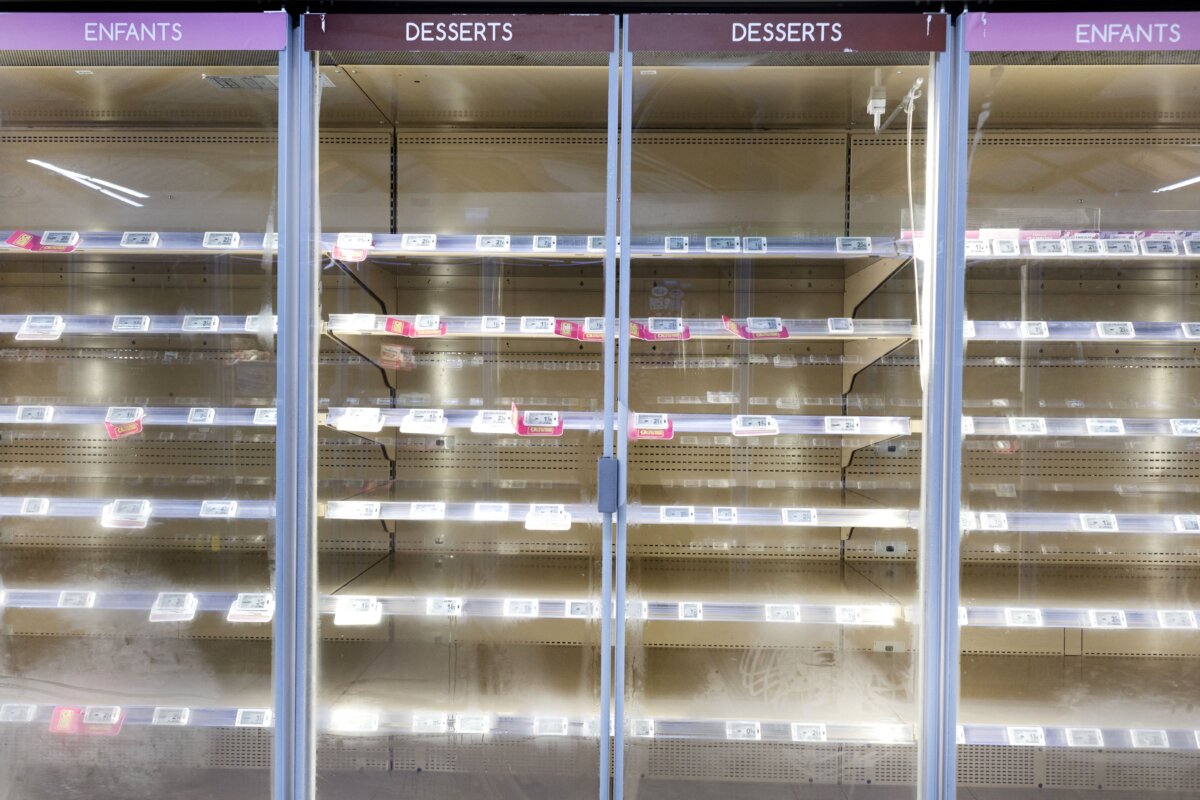

France has blamed Iran’s Islamic Revolutionary Guard Corps for last month’s cyberattack on refrigerators in hundreds of supermarkets, calling it an “unprecedented campaign in terms of its scale and level of aggressiveness.”
The French Ministry for Europe and Foreign Affairs said in a Nov. 9 statement that the attacks on the night of Oct. 11 to Oct. 12 that targeted supermarket refrigeration controllers affected some 700 major retail locations across France.
The ministry said it has identified the Shahid Kaveh cyberoffensive unit, affiliated with the electronic and cybercenter of Iran’s Islamic Revolutionary Guard Corps, as being behind the attack.
“France condemns in the strongest possible terms the unacceptable cyberattacks carried out on its territory by the Islamic Republic of Iran against its interests,” the ministry said.
It added that Paris will be asking partners in Europe to back new sanctions against Iranian entities and individuals.
French Minister of Foreign Affairs Jean-Noël Barrot told reporters on Nov. 9 that the attack was “of unprecedented scale and aggression.”
“It is the first large-scale cyberattack aimed at sabotage on national territory, and it is a major attack on the interests of the nation and the security of French men and women,” Barrot said.
Iranian officials have not commented on the allegations. The Iranian government did not respond to a request for comment by publication time.
October Cyberattacks
In the October cyberattacks, hackers remotely took control of refrigeration systems in 700 of France’s 10,000 supermarkets, forcing temperatures to rise.
The French Ministry for Europe and Foreign Affairs said in its Nov. 9 statement that the attacks caused “considerable material damage” and fires, as well as food losses estimated at tens of millions of euros.
These cyberattacks “represent a major threat to the interests of the nation and the safety of the French people,” the ministry said.
It called the attacks unjustifiable and inexcusable, saying that they violated international law.
“They also contravene the principles of the United Nations’ normative framework for responsible state behavior in cyberspace, to which the Islamic Republic of Iran has subscribed,” it said.
Recent Cyberattacks
Europe has seen a series of cyberattacks in recent months, including this past week, when several supermarket chains were hit by attacks against their refrigeration units, causing food to spoil.
A French blood bank was also targeted last week, although the French Blood Establishment said that the affected equipment was brought under control and that no blood products or samples were affected or ruined.
On Nov. 7, Italian Minister of Foreign Affairs Antonio Tajani said pro-Russian actors had leaked his personal data on the dark web.
The minister did not blame the Russian government directly.
“I said the hackers are pro-Russian,” Tajani said. “I did not say that the Russian government is responsible. If I had proof of Russian government involvement, I would say so.”
The following day, Tajani confirmed that the issue of the recent cyberattacks in Europe would be discussed at the G7 meeting of foreign ministers on Nov. 9 and Nov. 10 in Paris.