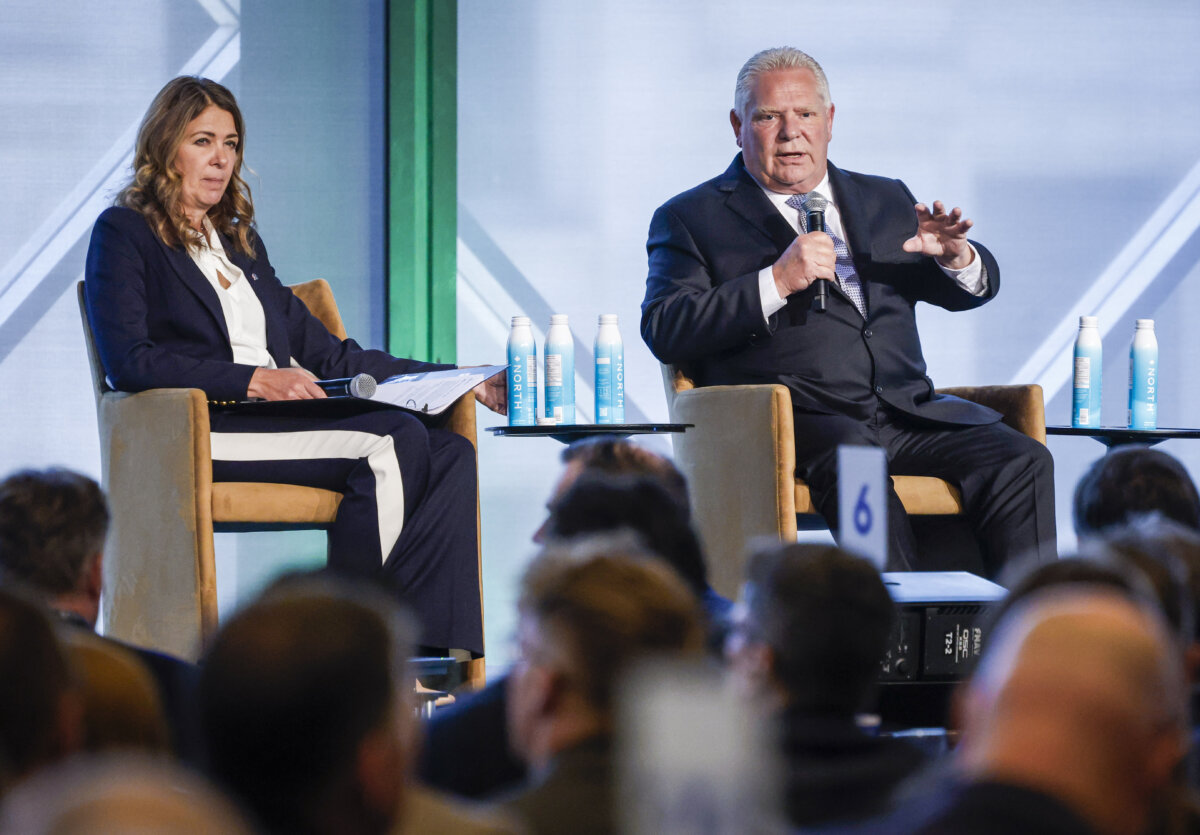

Ontario Premier Doug Ford says his province would help partially fund construction of the proposed Northern Shield pipeline, which would carry crude oil from Alberta to Ontario.
Ford made the announcement Sept. 28 alongside Alberta Premier Danielle Smith during an energy summit in Calgary.
“Our government is ready to step up with the capital necessary to build the Northern Shield pipeline,” Ford said, referring to a proposal he announced with Smith in July.
The proposed project would see a 3,300-kilometre pipeline transport oil from Western Canada to refineries in southern Ontario.
The west‑to‑east crude oil pipeline, dubbed the “Northern Shield Energy Corridor,” would extend from the town of Hardisty in east-central Alberta through Regina and Winnipeg to Sarnia, a city in southwestern Ontario. Sarnia is home to the largest oil refinery in the province.
The proposed pipeline would carry roughly 500,000 barrels of oil per day and could expand to 800,000 barrels per day.
Ford told those attending the forum that the project would create thousands of jobs while also aiming to protect Canada’s energy and economic sovereignty.
He added that governments need to streamline and speed up approvals so major projects have regulatory certainty for investors.
Smith said during the forum’s Q&A session that she felt “more and more confident” that various energy infrastructure projects would come to fruition, with the West Coast oil pipeline potentially being the first.
She said the federal government must build that pipeline first because it can help offset the challenges posed by the closure of the Strait of Hormuz, and show other countries that Canada is a secure energy supplier.
Alberta is partnering with the federally owned Trans Mountain Corp. and Pembina Pipeline on the West Coast oil pipeline project, which would start at a terminal northeast of Edmonton.
Smith and Prime Minister Mark Carney announced an agreement on July 2 that they said would advance the pipeline to the southern coast of B.C. while pairing it with a carbon capture system.
Smith said at the time that the agreement represented a step toward realizing Alberta’s oil reserve wealth and its goal of doubling production to 8 million barrels per day in the next 10 to 15 years.
Smith said during the forum that the Northern Shield Pipeline could happen faster than anticipated, considering Ford “has a pretty strong ambition to get that one done.”
Ford said Canada needs pipelines going in every direction and construction of the projects should happen simultaneously. He said that if former Prime Minister Sir John A. Macdonald could build a nation-spanning rail line in four years in the 1880s, then Canada should be able to build a pipeline much faster with current technology.
Smith also highlighted the South Bow and Bridger Pipeline, which she said could begin construction in 2027. She said the pipeline could carry 550,000 barrels of oil per day, while its proponents believe it can carry up to one million. She noted that the pipeline would require co-ordination between Canada and the United States.