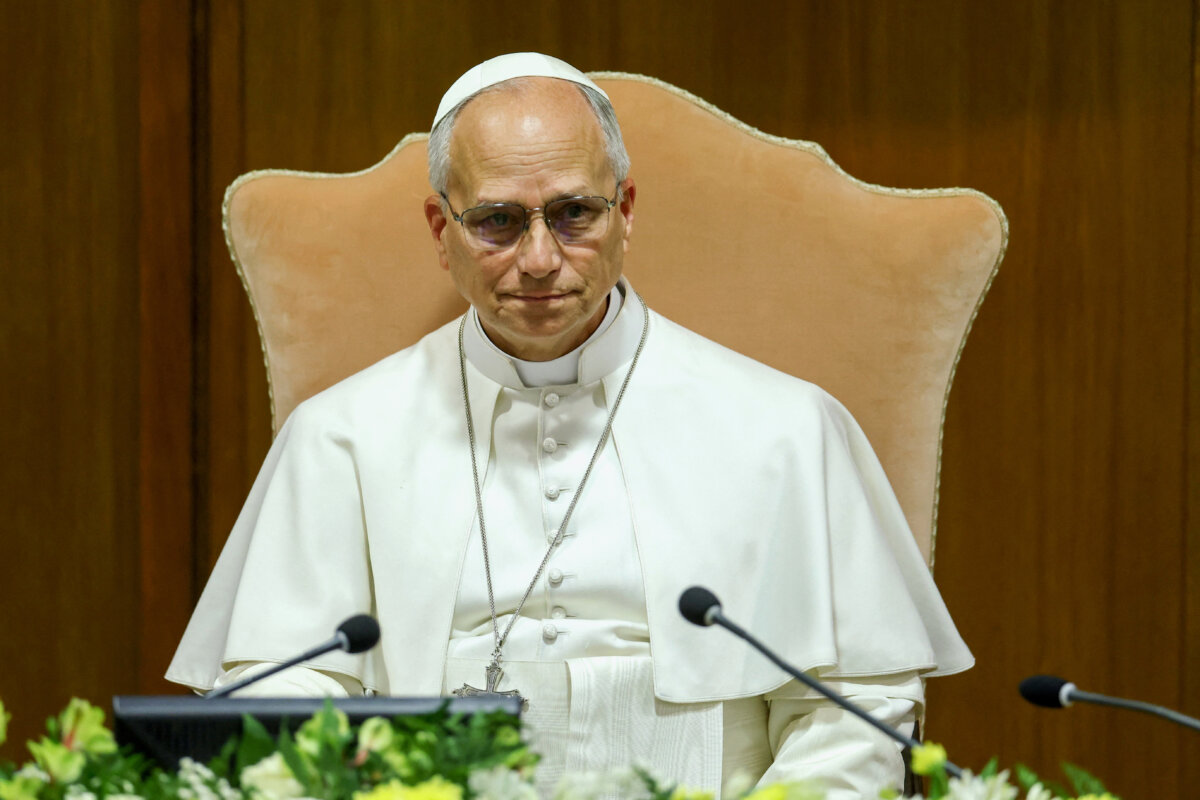
PARIS—Pope Leo XIV wrapped up a four-day visit to France on Sept. 28. During his visit, the pontiff drew an estimated 800,000 people to an open-air Mass in the heart of Paris, defended the right to life before President Emmanuel Macron two months after France legalized assisted suicide, and used the trip to outline his vision for Europe.
The visit, the first official papal trip to France in 18 years, brought the first American pope to Paris, Lourdes, and Metz.
His Sept. 26 Mass at Place de la Concorde was one of the largest gatherings of the trip.
According to the Vatican, attendance exceeded registrations by roughly 200,000, with crowds packing the Champs-Élysées and stretching beyond the Arc de Triomphe.
“A total success, without a single false note,” Louis Daufresne, editor-in-chief of the Paris Catholic radio station RCF Notre Dame, told The Epoch Times. “He was both very tender with the crowds and very firm with the government and President Emmanuel Macron.”
A Secular Republic With Catholic Roots
France is officially a secular republic, but its history is deeply intertwined with Catholicism.
The 1905 law separating church and state established the country’s secular framework. At the same time, France has traditionally been referred to by Rome as the “eldest daughter of the Church,” a title associated with the baptism of Clovis, king of the Franks, at Reims around 496.
Macron stayed away from the ceremonies in Paris and Lourdes. Prime Minister Sébastien Lecornu and First Lady Brigitte Macron represented him at the Place de la Concorde Mass. The president later rearranged his schedule to attend the pope’s final Mass in Metz.
Marine Le Pen, the National Rally’s candidate for next spring’s presidential election, was among those attending the Paris Mass, alongside other figures from the French right.
For Daufresne, the visit also highlighted a contrast in style between Leo XIV and his predecessor, Pope Francis, who traveled to Marseille and Corsica but never made an official visit to France.
“In style, attitude, and language, there is a rupture,” Daufresne said. “Francis was a fighter who charged in headfirst. Leo XIV is the exact opposite, with a will to calm things down.”
The Right to Life at the Élysée
On the first morning of his visit, Leo addressed Macron and other French political leaders at the Élysée Palace, telling them he was “concerned” by trends “promoting genetic manipulation, surrogacy, the trade in human organs or the possibility of arranging one’s own death.”
His remarks came two months after the French parliament, despite opposition from French bishops, passed legislation legalizing assisted suicide.
Alexandre Allegret-Pilot, a National Assembly Catholic member from the Union of the Right for the Republic, a conservative party allied with Le Pen’s National Rally, told The Epoch Times that the pope had arrived at “a somewhat equivocal moment.”
“There is a very strong tension between the Church and France’s leaders over the latest orientations imposed on our country at a forced march, which answer neither a demand from the population nor a real need, but the expectations of unabashed lobbies,” he said.
“On the other hand, we witnessed a genuine desire for communion between France and the pope. That is precisely what France needs today.”
For many French Catholics, the choice of Place de la Concorde for the Mass carried historical significance as it was there that King Louis XVI was guillotined in 1793, during the French Revolution.
Organizers said no other location in central Paris could accommodate a gathering of that size. Critics who favor a strict interpretation of French secularism argued that the square was too closely associated with the Republic and suggested the Invalides, where Benedict XVI celebrated Mass during his 2008 visit, would have been more appropriate.
Leo made no mention of the square’s revolutionary history during his homily. Daufresne said that was, in his view, deliberate.
It “was clever, because celebrating Mass on the Place de la Concorde was already an enormous gesture,” he said.
Louis Alphonse de Bourbon, Duke of Anjou, whom some French royalists regard as the head of the House of Bourbon and the rightful claimant to the defunct French throne as Louis XX, attended the Mass.
Illegal Immigrants
Before celebrating Mass on Sept. 26, Leo visited Maison Bakhita, a Church-run center for illegal immigrants in Paris. There, he spoke about the possibility of “living together in dignity and peace.”
Allegret-Pilot accused the left and far left of “instrumentalizing” the pope’s visit by presenting “his call to treat human beings with dignity” as “a plea for open borders.”
He pointed to other comments from Leo emphasizing the authority of countries to control their borders. The pope said last year that “every country has a right to determine who and how and when people enter.”
Leo returned to the subject two days later in Metz. Welcoming someone, he said, means integrating that person “as if they were part of one’s own family,” while also asking them “to enter into the life of the household.”
He described migration as creating “an unprecedented encounter between peoples and cultures,” one that should lead Europeans “to rediscover our roots in new and creative ways.”
Those remarks came shortly after Leo emphasized Christianity’s place in the continent’s history.
“We cannot speak of Europe without mentioning Christianity,” he said, adding that acknowledging “Europe’s debt to Christianity” should not be understood as “an exclusively religious criterion.”
In Metz
Leo ended his French visit on Sept. 28 in Metz, near the borders with Germany and Luxembourg.
Speaking in French at the city’s Robert Schuman Congress Center, the pope traced Europe’s identity to its Greek, Roman, and Christian heritage. He noted how Benedictine monks helped build schools, hospitals, and legal institutions across Europe, and said Robert Schuman’s Christian upbringing had taught the French Catholic statesman “the value of equality” and “the dignity of work.” The pope also mentioned the war in Ukraine and the question of European security.
“Today, sadly, war has returned, even to Europe,” he said.
Leo urged those involved in peace negotiations “to be willing to give up some positions for the greater good of peace,” while cautioning against “the illusion that rearmament is the answer.”
He concluded by addressing younger Europeans, urging them not to be afraid “to start a family” or “to defend the dignity of every person, from the moment of conception to death.”