
PARIS—Eurozone business activity grew at a steady pace in November, but a deepening downturn in France is clouding the bloc’s outlook, according to S&P Global survey data published on Nov. 23.
Chris Williamson, chief business economist at S&P Global Market Intelligence, told The Epoch Times that the uncertainty created by social unrest and upcoming elections is “a key factor behind what’s going on” in France.
The S&P Global Flash Eurozone Composite PMI Output Index was unchanged at 51.7, a fifth straight month above the 50 mark that separates growth from contraction.
German output rose at its fastest pace since March 2022, while French business activity fell at the sharpest rate in six months, leaving the widest gap in six years between the two economies that together account for nearly half of the entire euro area economy.
France’s composite index fell to 46.2 from 46.6 in October, and S&P Global economist Joe Hayes said in a statement that the data “raised the odds of France entering a technical recession in the fourth quarter.”
Twin Squeeze on Spending
“Households as well as businesses are uncertain about the economic future, and in a situation like that you normally see spending put on hold,” Williamson said. “So you’ve got a twin corporate and household squeeze on spending in France at the moment, which is dampening activity.”
French household confidence fell five points in October to its lowest level since June 2013, according to national statistics agency INSEE.
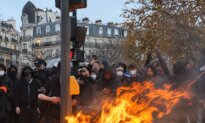
France’s weekly far-left protests began on Oct. 17, when marches descended into riots and looting in several cities. The French government blamed the far-left for the violence.
Spillover Beyond France
Germany faces the same cost-of-living squeeze and political uncertainty, Williamson said, but benefits most from “a backbone of growth in the euro area, which is the AI buildout supplemented by defense spending.”
He said the uncertainty and unrest appear to be spilling over to other economies, notably Spain, where left-wing unions held a general strike on Nov. 11.
“That will dampen eurozone growth, leaving the AI buildout and defense spending with a lot more work to do to maintain the pace of growth we’ve got in the eurozone at the moment,” he said.
‘Structural in Its Root Cause’
Michel Ruimy, an economist and professor at Sciences Po Paris, told The Epoch Times that France’s lag behind Germany is “cyclical in its intensity, but structural in its root cause.”
He cited a chronic public deficit, high debt, very high public spending, complex and costly taxation, dense regulation, a rigid labor market, and insufficient productivity. Public spending stood at 57.3 percent of gross domestic product in 2025, according to INSEE.
“Without credible reform of the state, of taxation, and of the financing of the productive economy, France risks seeing this gap persist, or even widen,” he said.
French business confidence was the second-lowest since the series began in 2012, excluding the COVID-19 crisis, the survey showed. Williamson called that “a major worry, because in that environment you don’t get hiring and you don’t get business investment.”
“Business needs to regain optimism about the future, and until that turns around, you’re not going to see growth pick up,” he said.
Economic Concerns Grow Over Potential Far-Left Victory
France’s 10-year government bond yield rose above 5 percent on Oct. 21 for the first time since 2002 in the context of violent protests, strained public finances, and uncertainty over the April 2027 presidential election.
Both Bank of France Governor Emmanuel Moulin and Amélie de Montchalin, president of France’s Court of Accounts, have warned that the country’s strained public finances could lead to a debt crisis.
A Toluna Harris Interactive poll published on Nov. 23 showed Jean-Luc Mélenchon of the France Unbowed party reaching the runoff in every scenario tested. National Rally candidate Marine Le Pen led a head-to-head contest against him by 65 percent to 35 percent.
Ruimy said that a victory for Mélenchon in 2027 could also have “significant economic consequences, mainly through uncertainty, taxation, and confidence.”
He added that Mélenchon’s far-left economic agenda would likely trigger an immediate reaction from financial markets.
“Investors could demand a higher risk premium on French debt, leading to higher interest rates and costlier financing for the state and for companies,” he said.
Mélenchon has also proposed outright cancellation of the French public debt held by the Bank of France. Speaking to RTL radio on Sept. 11, Moulin described the proposal as “illegal, dangerous, and useless,” warning that it would drive up interest rates.
Investors and the economic world are growing more and more concerned about the prospect of Mélenchon winning the presidential election.
Pierre Gattaz, a French industrialist and former president of Medef, France’s largest employers’ federation, said on BFMTV on Nov. 23 that if the presidential election came down to a runoff against France Unbowed, he would vote “without any hesitation” for Le Pen.
“Le Pen’s platform isn’t good. On the economy, it’s statist,” he said, before calling France Unbowed’s platform “confiscatory and freedom-killing.”
“I’m thinking of Stalin, Trotsky, and Robespierre, whom he [Mélenchon] adores, Chávez, Maduro,” the former head of the employers’ federation said.
“Either far-left dictatorships flopped within a month, which is rare, or you still have North Korea, Cuba, Venezuela.”