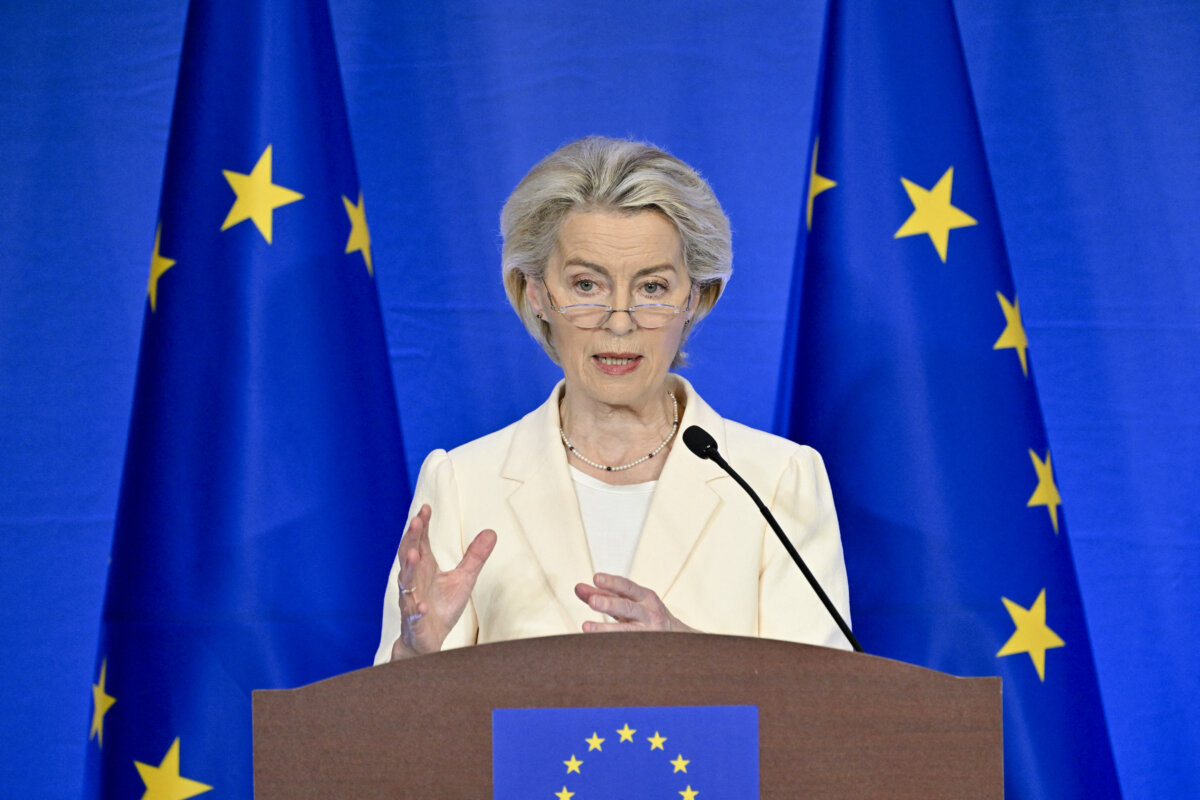

European Commission President Ursula von der Leyen told lawmakers in Strasbourg, France, on Sept. 10 that the bloc’s executive branch plans to suspend parts of its trade partnership with Israel, impose sanctions on certain ministers and settlers, and establish a Palestinian donor group in October with a mechanism for Gaza Strip reconstruction.
For the proposals to take effect, they must be approved by the Council of the European Union, through which national governments make decisions collectively. Trade measures can pass with a qualified majority, but sanctions fall under foreign policy and require unanimous support from all 27 member states, making agreement difficult given the bloc’s divisions over Israel and the Palestinians.
Ireland, Spain, Sweden, and the Netherlands have urged suspension of the EU’s trade pact with Israel, but Germany, Hungary, and the Czech Republic oppose the move.
Von der Leyen said that it would be hard to build a majority in favor of suspending parts of the EU–Israel Association Agreement, which has been in place since 2000.
The EU is Israel’s biggest trading partner. In 2024, about one-third of Israel’s imports came from the EU and nearly 30 percent of its exports went to the bloc.
“I know that any action will be too much for one and too little for others, but we must all take our own responsibility,” Von der Leyen told the lawmakers.
She said that the events in the Gaza Strip and the suffering of children and families have “shaken the conscience of the world.”
The war in the Gaza Strip was sparked when the Hamas terrorist group abducted 251 people from Israel on Oct. 7, 2023, and killed some 1,200 people, mostly civilians. Forty-eight hostages are still inside the Gaza Strip, about 20 of whom are believed to be alive.
According to the Hamas-run Gaza Health Ministry, more than 64,000 people have been killed since the start of the war. The ministry does not differentiate between civilians and combatants in the count. The Epoch Times cannot verify the accuracy of the figure.
The conflict has plunged the territory into a humanitarian crisis, in which Israel, alongside an international effort, coordinates aid initiatives.
While she backed a two-state solution for the region, Von der Leyen expressed her solidarity with Israel after the Oct. 7, 2023, Hamas attacks.
“The hostages have now been held captive by Hamas terrorists for more than 700 days since October 7,” she said. “That is 700 days of pain and suffering.
“There can never be any place for Hamas, neither now nor in future because they are terrorists who want to destroy Israel, they are also inflicting terror on their own people, keeping their future hostage.”
3-Point Package
The three-point package in Von der Leyen’s State of the European Union speech included proposals to create a donor group for Palestinians in October, with a dedicated instrument for Gaza reconstruction.
She said Brussels would ask member states to endorse sanctions on Israeli “extremist ministers and violent settlers.” Several Israeli individuals and entities are currently sanctioned by the bloc, including Ben-Zion Gopstein, founder of the Lehava group.
In July, the Netherlands imposed travel bans on Israeli National Security Minister Itamar Ben-Gvir and Finance Minister Bezalel Smotrich, accusing them of inciting violence in the Gaza Strip. The United States condemned the move, while both Ben-Gvir and Smotrich said they would continue to defend Israel’s security.
The commission has previously proposed suspending Israel’s access to parts of Horizon Europe, the EU’s flagship research program. The plan would bar Israeli startups from the European Innovation Council Accelerator but leave academic collaborations intact.
Dutch Prime Minister Dick Schoof has backed the proposal, saying the Netherlands would also push for broader EU measures, including trade action. After speaking with Schoof, Israeli President Isaac Herzog called the potential steps a “huge mistake.”
Von der Leyen told lawmakers that the suspension is currently “stuck” without a majority.
Ukraine
Turning to Ukraine, Von der Leyen argued that even though Europe has contributed close to 170 billion euros ($199 billion) in military and financial aid, more is needed.
“This is Russia’s war, and it is Russia that should pay,” she said, outlining plans to use immobilized Russian assets as backing for loans to Kyiv.
She said Ukraine’s rapidly adopted drone warfare accounted for “over two-thirds of Russian equipment losses.” But she warned that Moscow was scaling up production with Iranian support.
To counter this, she announced that the bloc will front-load 6 billion euros ($7 billion) and join a “drone alliance” with Ukraine.







