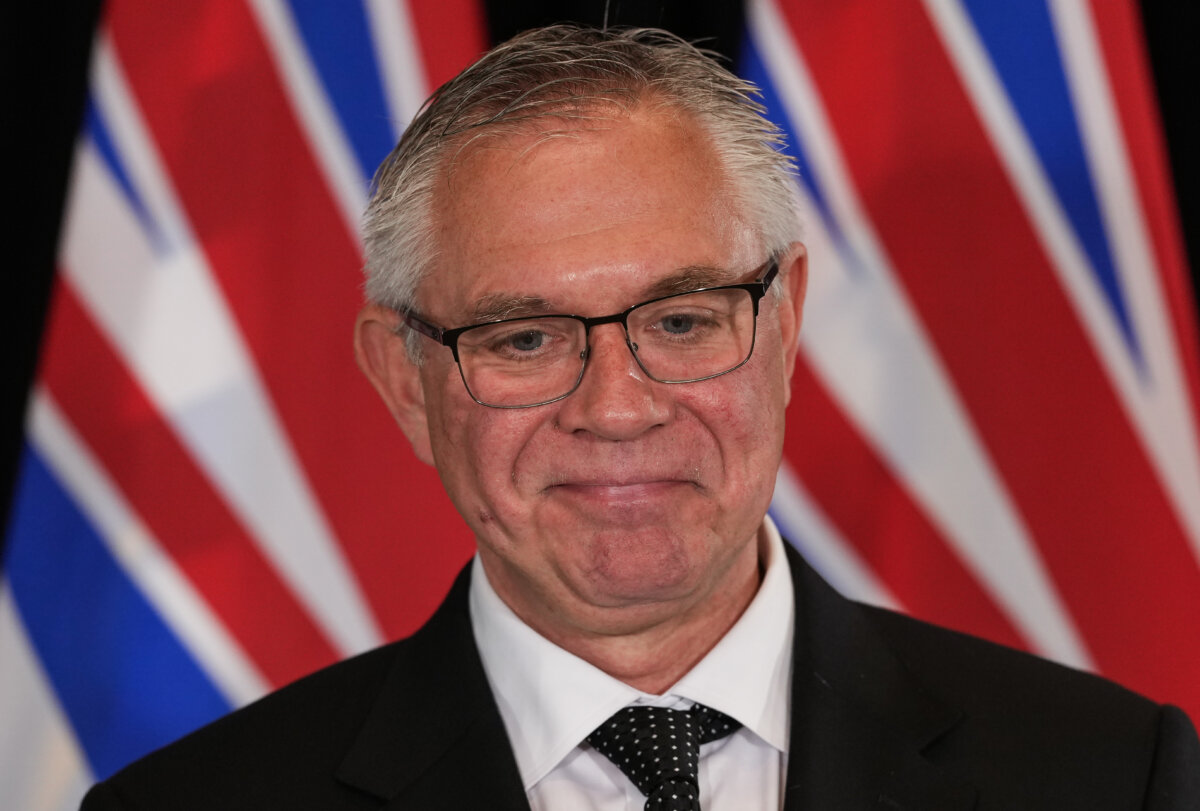

Premier-designate Lorne Doerkson says he will move to repeal B.C.’s Declaration on the Rights of Indigenous Peoples Act (DRIPA) “as soon as possible” and will also start an independent review of provincial finances as soon as he is sworn in as premier.
Doerkson made the remarks during an Oct. 25 press conference, the day after his party secured a majority government in a snap election called Sept. 22 by B.C. Premier and NDP Leader David Eby.
“I am still committed to the repeal of DRIPA. It has not worked in this province, and frankly, it has caused more problems to date than I think potentially anything else,” Doerkson said in response to a question from media.
Doerkson added that he hopes to table legislation to repeal DRIPA in the spring legislative session, which starts Feb. 9, 2027.
Land Rights
DRIPA was passed by the NDP government in 2019, obligating B.C. to work to align its laws with the U.N. Declaration on the Rights of Indigenous Peoples (UNDRIP), a declaration that sets out goals of cultural preservation, ownership of traditional lands and resources, and full consultation, participation, and informed consent before any decisions affecting indigenous peoples are made. The legislation has been cited in controversial court decisions dealing with aboriginal land title.
“The reality is, it hasn’t solved anything. We are in court all over British Columbia, with respect to docks in Pender Harbour and mining opportunities in the province,” Doerkson said in response to a question about why repealing it is necessary.
In February this year, area residents of Pender Harbour on B.C.’s Sunshine Coast brought a constitutional challenge against DRIPA over disputes involving dock regulations and proposed indigenous authority to make decisions on dock permits. The case remains before the B.C. Supreme Court.
On Dec. 5, 2025, the B.C. Court of Appeal ruled that the province’s former mineral claims framework is not consistent with indigenous rights under DRIPA because it allowed mining claims to be registered without adequately consulting affected First Nations beforehand. It also found that courts can enforce the province’s obligation to align its laws with the U.N. declaration under DRIPA.
The province has appealed the ruling to the Supreme Court of Canada, amid mining restrictions that went into place in March 2024 when the government put a moratorium on new mineral claims in Gitxaała and Ehattesaht First Nations territories.
A separate ban on new mineral claims in large areas of northern B.C. introduced in June 2025 and scheduled to expire in June 2026 was extended until Jan. 31, 2027, to give time for further land-use planning with affected First Nations.
These matters also come in the wake of the Aug. 7, 2025, B.C. Supreme Court ruling recognizing aboriginal title for the Cowichan Tribes over roughly 800 acres of land, including privately owned properties in the Richmond, B.C., area, a ruling which is under appeal by the B.C. and federal governments.
The B.C. Conservatives say DRIPA has worsened uncertainty over fee simple property rights in the province and stifled resource development. The party’s election platform also vows to repeal Section 8.1 of the province’s Interpretation Act along with litigation rules related to indigenous rights with the stated purpose of protecting private property rights and providing greater certainty for resource development.
A number of First Nations leaders have strongly opposed proposals to suspend or repeal DRIPA, warning that such measures would undermine reconciliation and create further uncertainty. In the wake of the December 2025 B.C. Court of Appeal decision, Eby said DRIPA creates “significant legal liabilities” for B.C. However, he walked back plans to suspend or amend DRIPA in April this year after strong opposition from some First Nations groups.
“Any attempt to interfere with the courts’ role, and First Nations’ access to justice, will be met with collective resistance from First Nations and allies across the province,” the First Nations Leadership Council said in an April 19 statement.
Doerkson said he will try to pursue a cooperative approach going forward.
“I will take a meeting with First Nations any day that we can grow a partnership and a friendship together, and I am fully committed to that,” he said at a press conference on Oct. 25.
Finances
Doerkson also said his government will launch an independent review of B.C.’s finances on day one of his new government.
“The deficit, as you know, is nearly $14 billion, and B.C. has had eight credit downgrades in three years,” Doerkson said on Oct. 25.
In its September financial update, the province projected a $13.8 billion deficit for this 2026–27 fiscal year, roughly $450 million higher than previously forecast.
“We need to know where things stand, and so do British Columbians. Before we table a budget, you will have the full picture,” Doerkson said.
He added that his government will raise B.C.’s basic personal income tax exemption to $32,000 from its current $13,216, a measure he said will give back roughly $1,000 per year to most working British Columbians.
Doerkson also said he will convene an expert commission within 100 days of forming government to deal with the issue of emergency rooms closings in B.C. and long medical wait times. In addition, he will table a Respect Local Democracy Act to ensure that no future provincial elections will be scheduled for the same fall as the municipal elections as they did during this most recent election.
In terms of economic development, Doerkson said he intends to work with Ottawa and Alberta to advance energy projects, including the proposed Pacific Link pipeline from Alberta to the B.C. Coast. The NDP had been generally opposed to the pipeline, saying Alberta should keep using the existing Trans Mountain Pipeline to get its oil to tidewater.
“We are going to supercharge this economy, and that means getting projects to yes, building out LNG, and getting our energy to new markets in Asia,” Doerkson said.
Doerkson was also asked about comments from Manitoba Premier Wab Kinew that the B.C. election results “should concern every elected politician” and stating that winning an election is “a serious responsibility that isn’t to be played with.”
“Well, I don’t disagree. We should all be concerned. British Columbians voted for change last night and for whatever reason they liked the platform that we put forward,” Doerkson said.