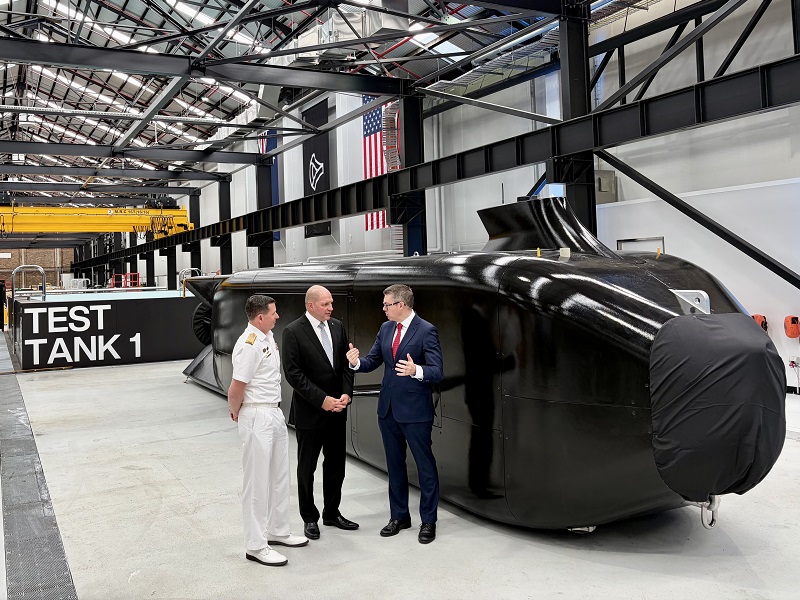

Australia’s Department of Defence says it may need exemptions from the federal government’s rules or restrictions on artificial intelligence (AI).
The Joint Select Committee on Artificial Intelligence on Oct. 30 heard from Defence’s Chief Artificial Intelligence Officer Chris Crozier who said frontier AI models—the most advanced systems—had “exquisite capabilities” which the Department “absolutely” needed and that could not be matched by cheaper, openly available models.
He said Australia was in “a pacing competition” and that Defence would prefer “full and unfettered access to the frontier models, particularly those coming out of the United States.”
But when Independent “Teal” Curtin MP Kate Chaney asked whether that benefit alone would justify bringing frontier AI training to Australia, even without an economic case, the officials stepped back.
“I don’t want to be incredibly selfish,” Crozier said.
First Assistant Secretary Sheridan Keenan said the government would have to weigh “broader kind of equities” that Defence could not balance on its own.
Asked by Chaney whether Australia was “potentially under threat” without such access, Crozier said, “I’m not suggesting that we’re under threat.”
Defence’s first AI strategy, being prepared under Crozier’s oversight, has yet to be released.
Under the federal government’s policy on responsible AI use, federal agencies must name an official accountable for AI, keep a register of how they use it, assess the impact of higher-risk uses, publish a regularly updated statement on their AI use, and train staff.
A ‘Highly Contested’ Environment
In its submission, Defence said some of its work takes place in “highly contested, time-critical and classified environments” that require their own governance and risk management.
“Where exemptions or modified arrangements to whole-of-government policy are required, Defence will continue to apply rigorous safeguards consistent with Australia’s domestic and international legal obligations,” the submission said.
It did not say which rules Defence might seek to be exempted from, or which of its AI systems would be involved.
The same submission (pdf) says AI-enabled capabilities, “such as autonomous systems and autonomous weapon systems,” can make the Australian Defence Force more effective “and contribute to deterrence.”
Autonomous weapons are systems that can carry out tasks, such as finding and engaging targets, with limited or no direct human control.
Defence said human judgement and accountability “remain central,” including “decisions involving the use of force,” and that it was pursuing AI “at speed and scale” while staying within the law.
Its policy on responsible AI use (pdf), released in March, says specific legal obligations apply to AI in weapons, including legal reviews of new weapons required under international law, and that “accountability cannot be transferred to a technology.”
The push to introduce AI into military operations is not without practical difficulties.
A review of the U.S. military’s efforts to deploy the technology found that exercises had produced mixed results, with some systems stalling or behaving unpredictably outside controlled environments. Defence specialists have also raised concerns about safety and the possibility of AI contributing to unintended escalation during a conflict.
DFAT’s Different Perspective
Australia’s Department of Foreign Affairs and Trade described the use of such technology around the world quite differently in its own submission (pdf) to the same inquiry.
It said AI-enabled surveillance and targeting, AI-enabled remote or autonomous weapons, and AI-generated misinformation were “undermining adherence to international humanitarian law,” the international rules of war, “and increasing risks for civilians.”
It was describing global trends and did not refer directly to Defence’s plans.
Neither autonomous weapons nor the possible exemptions were raised when Defence officials appeared before the committee on Oct. 30.







