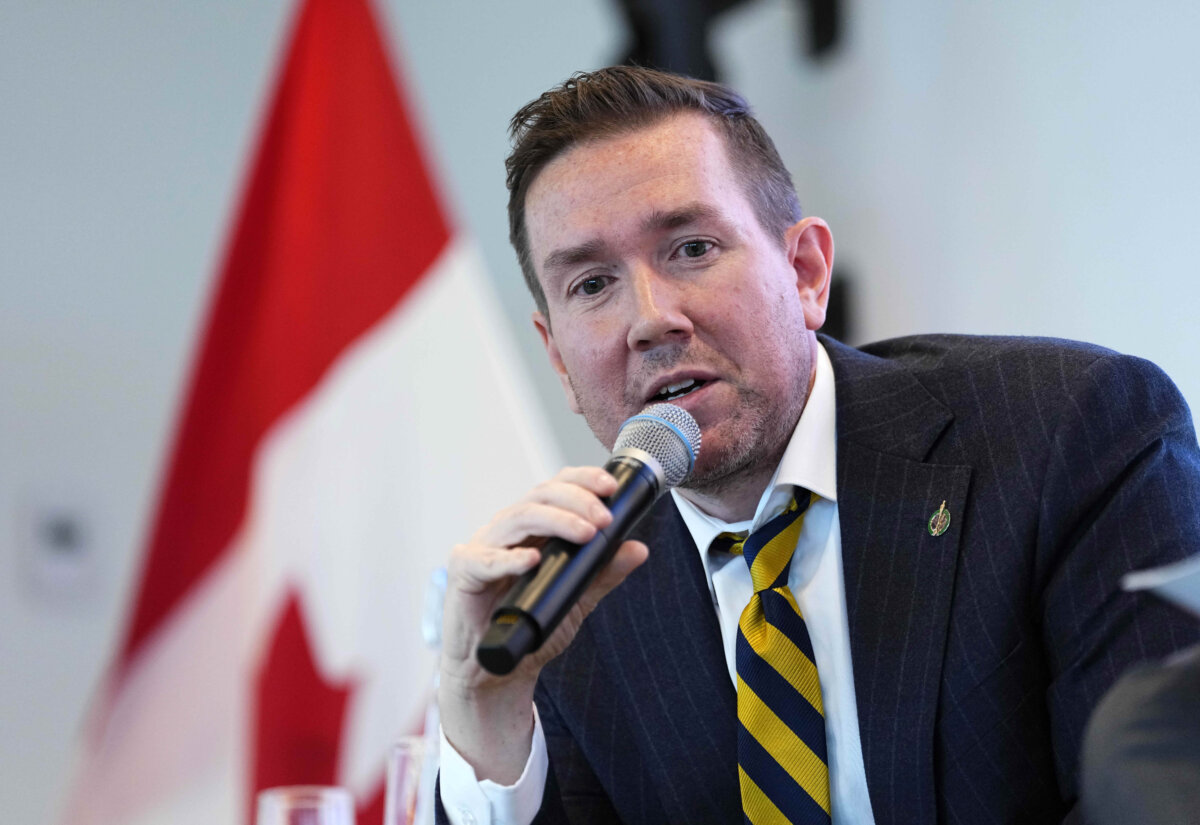

Countries are willing to pay more to sign long-term energy supply deals with Canada because it can offer both security and stability, Calgary MP Corey Hogan said at an energy conference Monday.
Hogan, the parliamentary secretary to the minister of energy, was the keynote speaker at an energy security conference in Ottawa hosted by the Canadian Global Affairs Institute.
He said countries are still reeling from global energy disruptions earlier this year, after U.S. military action prompted Iran to limit, and at times halt, shipping through the Strait of Hormuz, one of the most important global energy supply routes.
About one-fifth of world supplies of oil and liquefied natural gas used to flow through that strait, and its disruption has led to soaring gas prices and shortages in some parts of the world.
Hogan joked that the Georgia Strait—between Vancouver Island and mainland B.C. and a key shipping route out of Canada—isn’t likely to be shut down.
“Right now everybody is talking about diversification of supply and the durability of supply chains, and they look at Canada and they say ‘there’s a country that is a reliable trader. ‘That is a country that is not known to use trade as a lever over people. It’s in a safe part of the world,'” Hogan told the room.
“We are a natural partner in that sense, and frankly, they’ll even pay a little bit more for it sometimes because that supply assurance is something that’s increasingly important.”
Hogan said the case is an easy one for Canada to make right now, but noted it won’t always be so easy.
“I’m a cynical guy, and I think that it doesn’t take as much time as you hope for people to forget the lessons that they learned. And that will only take us so far,” Hogan said.
Canada aims to produce 100 million tonnes per year of liquefied natural gas by 2040, which S&P Global Energy says would make Canada the third-largest supplier globally.
The S&P report forecasted global LNG demand to rise by 176 million tonnes by 2050. But it also said there are more than 600 million tonnes of projects under development.
The bulk of those projects comes from the United States, accounting for 220 million tonnes of added supply. Another 80 million comes from Russia, 29 million from Argentina, 24 million from Mozambique, and 23 million from Qatar.
Current project proposals in Canada account for 36 million tonnes of added LNG supply.
“Canada has to move now to get projects into the queue to take market share from those it’s competing with,” said Kevin Birn, one of the report’s authors and the vice-president and chief Canadian energy analyst at S&P Global Energy.
“Canada can do this. It has an advantage resource in terms of greenhouse gas intensity as well. But it has to move at pace if it wants to capture that.
“It’s not a question whether this demand will be met. Yes, it will. It’s a question of who will bring it to market and who will service it. Our track record isn’t great.”