

Net overseas migration accounted for around two thirds of Australia’s population growth in the year to June 2025, data from the Australian Bureau of Statistics reveals.
There are now 27.6 million people now in the country, up 1.5 percent, or 420,100 people, compared to the previous year.
But “natural increase” (births minus deaths) accounted for just 114,600 of that figure, with net overseas migration adding another 305,600.
All states and territories had positive population growth over the period, with Western Australia achieving the fastest growth rate (2.2 percent) and Tasmania the slowest (0.2 percent).
But in every case, net overseas migration made up the greatest portion of that growth, and in the case of New South Wales (NSW), the Northern Territory (NT) and Tasmania—outside of natural births—it was the only thing countering a net loss of people as residents left for other states.
| Population growth (%) | Natural increase | Net overseas migration | Net interstate migration | |
| New South Wales | 1.2 | 34,576 | 91,573 | -24,328 |
| Victoria | 1.8 | 36,516 | 87,768 | -777 |
| Queensland | 1.8 | 20,606 | 55,743 | 21,595 |
| South Australia | 1.1 | 2,727 | 18,735 | -1,295 |
| Western Australia | 2.2 | 14,890 | 40,406 | 10,288 |
| Tasmania | 0.2 | 350 | 2,722 | -1,877 |
| Northern Territory | 1.4 | 2,024 | 3,608 | -2,105 |
| Australian Capital Territory | 1.3 | 2,882 | 4,981 | -1,501 |
During the year, 568,400 immigrated to Australia, 93,000 fewer than in the year to June 2024, while there was an increase of 30,600 in the number of people leaving, bringing the total to 262,800.
Australia’s birth rate, measured by the Total Fertility Rate (TFR), hit a record low of 1.481 births per woman in 2024, down from 1.499 in 2023, indicating fewer births overall, and well below the replacement level of 2.1.
While data for that indicator is not yet available for 2025, the new population data shows that the natural increase went up by 8.9 percent (9,400) compared to the previous year.
However, net overseas migration has long been the primary driver of Australia’s population increase, with the natural increase virtually flat, and falling in the last few years.
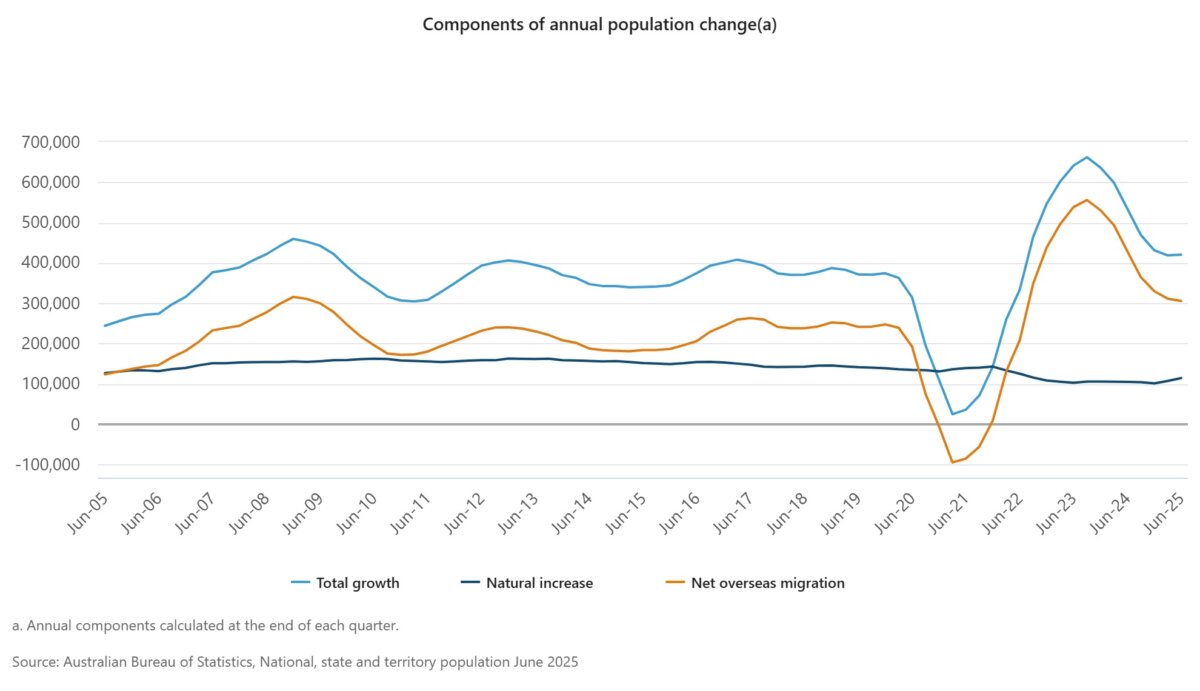
In the 12-month period to June, there were 300,300 births, up by 3.4 percent (9,900) on the previous year, while deaths, at 185,700, went up by only 0,3 percent.
According to the Department of Home Affairs, the countries with the most permanent migrants to Australia, expressed as a percentage of the country’s total population, were:
| United Kingdom | 4.3 |
| India | 3.2 |
| China | 2.5 |
| New Zealand | 2.2 |
| Philippines | 1.4 |
| Vietnam | 1.1 |
| South Africa | 0.8 |
| Nepal | 0.7 |
| Sri Lanka | 0.6 |
| Pakistan | 0.5 |
| Indonesia | 0.4 |
| Iran | 0.3 |
| Afghanistan | 0.3 |
| Burma | 0.2 |
| Syria | 0.1 |