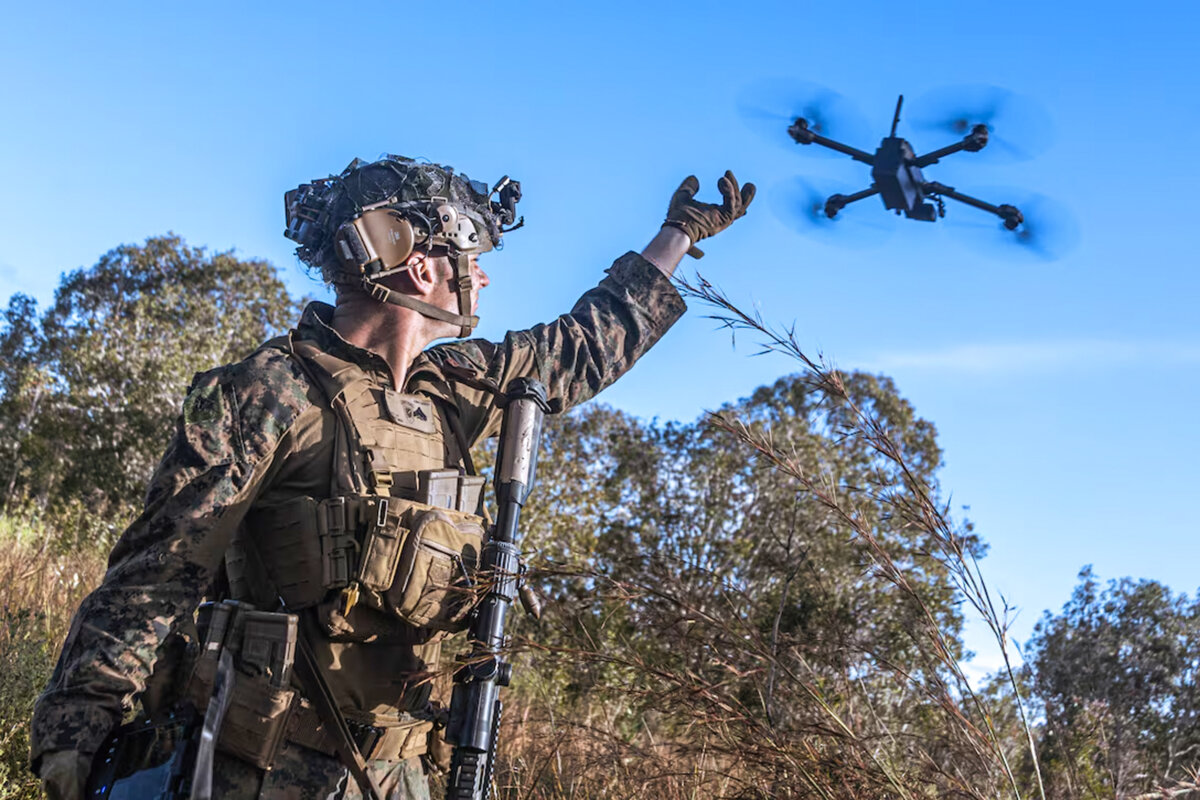

Air Force personnel did not try to bring down unidentified drones flying over one of Australia’s most important air bases in July because commanders did not believe they had the power to do so, a Senate committee has heard.
Chief of Air Force Air Marshal Stephen Chappell revealed to a Senate Estimates hearing on Oct. 29 that no orders were given to act against the drones seen over RAAF Base Williamtown, north of Newcastle, between July 11 and 13.
“The orders were not issued over the days you were talking about because we did not feel we had the lawful authorities to respond,” he said.
Williamtown is home to most of Australia’s F-35A fighter jets and all six of its E-7A Wedgetail surveillance aircraft.
Chappell said he now had permission from the Civil Aviation Safety Authority to respond to drones over defence airfields.
Equipment Failed to Detect Drones
Chappell said the drones were tracked by personnel on the base, but some were spotted by eye rather than picked up by detection equipment.
He said the reason for that depended on how a drone was flown, who made it, and whether its technology matched what the sensors were set up to recognise.
On one or two occasions, more than one drone was flying over the base overnight, he said.
Chappell said he was not aware of police identifying anyone responsible, so the operators’ motives remained unknown.
Asked whether that meant Defence did not know if it was “a silly teenager or something much more nefarious,” Secretary of Defence Meghan Quinn replied, “No, we don’t know that.”
Drone Incidents on the Rise
Deputy Secretary Celia Perkins said Defence received 204 reports of drone-related security incidents at its sites in the 2025/26 financial year, up from 141 the year before, 56 in 2023/24 and 19 in 2022/23. There have been 42 so far this financial year.
She said Defence had not identified any particular “high-end” concerns among them, but was “very concerned that this is a growing challenge.”
Liberal Senator James Paterson asked why it had taken until this month for new laws to be introduced when the problem had been growing for years.
Quinn said rules made late last year gave Defence some powers but could not override existing laws, and that the bill now before Parliament had been “in gestation for quite some time.”
Defence’s chief lawyer, Fran Rush, said public consultations had begun around 2023.
The government introduced the bill on Oct. 27, giving Defence ongoing legal power to detect, track, and act against drones over sensitive sites.
Paterson said the opposition strongly supported it, subject to a parliamentary inquiry.
The government has also announced substantial investment in counter-drone technology, including Australian-made systems designed to detect, track and neutralise unauthorised aircraft.
In April, it announced contracts worth $21.3 million for AIM Defence and $10.4 million for SYPAQ Systems as part of a broader expansion of counter-drone capabilities.
Asked about reports that staff at Williamtown were told to close their blinds during the incursions, Quinn said closing blinds was standard procedure for any security incident on a base, and took on notice whether anything different happened at Williamtown.
“We obviously need a much more robust way of protecting our people and the things they’re working on than closing the blinds,” Paterson said.
Chappell replied that work was “in train” to achieve that.