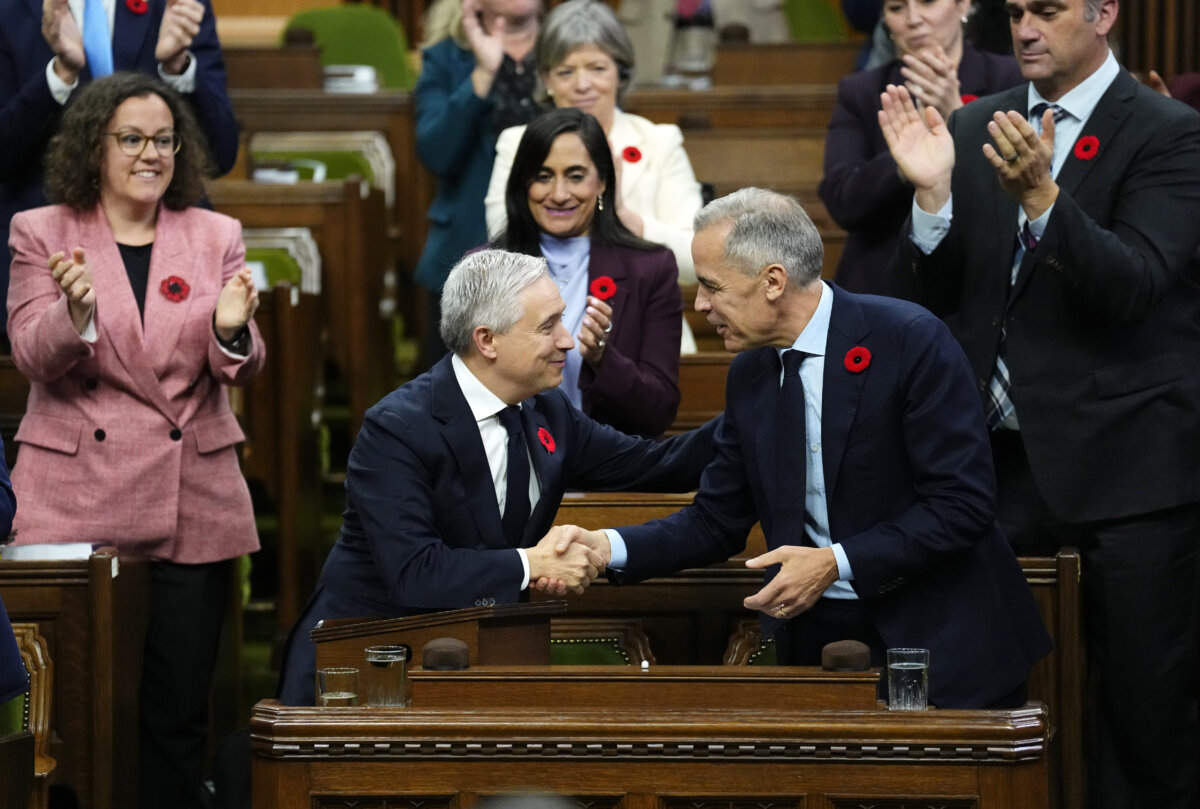


The Carney government tabled its second budget on Nov. 5, announcing measures it says will stimulate economic growth and increase affordability for Canadians, while boosting funding for cultural programs.
This includes proposals aimed at encouraging private-sector investment, boosting funding for infrastructure, housing, defence, and economically vulnerable industries, and introducing measures with the stated goal of reducing household expenses and providing more support to lower-income Canadians.
The budget notes that revenue exceeded projections thanks in part to higher oil prices, but reports a deficit as it maintains program spending and allocates funding for programs it says will help grow the economy.
Here are eight key takeaways from Budget 2026.
Higher Revenues and Maintaining a Deficit
The government forecasts a $62.3 billion deficit for the 2026-2027 fiscal year, roughly $3 billion lower than the projection in its spring economic update.
The budget says higher oil prices and stronger economic activity have boosted projections for corporate profits and wages, meaning the government will take in more income tax revenue. As a result, Ottawa now projects it will collect an average of $23.9 billion more in annual revenue between 2026–27 and 2030–31 than it forecast in the Spring Economic Update.
But the government is channelling the additional revenues into spending, saying it wants to boost long-term growth.
Ottawa says the deficit will decrease to $52.9 billion by the 2030-31 fiscal year, although federal debt is expected to rise over the same period from $1.37 trillion to $1.59 trillion as the government continues to spend more than it takes in revenue.
Annual interest and debt-servicing costs are also projected to increase by roughly 42 percent, from $60.2 billion to 85.5 billion over the same five-year period.
Billions in Incentives Meant to Boost Business
The budget includes a mix of existing and new programs meant to help businesses.
It includes $36 billion in spending over five years to fund the Productivity Mega Deduction. The tax measure allows businesses to deduct the full cost of eligible equipment, technology, and machinery in the year they are put into use, rather than spreading the deductions over several years, allowing businesses to reduce their taxable income sooner.
The budget also says that the Canada Strong Fund, a federal investment fund first announced in April, will receive $25 billion over three years in federal funding to spur investment in major Canadian companies and infrastructure projects.
The fund is set up as a Crown corporation operating at arm’s length from Ottawa and makes investments alongside private sector investors. Canadians would be able to invest in the fund by buying Canada Strong Notes at financial institutions to earn returns from the fund’s investments.
Ottawa says Canadians who purchase Canada Strong Notes would be guaranteed the return of their original investment even if the fund loses value, but it hasn’t said how that guarantee would work or who would cover any losses.
Ottawa has also proposed the Canada Growth Incentive, which would allow investors and business owners to exempt up to $15 million in capital gains from taxation on eligible Canadian company shares and defer capital gains taxes when reinvesting proceeds from the sale of qualifying shares into other Canadian small businesses.
The budget also includes measures meant to simplify the tax system, and puts $930 million over five years into expanding the Scientific Research and Experimental Development research tax credit to cover the cost of bringing products to market.
Military Expenditures and New CSIS Funding
The budget lays out how Ottawa will meet NATO defence spending targets through 2030, but offers no accounting beyond that point, leaving open how the government will fund its commitment to spend five percent of GDP on defence by 2035.
Budget 2026 makes several specific defence spending proposals, including $7.6 billion over five years from existing defence funding to extend and increase Canada’s military deployment in Eastern Europe under the ongoing Operation REASSURANCE, which is aimed at deterring potential Russian aggression against NATO allies.
Canada currently has approximately 2,000 personnel stationed in Latvia as part of Operation REASSURANCE, and plans to boost these numbers to up to 2,600 on an ongoing basis.
The budget also proposes allocating $2.3 billion over five years to the Defence Drone Initiative, a program launched in July with the goal of fast-tracking the development, purchase, and deployment of military drones and systems designed to detect and intercept enemy drones.
Separately, Ottawa is proposing $6 billion over 10 years, starting in the 2027–2028 fiscal year, to expand the capabilities and international operations of the Canadian Security Intelligence Service (CSIS), including its efforts to counter foreign interference, espionage, and terrorism.
Affordability Measures
The budget also proposes a one-time 50 percent raise to the Canada Groceries and Essentials Benefit for lower and middle-income Canadians for the 2026-2027 benefit year.
When combined with the 50 percent increase announced in June and a 25 percent increase that started in July, Ottawa says the new raise would bring total payments to $2,570 for an eligible family of four for the 2026-2027 benefit year.
The additional payment of up to $679 for an eligible couple with two children is scheduled to be delivered in early 2027.
The budget also proposes lowering the minimum earnings threshold for the Canada Workers Benefit from $3,000 to $500. It says this will allow more low-income workers to qualify for the refundable tax credit.
Additional affordability measures proposed in Budget 2026 include $845 million in funding over four years to make the Canada Caregiver Credit fully refundable starting in the 2027 tax year, as well as $610.3 million over four years to support Nutrition North Canada, a federal program meant to lower food costs in remote rural communities in Canada’s north.
Funding for Arts and Culture
Budget 2026 proposes $783.1 million over five years for Canadian heritage institutions and museums, including the National Arts Centre and Library and Archives Canada, as well as an additional $300 million in funding over two years for CBC/Radio Canada, which received roughly $1.4 billion in annual federal funding in 2024-25.
The budget also proposes $134 million over four years to support the Local Journalism Initiative, which was set up in May 2019 to help fund journalism that covers remote, underserved, and rural communities across the country.
In addition, Ottawa proposes developing a new Canada Creative Credit it says could give tax relief on up to $45,000 of income from eligible artistic work.
Committing to End Homelessness
The budget lays out a goal of ending homelessness in Canada within 10 years, proposing to allocate $11.2 billion over four years starting in the 2027-2028 fiscal year, and a further $17.8 billion in future years.
The funding includes $1.8 billion over four years to create an Integrated Supports Fund that will offer addictions and mental health treatment along with housing assistance and social services for the homeless.
Another $3.6 billion over four years is earmarked to build transitional and supportive housing, with provinces and territories expected to provide futher funding and support services.
Another $2 billion over two years, as part of the overall $11.2 billion in funding, would finance mental health treatment and addictions clinics across Canada, while also replenishing funding for the Reaching Home Initiative and the Veterans Homelessness Program.
$50 Billion for Indigenous Programs
Budget 2026 proposes spending $50 billion on indigenous programs over varying lengths of time.
This includes $32 billion over 10 years for First Nations housing and infrastructure, $6 billion over six years for the Jordan’s Principle program that helps First Nations children access social, educational, and health services, and $5.8 billion over five years to fund elementary and secondary schools on reserves.
The budget also includes $2.9 billion over three years to keep providing health coverage for First Nations and Inuit people that isn’t covered by Canada’s public healthcare system.
In addition, it proposes $633.7 million over four years to go toward policing for First Nations and Inuit policing and other expenditures.
Opposition Reaction
Conservative Leader Pierre Poilievre criticized the budget for adding to the national debt, saying it would fuel inflation.
“The single biggest item of spending growth in this budget is not seniors programs, not healthcare, not security, not sovereignty, but the opposite. It is interest on the national debt,” Poilievre said Nov. 5 in the House of Commons.
“He’s cooked the books. He’s divided the spending onto three separate credit cards: operational, capital and Crown corporations. The only problem is he has no rule to determine which expense goes where.”
NDP Leader Avi Lewis said the budget doesn’t do enough to help lower costs for Canadians.
“Today’s budget is Christmas come early for CEOs, foreign investors and arms dealers. It talks a lot about affordability but does little to actually lower your costs,” he said, while acknowledging the budget does allocate more to fight homelessness.
Dan Kelly, president of the Canadian Federation of Independent Business (CFIB), said that despite the Mega Deduction the budget offers “no help” to small business owners.
“If you are a small business owner struggling to keep your business going in the face of rapidly rising costs and a trade war, the budget will provide you with no help whatsoever,” Kelly posted Nov. 5 on X.
The government says its budget will help raise Canada’s competitiveness, and that Canada “is projected to grow at the second-fastest pace in the G7 in 2027.”
“We are masters of our destiny. Budget 2026 is our plan to build a stronger, more united Canada where we are all free to live as we choose,” Prime Minister Mark Carney said.