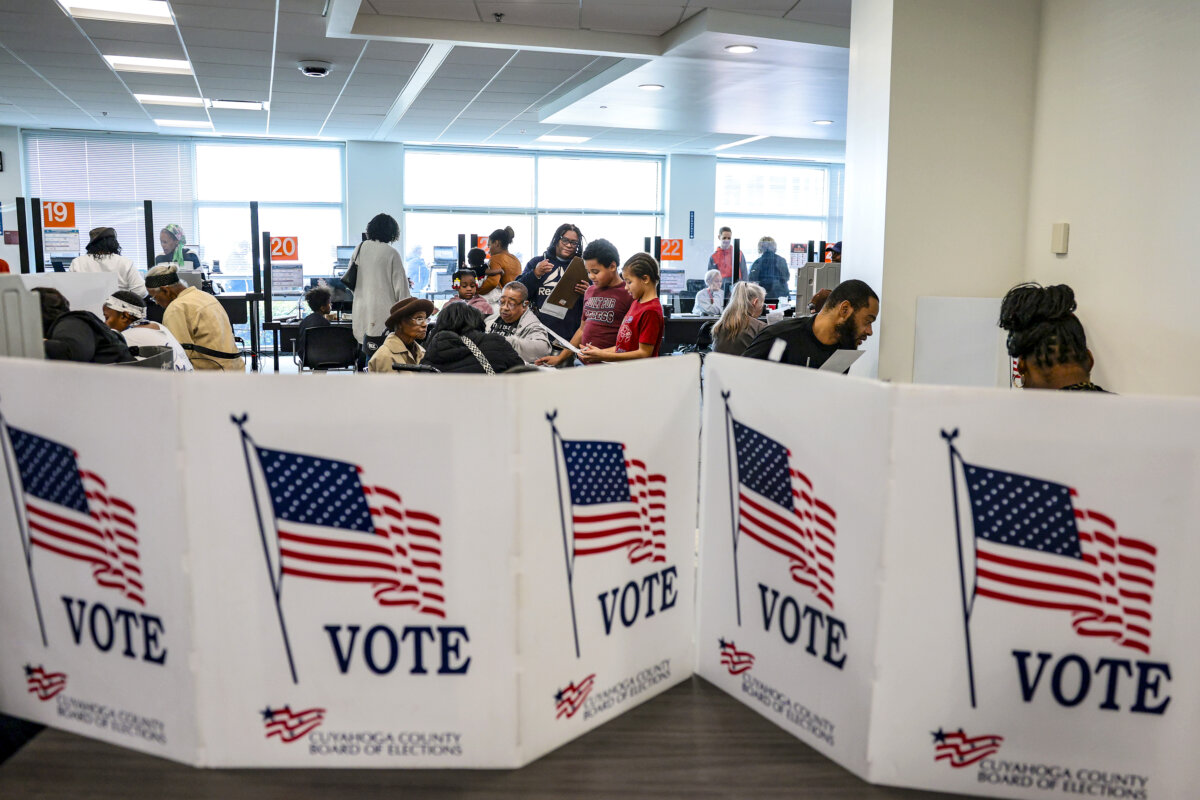

World leaders have quickly responded to the Democratic Party’s sweeping victory on Nov. 3, which led to the party winning majorities in both the Senate and House of Representatives.
As of the afternoon of Nov. 4, Democrats were projected to win at least 54 seats in the Senate and 234 seats in the House, with two Senate races and more than 60 House races still to be called. International politicians suggested on Nov. 4 that the election results could signal major changes, including foreign policies that affect the Iran and Russia–Ukraine wars.
German Defense Minister Boris Pistorius described the Nov. 3 election results as a “historic victory” for the Democratic Party. South African President Cyril Ramaphosa, who has previously clashed with U.S. President Donald Trump, told reporters that the results would “introduce a new era in world relations.”
“We have seen that the Democrats have taken control of the Senate and of the House, and the people of America have spoken,” Ramaphosa said.
Signal of Change
Many world leaders issued statements on Nov. 4 suggesting that the U.S. midterm election results signaled a change in the United States and across the globe.
Norwegian Prime Minister Jonas Gahr Store said the election results indicated a “powerful political signal” of change among voters in the United States.
“Voices are now emerging in American politics that are closer to us than the president and the administration have stood for, for example on climate and environment, and in foreign policy and development aid policy,” he said.
European Union Parliament Vice President Christel Schaldemose described the Nov. 3 election as a “wild result.” She said she was “cautiously optimistic” for Europe, noting that the results could “benefit the support for Ukraine, the green transition, and relations with the rest of the world.”
Socialist Spanish Prime Minister Pedro Sánchez, who has called for an election in his own country on Nov. 29, suggested in a statement on Nov. 4 that a movement he described as a “far-right wave” was collapsing.
“Yesterday, American society voted against policies that only make people poorer. Against hate. Against sexism. Against climate denial and against elite privilege,” he wrote.
British Prime Minister Andy Burnham said on Nov. 4 that leaders should focus on addressing key issues in the aftermath of the midterms.
“I feel the world has an opportunity now to unite around the issue that is affecting us all, and that’s the cost of living,” he said.
The prime minister added that he could not reduce the cost of living in the UK until the Iran and Russia–Ukraine wars are resolved.
Asked whether the U.S. midterm elections were part of a trend toward a decline of the “popular right” across the world, Burnham said, “I think people want to see the world coming together and focusing on the things that matter to people, and that’s what the voters, in my view, are saying in the United States.”
Meanwhile, Kremlin spokesman Dmitry Peskov told reporters on Nov. 4 that the midterm election results were an “internal matter” in the United States, according to Russian media outlet The Moscow Times.
“President Trump will continue his term, and we sincerely count on him continuing his peacemaking efforts,” Peskov said.
In a statement reported by Russian state-run news agency RIA Novosti, Russian Deputy Foreign Minister Sergei Ryabkov said that the country’s foreign policies, including its position on Ukraine, are “not based on short-term considerations” and do not rely on political changes in other countries. However, Ryabkov suggested that the Democrats taking control could negatively affect relations with Russia.
“The Democratic Party leadership’s approach to relations with Russia is sharply negative. There is nothing new about that,” he said.
Impact of Iran War
Iranian leaders credited the war between Washington and Tehran as the driving factor behind the Nov. 3 results and celebrated the president’s party’s losses across the United States.
Mohammad Bagher Ghalibaf, speaker of the Iranian Parliament, said in a statement that American voters rejected the war between the United States and Iran, which has lasted for more than eight months.
“Conscience or the cost of living, Americans said NO TO WAR, and we endorse this message,” he wrote on X.
Mohsen Rezaei, secretary of Iran’s Supreme National Security Council, said Iran handed Trump a “strategic defeat on the battlefield and in the Hormuz—and a POLITICAL DEFEAT in Washington.”
Iranian Foreign Ministry spokesman Esmail Baghaei said the American people sent the Trump administration a “clear message” and warned that additional consequences could “extend far beyond what you have already witnessed.”
During an interview with Fox News on election night, Trump acknowledged that the conflict with Iran at least partially contributed to Republican losses in the midterms.
On Nov. 4, U.S. Vice President JD Vance also pointed to the Iran war as the first of four factors that led to Republicans losing the election. He said that according to Americans who supported Trump in 2024 but switched to voting for Democrats on Nov. 3, Republicans should end the war, focus on the cost of living, put America first, and change America’s relationship with Israel.
Reuters contributed to this report.