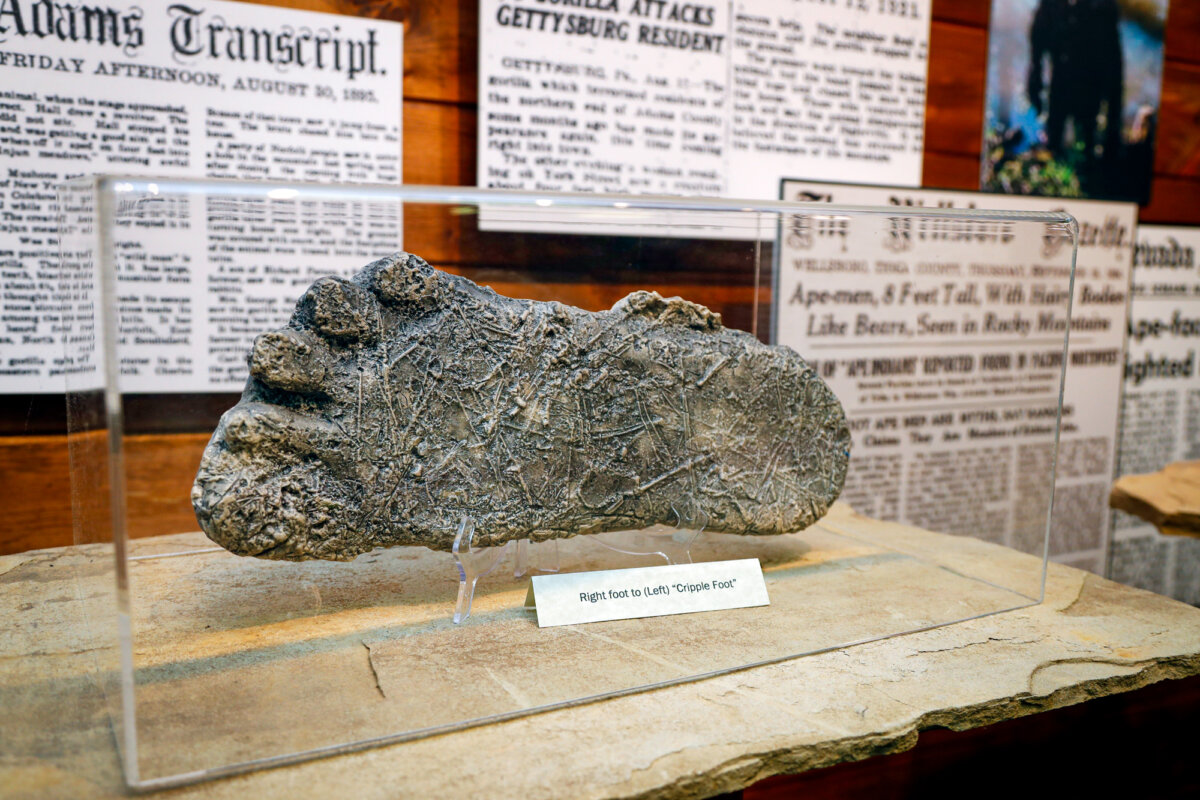

On June 18, 1982, a wildlife biologist penned an unusual letter to a resource staff member at the U.S. Department of Agriculture Forest Service regional office in Oregon.
In the letter, Rodney Johnson documented his findings after being asked to accompany a group investigating the reported discovery of “Bigfoot tracks” in the Low Creek drainage area within the Umatilla National Forest.
Johnson also noted anomalies: The stride remained about four feet across varying inclines, the prints were shallower than investigators’ boot prints, and some appeared isolated rather than part of a continuous trail.
The footprints, however, were large—15 inches long and seven inches wide in one case. Johnson photographed them and made plaster casts at two sites. He examined the prints carefully before presenting his findings.
He told the Forest Service it was his opinion that the tracks were made by “something other than a 300-pound plus two-footed being,” indicating they had not been made by a Bigfoot.
“In several cases, it appeared that the foot may have been ‘rocked’ from side to side to make the track,” he said.
“If the tracks were faked, someone went to a great deal of trouble and detail. The print marks on the foot would have to be very hard to duplicate. They appear very natural.”
He added, “I would almost suspect a cast made of an actual foot would have had to be used to make the ‘fake’ feet,” although he noted, “other creases in the foot should have shown.”
In a July 28, 1982 memorandum to the Forest Service district supervisor in Walla Walla, Washington, U.S. Border Patrol officer Joel Hardin concluded the footprints were man-made.
“My opinion is that the tracks were a very clever attempt to perpetrate a hoax involving your office or agency in order to lend authenticity or credibility to the general public,” Hardin wrote.
Hardin based his conclusions on a June 17, 1982 site visit.
In at least two locations, he said, the tracks appeared identical, as if they had been made by “the same” Bigfoot.
He continued, “I believe they were man-made by using some type of soft plaster or rubber coated foot.”
“Who made the tracks—my opinion, someone with normal access to the area, very knowledgeable and interested in ‘Bigfoot’ legends and stories; a person large enough” to use the device to leave the tracks behind.
The letter and memorandum are among three documents the Forest Service released in mid-October in response to a Freedom of Information Act request.
“Stories of Bigfoot, Sasquatch, and other legendary creatures have long been part of the cultural fabric of the Sierra and continue to add to the rich tradition of folklore that surrounds our public lands,” a Forest Service spokesperson told The Epoch Times.
According to the agency, it occasionally receives Bigfoot-related records requests at its Washington or regional FOIA offices. Its practice is to post records in its National Reading Room when they have been requested three or more times.
A second document concerns a Jan. 13, 2003, article in the Clark Fork Valley Press in Montana, documenting hundreds of large footprints that were found near a local sawmill.
One witness reported seeing a hairy, two-legged creature in connection with the footprints. Another told the newspaper the footprints appeared more human than animal.
A six-page document titled, “What Do You Know About Petty Creek? Leo T. Kinney Version,” recounts a report from the 1940s in Montana.
Kinney wrote that during a hunting trip, an elk appeared to have been carried off by someone or something. Only its entrails remained.
“Whatever it was had picked up the elk whole and clear of the ground,” Kinney wrote.
“At this point, we held a conference and decided that we were not particularly anxious to catch up to whatever it was and tho [sic] we didn’t confess it at the time, in later conversations we found out we all had a very uneasy feeling and could feel chills running up and down our backs.”
Although no actual sightings were reported, the document described other accounts of a strong odor and grunting sounds in the area.
Both states have had numerous reported Bigfoot sightings over the years, according to the Maryland-based Bigfoot Field Researchers Organization (BFRO).
Montana had 55 reported sightings between 1978 and October 2024, when tribal members reported an alleged Bigfoot encounter on the Rocky Boy Indian Reservation.
The organization listed Oregon with 262 reported sightings or encounters between 1984 and 2025.
In October 2025, a deer hunter reported hearing loud knocks near Hyatt Lake in Jackson County, allegedly made by a Bigfoot.
“While the Forest Service does not endorse or make any claims regarding the existence of such creatures, we appreciate the public’s enthusiasm for exploring and learning about our public lands,” an agency spokesperson said.