
The U.S. federal government has added helium to its Critical Materials List under the Energy Act of 2020.
The Department of Energy (DOE) announced the designation on Oct. 23, citing helium’s critical role in semiconductor manufacturing and other advanced technologies.
The designation makes helium supply a higher federal priority. It could make projects involving helium production and processing eligible for federal loans, grants, and other programs aimed at strengthening domestic supply chains.
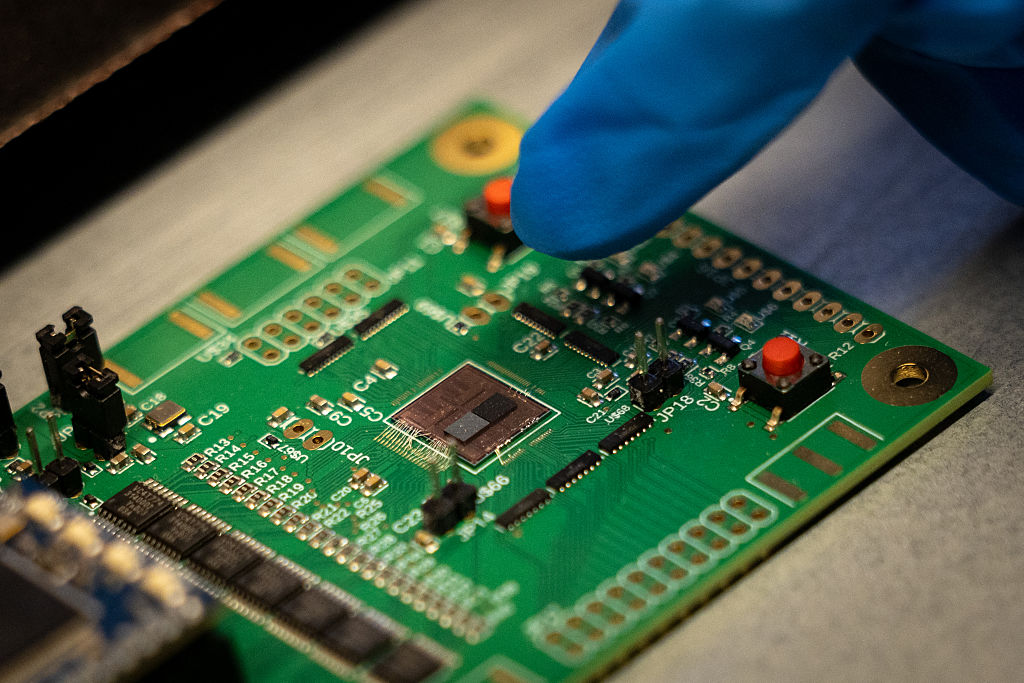
Helium plays a critical role in the semiconductor industry, even though it isn’t part of the finished chip. Instead, manufacturers use it during production to control temperatures and create the precise conditions needed to reliably make the most sophisticated chips at scale.
It is also used in medical imaging, aerospace, fiber-optic manufacturing, and some quantum-computing systems.
“Helium’s unique properties make it indispensable to semiconductor production, with no viable substitutes in many critical applications,” the DOE said.
On Earth, helium is effectively a non-renewable resource because, once released into the atmosphere, the extremely light gas will keep rising until it escapes into space.
Global Supply at Risk
Unlike many other critical materials, the United States has abundant domestic helium resources.
Helium is generally recovered as a byproduct of natural-gas harvesting. According to the Bureau of Land Management, underground natural-gas deposits in Texas, Oklahoma, and Kansas are among the world’s most helium-rich.
The United States remains the world’s largest helium producer. The U.S. Geological Survey estimates that the nation produced about 81 million cubic meters, or 2.9 billion cubic feet, of helium in 2025, accounting for roughly 43 percent of global output.
The DOE warned, however, that limited refining capacity and lengthy permitting timelines constrain domestic production.
“Global demand for helium is growing faster than production, increasing supply risks for American manufacturers,” the department said.
Recent geopolitical instabilities have added to those risks.
The exports of Qatar, the world’s second-largest helium producer, have been severely disrupted by the Iran war.
Iranian attacks have damaged Qatar’s natural-gas infrastructure, and passage through the Strait of Hormuz—the route through which nearly all of the country’s helium exports leave the Persian Gulf—has at times been highly unreliable.
Russia, another major helium producer, has also tightened control over exports amid its war with Ukraine.
In April, the Russian government placed temporary restrictions on helium exports to secure supplies for its domestic market, which are scheduled to remain in effect through the end of 2027.
Expanding the Critical Materials List
Under the Energy Act of 2020, the DOE can designate a non-fuel material as critical when it faces a high risk of supply disruption and serves an essential function in energy technologies.
The agency considers factors including availability, competing demand, dependence on a limited number of producers, and the availability of substitutes.
Metallurgical coal, which is used to make steel, was the most recent material added to the list before helium, in May 2025.
The only other gas on the list is fluorine, the essential element for producing hydrofluoric acid, which is vital for manufacturing lithium-ion batteries.







